


Principal Fields Of Inventive Endeavor
Description
This section is from the book "Scientific American Reference Book. A Manual for the Office, Household and Shop", by Albert A. Hopkins, A. Russell Bond. Also available from Amazon: Scientific American Reference Book.
Principal Fields Of Inventive Endeavor
Federal Constitution. On the 5th of September, 1787, it was proposed to incorporate in a constitution a patent and copyright clause. The germinating principle of this clause of the Constitution has vitalized the nation, expanded its powers beyond the wildest dreams of its fathers, and from it more than from any other cause, has grown the magnificent manufacturing and industrial development which we to-day present to the world.
In the early days the granting of a patent was quite an event in the history of the State Department, where the clerical part of the work was then performed. It would be interesting to see Thomas Jefferson, the Secretary of War, and the Attorney-General, critically examining the application and scrutinizing each point carefully and rigorously. The first year the major ity of the applications failed to pass the ordeal, and only three patents were granted. In those days every step in the issuing of a patent was taken with great care and caution, Mr. Jefferson always seeking to impress upon the minds of his officers and the public that the granting of a patent was a matter of no ordinary importance. Prior to 1836 there was no critical examination of the state of the art preliminary to the allowance of a patent application. Since the act of 1836 there have been various enactments modifying and improving the law in matters of detail. In 1801 the term for a patent was increased from fourteen to seventeen years, and in 1870 the patent law was revised, consolidated and amended; but in its salient features the patent system of today is that of the law of 1830. The subject of patents is admirably treated by Mr. Story B. Ladd, of the Census Office, and we are indebted to Bulletin No. 242 for most interesting matter herewith presented.
The growth of the number of patents granted in the United States to citizens of foreign countries, is a striking feature, and shows the high esteem in which this country is held by the world at large as a field for the exploitation of invention. The per cent, of patents to foreign inventors has more than doubled during each period of twenty years since 1800.
The majority of these foreign patentees are citizens of the great manufacturing countries; four-fifths of them are from England, France, Germany, and Canada; the number from the latter country being largely augmented by reason of her proximity to the United States. The patents to foreign inventors, 1890-1900, were distributed as follows:
Country. | Number of Patents. | Per Cent. |
Canada.............. | 3,135 | 14.0 |
England.................. | 7,436 | 32.0 |
France.................... | 2,163 | 9.0 |
Germany.................. | 5,788 | 25.0 |
All other countries............... | 4,561 | 20.0 |
Total to citizens of foreign countries. . | 23,083 | 100.0 |
This marked growth in the number of patents to aliens is explained by the very liberal features of our patent system. Foreigners stand here on an equal footing with citizens of this country, and they are neither subjected to restrictions in the matter of annuities or taxes payable after the grant of a patent, nor required to work an invention in this country to maintain it in force, as is the case in most foreign countries.
Moreover, the thorough examination made by our Patent Office as to the novelty of an invention prior to the allowance of an application for a patent - an examination that includes not only the patents and literature of our own country bearing on the art or industry to which the invention relates, but the patents of all patent-granting countries and the technical literature of the world - and the care exercised in criticising the framing of the claims have come to be recognized as of great value in the case of inventions of merit, and hence the majority of foreign inventors patenting in this country take advantage of this feature of our patent system, and secure the action of the Patent Office on an application for a patent before perfecting their patents in their own and other foreign countries, taking due precaution to have their patents in the dif ferent countries so issued as to secure the maximum term in each, so far as possible. This practice holds now in the case of probably nine-tenths of the alien inventions patented in this country.
The working of an invention has never been required under our patent laws, though in most foreign countries, with the exception of Great Britain, an invention must be put into commercial use in the country within a specified period or the patent may be declared void. In the case of patents for fine chemicals and like products, which require a high order of technical knowledge and ability for their inception, and skilled workmen for their manufacture, the effect of this requirement, that the industry must be established within the country, has been most salutary in building up chemical industries within the home country, to some extent at the expense of other countries where the working of a patent is not obligatory. This shows most strongly in the case of carbon dyes and in the patents for chemicals of the class known as carbon compounds, which includes numerous pharmaceutical and medicinal compounds of recent origin, aldehydes, alcohols, phenols, ethers, etc., and many synthetic compounds, as vanillin, artificial musk, etc.
There are many extensive industries which are entirely the creation of patents, and can be readily differentiated from the great mass of manufactures; for example, certain industries based upon chemical inventions and discoveries, as oleomargarine, which now employs $3,023,646 of capital, and supplies products to the value of $12,499,-812; glucose, which uses $41,011,345 of capital, and gives products to the value of $21,693,656; wood pulp, which, starting with the ground-wood pulp patent of Voulter, in 1858, and following with the soda fiber and sulphite fiber processes, is now the chief material employed in paper manufacture, with products aggregating $18,-497,701; high explosives, which, starting with the nitroglycerin patent of Nobel, in 1865, now includes dynamite, the pyroxylin explosives, and smokeless powder, with products aggregating $11,233,396; while the electrical industries, which now touch all fields of industrial activity, power and transportation, lighting and heating, electrochemical processes, telegraphy and telephony, employ directly and indi-rectly capital extending into the billions, and are the creation of patents. The rubber industry was insignificant prior to the discovery by Charles Goodyear of the process of vulcanization, while now the products in the shape of rubber and elastic goods and rubber boots and shoes amount to $93, 716,849. Bicycles and tricycles employ $29,783,659 of capital, with products valued at $31,915,908. Manufactured ice employs $38,204,054 of capital, with a return in products of $13,874,513.
Phonographs and graphophones, starting in 1877, now show the use of $3,348,282 of capital, and products to the value of $2,240,274. Photography, including the manufacture of materials and apparatus as well as the practice of the art - all the outcome of invention - is now represented by 7,700 establishments, with a combined capital of $18,711 339, and products to the value of $31,038,107. The manufacture of sewing machines employs $18,-739,450 of capital, and supplies products to the value of $18,314,490. The manufacture of typewriters and supplies, within three decades, has become an industry that employs $8,-400,431 of capital, and gives products to the value of $6,932,029. These are but examples of what may be considered as patent-created industries.
If we attempt to enumerate the industries which, existing prior to the period of patent growth, have been revolutionized by inventions, a catalogue of all of the old industries is virtually required. The returns for the manufacture of agricultural implements for the present census show 715 establishments, with a capital of $157,707,951, giving employment to 46,852 wage-earners, who re-
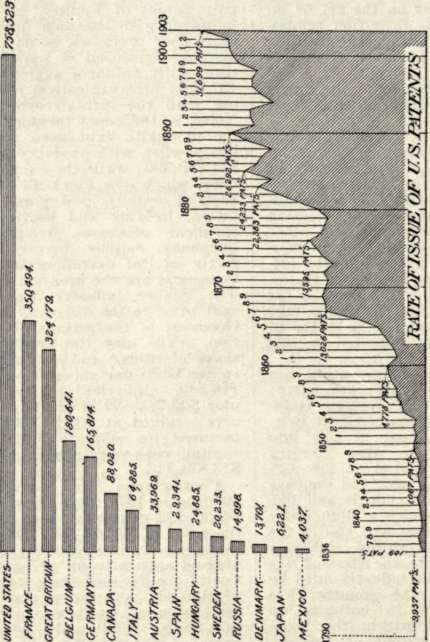
Copyright, 1904, by Munn & Co.
Total Number Of Patents To December 31, 1903. (Foreign Patents for 1903 Estimated).
ceive $2,450,880 in wages, and manufactured products to the value of $101,-207,428; and, in the entire range of agricultural implements and machines now manufactured every one, from hoe or spade to combined harvester and thrasher, has been, either in the implement or machine itself, or in the process of manufacture, the subject of a patented improvement which has produced a new or better article, or cheapened the cost of manufacture.
The great iron and steel industry as it exists to-day is the product of countless inventions which permeate every branch thereof, and include many revolutionizing inventions, as, for example, the Bessemer process.
The blast furnaces, rolling mills and forges and bloomeries, reported at the present census comprise 668 establishments, with a capital of $573,391,663, employing 222,490 wage-earners, with $120,820,276 paid in wages, and supplying products to the value of $803,-968 273. A prohibition of the use of the patented inventions of the last half century would stop every one of these establishments.
The same may likewise be said of the textile industry, the manufactures of leather, of lumber, chemicals, etc., and the railway system in its entirety, from the rail to the top of the smokestack, and from the pilot to the rear train light or signal, is an aggregation of American inventions.
Without attempting to touch upon the industries which have been revolutionized or expanded by patents, the summaries which follow aim to show the growth of patents which have generally sprung from industries.
The closing decades of the nineteenth century have witnessed the most extraordinary development of manufactures and commerce known in our history. Industrial demand and invention go hand in hand. They act and react, being interdependent. Any change in industrial conditions creating a new demand is at once met by the invention of the means for supplying it, and through new inventions new industrial demands are every year being created. Thus through the process of evolution the industrial field is steadily expanding, and a study of the inventions for any decade will point out the lines of industrial growth for the succeeding decade.
The following figures give an idea of the development of American inventions during the past fifty-four years:
Continue to:


My Books

