
![previous page: 1. Berberis [Tourn.] L. Sp. Pl. 330. 1753](../../../images/nav/page_prev.gif)


2. Odostèmon Raf. Am. Month. Mag. 2: 265. Feb. 1818
Description
This section is from the book "An Illustrated Flora Of The Northern United States, Canada And The British Possessions Vol2", by Nathaniel Lord Britton, Addison Brown. Also available from Amazon: An Illustrated Flora of the Northern United States, Canada and the British Possessions. 3 Volume Set..
2. Odostèmon Raf. Am. Month. Mag. 2: 265. Feb. 1818
[Mahonia Nutt. Gen. 1: 211. 1818.]
Shrubs, with pinnate leaves of several or many coriaceous leaflets, and yellow racemose flowers, the branches not spiny, but the leaflets often with bristle-tipped teeth. Sepals mostly 6. Petals and stamens of the same number as the sepals. Filaments often dilated; anthers dehiscent by valves. Berries mostly blue or white. [Greek, swollen stamen.]
About 20 species, natives of North America and Asia. Type species: Berberis Aquifolium Pursh.
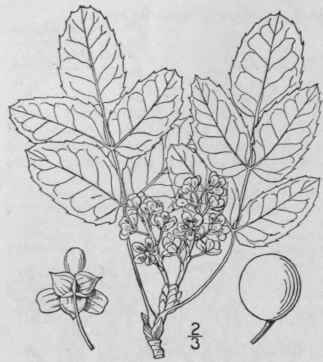
1. Odostemon Aquifòlium (Pursh) Rydb. Trailing Mahonia
Fig. 1957
Berberis Aquifolium Pursh, Fl. Am. Sept. 219.
1814. Berberis repens Lindl. Bot. Reg. pl. 1176. 1828. Mahonia repens Don, Gard. Dict. 1: 118. 1831. Odostemon Aquifolium Rydb. Bull. Torr. Club 33: 141. 1906.
A low trailing glabrous shrub. Leaves petioled, pinnate; leaflets 3-7, ovate, oval, or nearly orbicular, obtuse or acute at the apex, oblique and obtuse, truncate or slightly cordate at the base, sessile, thick, persistent, finely reticulated, dentate with spine-bearing teeth, 1-2' long; racemes several, erect, dense, terminal, many-flowered; flowers yellow, 3"-4" broad, short-pedicelled; bracts ovate, persistent; berry globose, blue or purple, about 3" in diameter.
Western Nebraska and throughout the Rocky Mountain region, extending to Arizona and British Columbia. Holly-leaf barberry. Grape-root. Rocky mountain or Oregon grape. April-May.
Continue to:


My Books

