


20. Myagrum L. Sp. Pl. 640. 1753
Description
This section is from the book "An Illustrated Flora Of The Northern United States, Canada And The British Possessions Vol2", by Nathaniel Lord Britton, Addison Brown. Also available from Amazon: An Illustrated Flora of the Northern United States, Canada and the British Possessions. 3 Volume Set..
20. Myagrum L. Sp. Pl. 640. 1753
An annual glabrous glaucous branching herb, with entire or undulate oblong to lanceolate leaves, the lower petioled, the upper sessile and deeply auricled at the base. Flowers small, yellow, in elongating racemes; pedicels short, erect-ascending, bractless. Sepals nearly erect.
Petals short; longer stamens somewhat connate in pairs Silicle obcuneate to spatulate, flattened, indehiscent, falsely 3-celled, 1-seeded, tipped by the short style. Seed pendulous; cotyledons incumbent. [Greek, a fly-trap.]
A monotypic genus of Europe and western Asia.
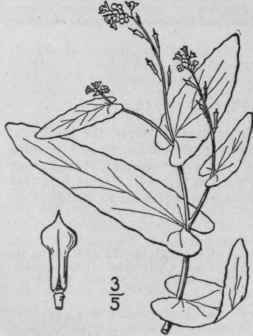
1. Myagrum Perfoliàtum L. Myagrum
Fig. 2047
Myagrum perfoliatum L. Sp. Pl. 640. 1753.
Lower leaves oblong, narrowed into petioles; upper leaves 2'-5' long, 1/2'-1' wide, obtuse or acutish at the apex, the basal auricles mostly rounded; racemes, in fruit, elongating to several inches in length; pedicels 1"-2" long, 2-3 times shorter than the pods, equalling or a little longer than the calyx; longer stamens about equalling the petals.
In waste places about Quebec. Fugitive or adventive from Europe. Summer.
21. STÁNLEYA Nutt. Gen. 2: 71. 1818.
Glabrous and glaucous, perennial tall mostly erect and branching herbs, with entire toothed lobed or pinnately divided leaves, and large yellow bractless flowers in elongated terminal racemes. Sepals linear, narrow. Petals narrow, long-clawed. Stamens 6, very nearly equal; anthers twisted. Ovary short-stipitate; style short or none. Siliques linear, long-stipitate, spreading or recurving, somewhat compressed, dehiscent, the valves with a strong midnerve. Seeds in 1 row in each cell, numerous, pendulous. Cotyledons straight, incumbent. [Named for Lord Edward Stanley, President of the Linnaean Society.]
About 3 species, of western North America, the following typical.
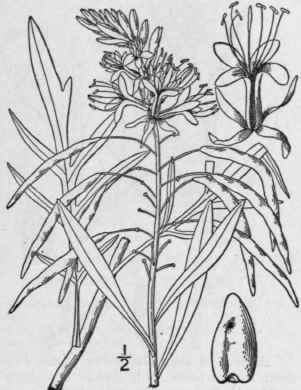
1. Stanleya Pinnàta (Pursh) Britton. Stanleya
Fig. 2048
Cleome pinnata Pursh, Fl. Am. Sept. 739. 1814. Stanleya pinnatifida Nutt. Gen. 2: 71. 1818. Stanleya pinnata Britton, Trans. N. Y. Acad. Sci. 8: 62. 1888.
Stems stout, 2°-5° tall, sometimes decumbent. Lower leaves pinnatifid or pinnately divided, or entire, 5'-8' long, 1'-3' wide, long-petioled; upper leaves similar, or less divided, or narrowly oblong or lanceolate, entire, short-petioled and narrowed at the base; flowers numerous, showy; petals 8"-12" long; filaments filiform, exserted; siliques 2'-3' long, about 1" thick, 2-3 times as long as their stipes, spreading, downwardly curved, somewhat constricted between the seeds when dry.
In dry soil, South Dakota and Nebraska to California, New Mexico and Arizona. Plant with the aspect of a Cleome. May-July.
Continue to:


My Books

