


4. Parthenocíssus Planch, In Dc. Mon. Phan. 5: Part 2, 447. 1887
Description
This section is from the book "An Illustrated Flora Of The Northern United States, Canada And The British Possessions Vol2", by Nathaniel Lord Britton, Addison Brown. Also available from Amazon: An Illustrated Flora of the Northern United States, Canada and the British Possessions. 3 Volume Set..
4. Parthenocíssus Planch, In Dc. Mon. Phan. 5: Part 2, 447. 1887
[Psedera Neck. Elem. 1: 158. Hyponym. 1790.]
[Quinaria Raf. Am. Man. Grape-vines, 6. 1830. Not Lour. 1790]
Climbing or trailing woody vines, the tendrils often tipped with adhering expansions (disks), or sometimes merely coiling, our species with digitately compound leaves, the leaflets 5-7. Flowers perfect, or polygamo-monoecious, in compound cymes or panicles. Petals 5, spreading. Hypogynous disk obsolete or wanting in our species. Stamens 5. Ovary 2-celied; ovules 2 in each cavity; style short, thick. Berry 1-4-seeded, the flesh thin, not edible.
About 10 species, natives of eastern North America and Asia, the following typical. Besides thefollowing, another occurs in Texas.
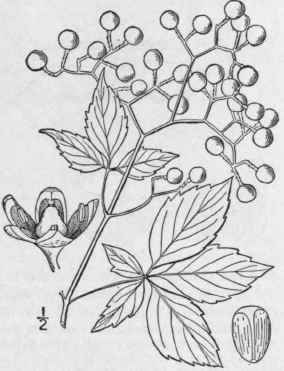
1. Parthenocissus Quinquefòlia (L.) Planch. Virginia Creeper. False Grape. American Ivy
Fig. 2842
Hedera quinquefolia L. Sp. Pl. 202. 1753.
Vitis quinquefolia Lam. Tabl. Encycl. 2: 135. 1793.
Ampelopsis quinquefolia Michx. Fl. Bor. Am. 1: 160.
1803. Parthenocissus quinquefolia Planch. in DC. Mon.
Phan. 5: Part 2, 448. 1887. P. vitacea A. S. Hitchc. Spring Fl. Manhattan 26.
1894.
High-climbing or trailing, glabrous or pubescent. Tendrils usually numerous, and often provided with terminal adhering expansions, the vine sometimes supported also by aerial roots; leaves petioled, digitately 5-foliolate (rarely 7-foliolate); leaflets stalked, oval, elliptic, or oblong-lanceolate; 2'-6' long, acute or acuminate, narrowed at the base, coarsely toothed, at least above the middle, pale beneath, dark green above, glabrous or somewhat pubescent; panicles ample, erect or spreading in fruit; berries blue, about 6" in diameter, usually 2-3-seeded; peduncles and pedicels red.
In woods and thickets, Quebec to Assiniboia, Missouri, Florida, Texas and Mexico. Bahamas; Cuba. July. Fruit ripe in October. The foliage turns deep red in autumn. The species consists of numerous races, differing in pubescence, serration of leaflets and in the tendrils. Five-finger-ivy or -creeper. Five-leaf-ivy. Erroneously called woodbine.
Parthenocissus tricuspidàta (Sieb. & Zucc.) Planch., the Ampelopsis Veitchii of the gardeners, a Japanese vine, clinging to walls by its very numerous disk-tipped tendrils, has the leaves sharply 3-lobed or sometimes 3-divided; it is freely planted for ornament.
Continue to:


My Books

