


Changes Which Occur During Germination
Description
This section is from the book "Alcohol, Its Production, Properties, Chemistry, And Industrial Applications", by Charles Simmonds. Also available from Amazon: Alcohol: Its Production, Properties, Chemistry, And Industrial Applications.
Changes Which Occur During Germination
We owe to Brown and Morris the first satisfactory exposition of the principal chemical and morphological changes which go on in the barley grain during the early stages of germination. These investigators studied chiefly the carbohydrate constituents of the grain, and the manner in which these were transformed, rendered assimilable by the growing plantlet, and transferred from one part of the corn to another in subserving the plantlet's needs.2 Later, Brown and Escombe further elaborated these studies;3 and still later, with other coadjutors (McMullen and Millar) extended them to the investigation of the transformation and migration of the protein constituents of the grain.4 These researches are well worth reading in the original accounts by those interested; all that can be done here is to give a short summary of the chief results, in so far as they are germane to present purposes.
The main bulk of the barley corn consists of the starchy endosperm, which is reserve material serving to nourish the developing embryo until such time as the latter, having put forth roots and leaves, is in a position to obtain its own nutriment from the soil and the Median section through proximal end of a grain of barley, showing embryo and a little of the endosperm. (Reproduced by permission from Trans. Chem. Soc, 1890, 57.)
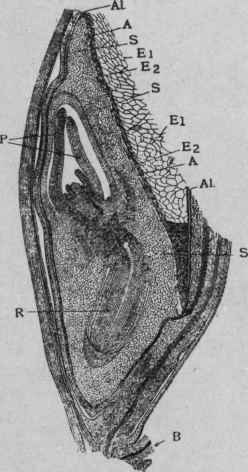
Fig. 15.
P, plumule (acrospire) of embryo.
R, radicle ,, ,,
S, scutellum.
A, secretory epithelium.
Al, aleurone cells of endosperm. E1, starch „ ,, - ,, E2, depleted ,, „ ,, air. The embryo itself is situated at one end of the corn. It is not structurally connected with the endosperm, but only in close apposition to it, kept in place by the integument which surrounds both. But the endosperm is a hard, compact mass; the starch granules are packed tightly in the endosperm cells; and these cells themselves are invested with a cellulose membrane, forming the cell-walls. The question is, exactly how, and in what form, does the hard starchy mass reach the developing germ? What are the changes which are invoked in it, to allow of its being transported from one part of the corn to another, and to arrive in such a condition that it can be absorbed and assimilated by the young plantlet ? These are the questions to which the investigators above-mentioned, with others, have in large measure supplied the answer.
B, basal bristle of grain.
1 J. Soc. Chem. Ind., 1908, 27, 1033.
2 "Researches on the Germination of some of the Graminese," Trans. Chem. Soc, 1890, 57, 458 et seq. 3 Proc. Roy. Soc, 1898.
4 Trans. Guinness Research Laboratory, 1906; pt. ii, 284.
The part of the embryo which is in contact with the starchy endosperm is a sort of partition-wall; a cellular structure known as the scutellum, which bears on its surface a remarkable epithelium containing a layer of elongated (columnar) cells, termed the secretory layer. Also, surrounding the endosperm and in contact with the starch cells, there is a layer of tissue consisting of square cells, and known as the aleurone layer. When moisture is absorbed by the grain and germination commences, one of the early changes is the secretion, in part by the scutellar epithelium and in part by the aleurone layer, of an enzyme, cytase, which is capable of attacking the cellulose walls of the starch cells and either destroying them completely, or at least partly dissolving them and rendering them softer and more permeable to liquids. This enzyme gradually invades the whole of the endosperm, disintegrating the cell-walls, and thus producing what, in malting, is technically termed the "modification" of the endosperm, by which the corn is rendered mealy and friable.
The scutellar epithelium, moreover, secretes a yet more important enzyme, namely, amylase (diastase). Brown and Morris were able to demonstrate this experimentally by removing the embryo entirely from the barley corn, and cultivating it on gelatin impregnated with starch, and on other nutrient media. One or two typical experiments out of a large number made may be quoted here.
First, it was shown that diastase is secreted by the growing embryo. Fifty embryos were removed from barley corns and germinated on moistened glass wool. After growing for a time, the embryos were macerated in a suitable volume of water, and a definite quantity of the liquid was allowed to act upon a solution of soluble starch. If diastase were present it would convert some of the starch to maltose, and a measure of the amount could be obtained by weighing the copper oxide precipitated when the liquid was heated with an alkaline copper sulphate solution. The total diastatic power of these fifty embryos was thus found to be represented by 148 milligrams of cupric oxide, and of another fifty germinated on gelatin, 163 milligrams; whereas the diastatic power of a similar number of ungerminated embryos was found to be nil or very small, only 5 milligrams of cupric oxide being obtained, and this quantity was possibly within the limits of error under the conditions of the experiment. Diastase had therefore been produced in relatively large quantity in the embryos during their germination.
Also it was shown that the power of secreting the diastase was localised in the scutellar epithelium. For on removing the latter, and cultivating the embryo on starch-gelatin, it was found to have lost its power of dissolving the starch granules. This was not due to the embryo having also lost its power of growth, because the embryo, deprived of its epithelium as before, still grew readily when sugar, instead of starch, was included in the culture-medium. The ground-tissue of the scutellum could absorb the soluble and readily-assimilable sugar; but in the absence of the epithelium no diastase was produced, and consequently the insoluble starch could not be attacked and dissolved.
Continue to:


My Books

