


Cookery For The Sick
Description
This section is from the book "The New Cyclopaedia of Domestic Economy, and Practical Housekeeper", by Elizabeth Fries Ellet. Also available from Amazon: The New Cyclopaedia of Domestic Economy, and Practical Housekeeper.
Cookery For The Sick
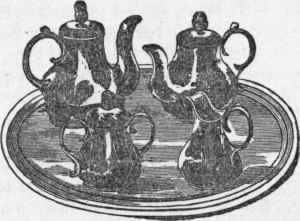
Invalid's Breakfast Set.
It may be necessary to premise that a choice should be made of those things most likely to agree with the patient, and, as invalids require variety to indulge their appetite, frequent changes should be provided, but great simplicity observed in the preparation. Perhaps jellies and meat broths, together with various kinds of farinaceous food, are the lightest on the stomach, as well as, generally speaking, the most nutritious.
A Good Jelly
Soak twelve shanks of mutton four hours, then brush and scour them very clean. Lay them in a saucepan with three blades of mace, an onion, twenty Jamaica and thirty or forty black peppers, a bunch of sweet herbs, and a crust of bread made very brown by toasting. Pour three quarts of water to them, and set them on a hot hearth close covered; let them simmer as gently as possible for five hours, then strain it off, and put it in a cold place.
This may have the addition of a pound of beef, if approved, for flavor. It is a remarkably good thing for people who are weak.
Sheep's heads and trotters are also good restoratives; savory jelly may also be made in the same manner, without lemon, wine, or sugar, but flavored with ham and spice.
Dr. Ratcliff's Pork Jelly. - Take a leg of well-fed pork, just as cut up; beat it, and break the bone. Set it over a gentle fire with three gallons of water, and simmer to one. Let half an ounce of mace and the same of nutmegs stew in it. Strain through a fine sieve. When cold, take off the fat. Give a coffee-cupful the first and last thing, and at noon, putting salt to taste.
Lambs' feet are very nutritious; purchase them ready cleaned; lay them ten minutes in boiling water, by doing which you will be able to draw out the leg-bone with facility; then put them in a stewpan (two would be sufficient), and pour over a pint of water with which you have mixed smoothly a table-spoonful of flour, and half a teaspoonful of salt; place them upon the fire, stirring frequently until boiling, then add a small onion, with celery, parsley, and parsnip; boil gently for two hours, and when done, serve plain upon a plate, or with a little melted butter and parsley poured over. By using a little white broth from any meat, instead of water, you make a delicious soft soup, which may be partaken of freely.
Calves' feet are dressed in the same manner, but using a double proportion of every thing, and stewing them double the time; they are served precisely the same.
Real Essence Of Beef
Take one pound of beefsteak, cut it into thin slices, which scrape fine; put it into a stewpan, and stir over the fire five or ten minutes, until thoroughly warmed through, then add half a pint of water, cover the stewpan as tightly as possible, and let it remain close to the fire or in a warm oven for twenty minutes; then pass it through a sieve, pressing the meat with a spoon to extract all the essence.
Strengthening Jelly
Take two pounds of gravy-beef, cut into small pieces; put the pieces into a jar. - cover close, and stand the jar in a saucepan of water; let it simmer from four to six hours. This I have made from either beef or veal. I have found it invaluable in cases of sickness, and it will be found that the real essence of the meat is extracted.
A Clear Broth That Will Keep Long
Put the mouse-round of beef, a knucklebone of veal, and a few shanks of mutton, into a deep pan, and cover close with a dish or coarse crust; bake till the beef is done enough for eating with only as much water as will cover it. When the broth is cold, cover it close, and keep it in a cool place. When it is to be used, give what flavor may be best liked. Cowheels make good broth.
For a quick-made Broth, take a bone or two of a neck or loin of mutton, take off the fat and skin, set it on the fire in a small tin saucepan that has a cover, with three-quarters of a pint of water, the meat being first beaten and cut in thin bits; put a bit of thyme and pars-ley, and, if approved, a slice of onion. Let it boil very quickly; skim it; take off the cover if likely to be too weak, else cover it. Half an hour is sufficient for the whole process.
Liebig's Beef Tea
Chop a pound of lean beef as fine as for sausage-meat-. mix with a pint of cold water - put it over a slow fire - when it has boiled five minutes strain through a coarse cloth. Salt to taste.
Chicken Broth
Boil a chicken in a quart of water till about three parts cooked, or about a quarter of an hour; remove the skin and the rump, and put it into the water it was boiled in, with a slice of onion, ten white peppercorns, and a blade of mace; then simmer until it has a good flavor. Beat a quarter of an ounce of blanched sweet almonds with a teaspoonful of water, till of a good consistence and fine, add this paste to the broth, simmer for a minute, then remove, strain, and set aside to get cold. When quite cold, remove the fat, and warm the broth again; season with salt, and serve in a broth basin, with toast dice on a plate.
Panada is merely a preparation of bread made up in various ways.
How To Make It In Five Minutes
Set a little water on the fire with a glass of white wine, some sugar, and a scrape of nutmeg and lemon-peel: meanwhile grate some crumbs of bread. The moment the mixture boils up, keeping it still on the fire, put the crumbs in, and let it boil as fast as it can. When of a proper thickness just to drink, take it off.
Or:- Put to the water a bit of lemon-peel, mix the crumbs in, and, when nearly boiled enough, put some lemon or orange syrup. Observe to boil all the ingredients, for, if any be added after, the panada will break and not jelly.
Chicken Panada
Boil a chicken till about three parts ready in a quart of water; take off the skin, cut the white meat off when cold, and put into a marble mortar: pound it to a paste with a little of the water it was boiled in, season with salt, a grate of nutmeg, and the least bit of lemon-peel. Boil gently for a few minutes to the consistency you like; it should be such as you can drink, though tolerably thick.
Continue to:


My Books

