


Culinary Utensils. Part 3
Description
This section is from the book "The New Cyclopaedia of Domestic Economy, and Practical Housekeeper", by Elizabeth Fries Ellet. Also available from Amazon: The New Cyclopaedia of Domestic Economy, and Practical Housekeeper.
Culinary Utensils. Part 3
Knife Sharpeners.
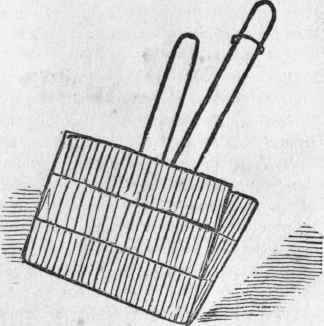
Oyster Broiler, or Toast Gridiron.
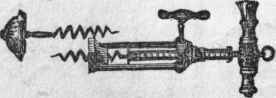
Corkscrews.
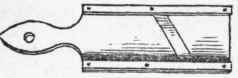
Cucumber and Vegetable Slicer.
Saucepan Digester
The great importance of the digester, not only to poor families, but to the public in general, in producing a larger quantity of wholesome and nourishing food, by a much cheaper method than has ever been hitherto obtained, is a matter of such serious and interesting consideration, that it cannot be too earnestly recommended to those who make economy in the support of their families an object of their attention. The chief, and indeed the only thing necessary to be done, is to direct a proper mode of using it to advantage; and this mode is both simple and easy. Care must be taken in filling the digester, to leave room enough for the steam to pass off through the valve at the top of the cover. This may be done by filling the digester only three parts full of water and bruised bones or meat, which it is to be noticed are all to be put in together. It must then be placed near a slow fire, so as only to simmer, and this it must do for the space of eight or ten hours. After this has been done, the soup is to be strained through a hair sieve or cullender, in order to separate any bits of bones. The soup is then to be put into the digester again, and after whatever vegetables, spices, etc, are thought necessary are added, the whole is to be well boiled together for an hour or two, and it will then be fit for immediate use.
Any thing that is to be warmed and sent to table a second time should be put into a basin or jar, placed in hot water, which is not permitted to come to the boiling point. If allowed to boil, the meat will harden, or the sauce will be reduced and become thick: by avoiding these chances the flavor will be preserved and the viands may be warmed up more than once without injury. The steam-apparatus now employed in most kitchens is admirably adapted to this purpose, since the heat can be regulated to the required temperature.
A spacious movable screen, large enough to completely cover the fire, lined throughout with'tin, and having shelves for the warming of plates and dishes, should also be an appendage; and there should be an abundance of kitchen utensils of the best kind, kept in their proper places and strictly clean. Cleanliness is, indeed, of the first importance, and no kitchen-maid should ever put away a metal saucepan which has been used for any other purpose than merely boiling pure water, without scalding it thoroughly and then drying it.
Every kitchen should be provided with a clock to keep the cook to her time; also with a large and a small marble mortar for the pounding of meat, with chopper, meat-saw, various-sized scoops for vegetables, when required for haricos etc, paste-cutters, steak-tongs, etc, and those insignificant, though useful little articles, minute-glasses, to regulate the boiling of an egg; nor should a spice-box, containing whole pepper, mace, nutmegs, and cinnamon, be forgotten; together with various dried sweet herbs. Scales, with weights from 1/4 oz. to 2 lbs., should be placed on the dresser, and the weights carefully kept in regular order. A set of tin measures with small spouts or lips, and with the contents distinctly marked upon them, from a gallon down to half a gill, will also be found very convenient. It is likewise well to have a set of wooden measures, from a bushel to a quarter of a peck.
Let it be remembered, that, of liquid measure -
Two grills are half a pint. Two pints are one quart. Four quarts are one gallon.
Of dry measure-
Half a gallon is a quarter of a peck. One gallon is half a peck. Two gallons are one peek. Four gallons are half a bushel. Eight gallons are one bushel.
About twenty-five drops of any thin liquid will fill a common-sized teaspoon.
A common tumbler holds half a pint.
Four tablespoonfuls, or half a gill, will fill a common wine-glass.
Four wine-glasses will fill a half-pint or common tumbler, or a large coffee-cup.
A quart black bottle holds in reality about a pint and a half.
Of flour, butter, sugar, and most articles used in cakes and pastry, a quart is generally about equal
In quantity to a pound avoirdupois (sixteen "ounces). Avoirdupois is the weight designated throughout this book.
Ten eggs generally weigh one pound before they are broken.
A tablespoonful of salt or brown sugar is generally about one ounce.*
Sieves, of various descriptions, are very essential. Every utensil for cookery should be of various sizes, so as to suit the quantity of which the dishes may be composed; and each should be kept in a fixed place, as well as washed and dried immediately after using. The cook should also be charged to take care of jelly-bags, tapes for the collared
* Mrs. Hale gives the following table, by which persons not having scales and weights at hand may readily measure the articles wanted to form any receipt, without the trouble of weighing. Allowance to be made for an extraordinary dryness or moisture of the article weighed or measured.
WEIGHT AND MEASURE. | ||||
Wheat flour ....... | 1 | pound is . . | 1 | quart. |
Indian meal .. | 1 | pound, 2 oz., is | 1 | quart. |
Butter, when soft . . | 1 | pound is . . | 1 | quart. |
Loaf sugar broken . . | 1 | pound is . . . | 1 | quart. |
White sugar, powdered | 1 | pound, 1 oz., is | 1 | quart. |
Best brown sugar . . | 1 | pound, 2 oz. is | 1 | quart. |
Eggs........ | 10 | eggs are . .. | 1 | pound |
Flour ... | 8 | quarts are . . | 1 | peck. |
Flours ... | 4 | pecks are . . | I | bushel. |
things, etc, which, if not perfectly scalded and kept dry, give an unpleasant flavor when next used.
Continue to:


My Books

