


The Garden - Orchids For Amateur Gardeners
Description
This section is from "Every Woman's Encyclopaedia". Also available from Amazon: Every Woman's Encyclopaedia.
The Garden - Orchids For Amateur Gardeners
The Best Orchid-growing House - Species and their Characteristics - How to Deal with New Plants - The Compost for Potting - Insect Pests - The Proper Temperature
Many people are deterred from attempting to grow orchids because they have an idea that nothing less than stove-heat and other elaborations of treatment will satisfy their requirements. Yet in the case of " cool orchids " only a little care and knowledge are required to achieve charming results. Foremost among tlese orchids stand many of the beautiful odontoglossums, introduced from Peru and elsewhere, and some oncidiums which flourish at high altitudes; these will do well in a greenhouse where only a sufficiently high temperature is maintained to keep them secure from frost, while many Mexican orchids are happy in a cool greenhouse or small conservatory. To study as far as possible the native conditions of the orchids about to be grown will prove not only interesting but also a great help towards their successful culture. The Best Orchid-growing House
The ideal, of course, is to have a house devoted to orchids only, but quite good results may be had by people who wish to introduce a few pretty and interesting specimens into the conservatory. Provided, that is, that they are ready to give an undisturbed corner to them - a place where air can circulate freely, but protected from draughts, and where the plants can have the requisite amount of light in winter and shade in summer.
If a separate house can be devoted to orchids, a span-roofed structure slightly sunk in the ground - though this is not essntial - will be best.
Shell-gravel or coal - ashes make a good bottom for the pots to stand on
Species and Their Characteristics
The two main classes of orchids - terrestrial and epiphytal - require, of course, different treatment to start with. Plenty of moisture must be given to terrestrial orchids - i.e., to those which root in pots or pans of soil, but any chance of stagnation must be carefully avoided. For this reason use the special pots with holes at the sides, and let them be thoroughly drained by filling almost half-way with broken potsherds.
The potting medium used will consist of rough fibrous peat in two parts with sphagnum moss in one part, mixed with small lumps of charcoal.
In filling the pot, leave a good deep rim at the sides, but raise the centre a little in mound-shaped fashion. Keep the crown of the plant well raised, and pot somewhat firmly, though so hard as to prevent the roots from lining air.
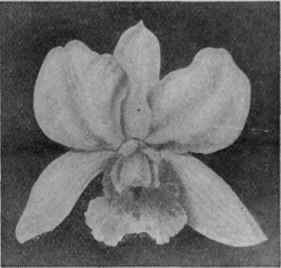
A specimen of Cattleya Brienana Copyright: Stuart Low
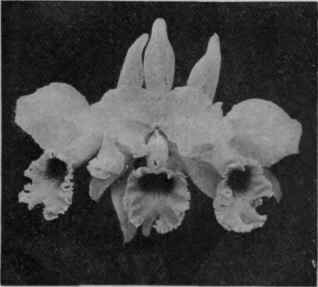
A specimen of Cattleya Mendelii Copyright: Stuart I.ow
Most orchids make a new root growth each year, and fairly frequent repotting is thus seen to be necessary, so that dead roots can be cut away and one fruitful source of disease kept at a distance. Orchids in a diseased state can sometimes be restored by planting them in wooden baskets, where conditions of aeration and drainage are, of course, exceptionally good.
Epiphytal orchids - i.e., those with surface roots - succeed in baskets or on a block of wood - teak, or some other hard wood being most suitable - with little or no soil, or on the tops of orchid pots filled with crocks and sphagnum moss and a little peat.
Haw to Deal with New Plants
When newly imported plants arrive, the treatment given varies a little. Such orchids as the beautiful white Coelogyne cristata, which flowers in February, should, after arrival, be laid on sphagnum moss and syringed occasionally with tepid water. When under this treatment the round green storehouses of food - called pseudo-bulbs - lose their shrivelled appearance, they can be placed in well-drained pans of turfy loam and peat.
The same does not apply to cool odontoglossums, oncidiums, Lycaste skinneri, and Miltonia vexillaria, which are best placed in pans of crocks, not upon moss, and these crocks kept only just moistened, using the spout of the can so that the pseudo-bulbs are not touched with the water. Keep the bulbs shaded the while. After recovery they should be potted in equal parts of peat and sphagnum, with pounded potsherds to secure drainage.
The Compost for Potting
Orchid peat costs about i S. 6d. per bushel, sphagnum moss about 4s. per bushel. When placed on the top of orchid pots, the sphagnum may be chopped up finely; this improves the appearance of the pot, and is said to add to the plant's well-being. Newly imported bulbs should be encouraged by every means to make healthy growth, but must not be allowed to exhaust themselves by over-flowering the first year. Repotting orchids, where necessary, is done at the season of new growth. Division of the pseudo-bulbs may be followed - as is notably the case with Coelogyne cristata - by a temporary decrease in luxuriance. As treatment after importing these bulbs has previously been described, it may be mentioned that division is so easy as to make it unnecessary to buy imported bulbs unless desired.
Continue to:


My Books

