


2. The Garden
Description
This section is from "Every Woman's Encyclopaedia". Also available from Amazon: Every Woman's Encyclopaedia.
2. The Garden
As regards insect posts, the beetle and cockroach may be troublesome, and, if so, must be trapped, also slugs and snails if these have gained entry. That tiny enemy known as thrip will very likely make" its appearance in which case syringe with a solution in which half a pound of lime and a quarter of a pound of sulphur have been boiled in six pints of water mixed with soft soap emulsion. The latter is made up of three-quarters of a pound of soft soap and a quarter of a pound of paraffin to four gallons of water, churned up with a syringe. If a whole house is affected with insect pests, fumigation will be found the most effective remedy.
Orchids are sometimes attacked by disease known as " spot," which is usually caused by overheating, or some other unhealthy condition, such as root decay, which would show the need of fresh potting.
" Scale " is best treated by sponging leaves with the emulsion mentioned above, or with Gishurst compound. Cleanliness is the great antidote to disease in any form. Orchid pots should be scrubbed in winter, choosing a time when no fear of severe frost in the day-time prevails.
As regards temperatures, that for a cool orchid-house in the winter should average by night 380 to 45°, by day 450 to 500; summer, 60° to 750 by day, 550 to 60° by night. Mid-october to mid-april may be reckoned as winter in an orchid-house, but a change of temperature should be made gradually. Syringing the house and damping-down must be done whenever dryness of atmosphere and bright sunshine make it needful.
The following is a list of some of the best, known orchids suited for a conservatory or cool greenhouse: Crelogyne cristata, Cypripedium insigne, C. villosum, Cymballaria eburneum, Dendrobium japonicum," D. spectabile, and many Epidendrums. Epidendrum vitelinum majus, like the beautiful Sophronitis, should be placed' in small pans hung near the roof.
Disa grandiflora, Bletia hyacinthina, Habenana Hexuosa, many Mandevillas, Miltonia Clowesii, *Ada amantica, *Lycaste Skinneri, Plejone humilis, *Odontoglossums, such as O. crispum, O. Harryanum, O. triumphans, O. densi-florum, O. Pescatorci, O. Rossi majus, O. Barkeria, and O. andersonianum, are all plants for the cool house.
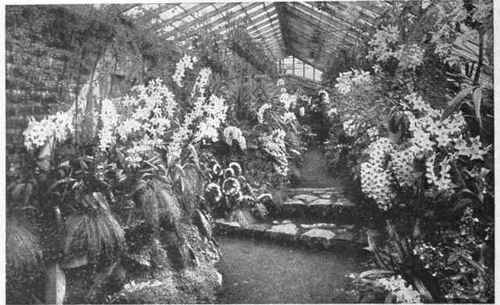
It is a popular fallacy to believe that to grow orchids successfully very high temperatures are required.
Certain varieties, if treated properly, grew admirably in a cool house, of which this illustration is a charming example Orchid growing, therefore, need not be an expensive hobby.
Copyright: Stuart Low
Those marked with an asterisk may be used for window decoration, while Cypripedium spectabile is the outdoor orchid par excellence for growing by the water-side.
The orchids above mentioned can be had at fairly moderate prices, ranging from 3s. 6d to 7s. 6d. or 10s. 6d. each. The amateur will very probably develop a taste for orchid-hunting at auction rooms, where sales are frequently held.
Continue to:


My Books

