


German Applique Work
Description
This section is from "Every Woman's Encyclopaedia". Also available from Amazon: Every Woman's Encyclopaedia.
German Applique Work
An Ever Popular and Adaptable Form of Fancy-work - Materials and Method of Working - How an Artistic Splasher can be Made - A Charming Design for a Basket - An Original
Newspaper Rack
Applique, ever a popular form of fancy-work among those whose aim it is to secure excellent effects with the smallest possible amount of time and trouble, is never likely to be dethroned from its high position in the world of needlecraft by newer and more intricate styles demanding much close application.
German applique offers a pleasing variation from old-time methods, and, while affording scope for considerable artistic skill and ingenuity, is easily and quickly accomplished.

A splasher in art blue linen worked in German applique, using the outline designs on page 4436. This work opens up delightful possibilities to the artistic worker
Also, it is an excellent way of using up old scraps of coloured felt, cloth, or soft leather, and is equally adaptable for large or small objects.

Designs for German applique. All the designs shown here for the bulrushes, gold fish, water lilies, and moon, can be cut out separately and arranged to form beautiful needlework pictures such as are shown in the illustrations
Materials And Patterns
Though the material destined to receive the applied designs (which are usually of a floral character) may vary considerably, according to the requirements of the workers, it is absolutely essential that the appliques themselves should be cut from material that is not liable to fray out, such as cloth, felt, kid, or suede. Velvet may also be employed if all the edges of the design are first outlined in poker-work before being cut out with sharp scissors, so as to form a perfectly clean
Needlework edge. The reason for this is that German applique, unlike other forms of this particular work, is not stitched down with silks, buttonholed round the outer edge, or held down by braid, but is simply secured to the foundation material by a few stitches only, often invisible, or in some instances serving as the stamens of flowers, the stems and veinings of leaves, or appearing in the form of a few French knots relieving the plain surface of the design.
By this manner an extremely natural and light appearance is easily achieved, the petals of flowers standing well away from the background with remarkably realistic effect.
An Appropriate Design for a Splasher
The splasher illustrated is of grey-blue linen, and is made with a deep hem at the top, through which is slipped a flat strip of wood. The appliques are in cloth of six different shades - viz., pale champagne colour for the lilies, buds, and moon; light gold for the fish, with orange-red for the fins and tails; two shades of green (one of a decidedly greyish tone) for the leaves, reeds, and stems; and dark brown for the bulrushes.
Sketches of all the various parts of this aquatic design are here given, and these parts can be traced and arranged in any way to suit the personal taste of the worker. It will readily be seen that the reeds and stalks of the bulrushes must be considerably elongated in order to make them tall enough for a splasher of any size. When working the original, the horizon line, of silver braid, was first laid on and sewn in place. This was necessary because the design covers it in many places. The other lines of silver braid, representing water, were done at. the last, as in several instances the ends were secured under the leaves, instead of being taken through to the back.
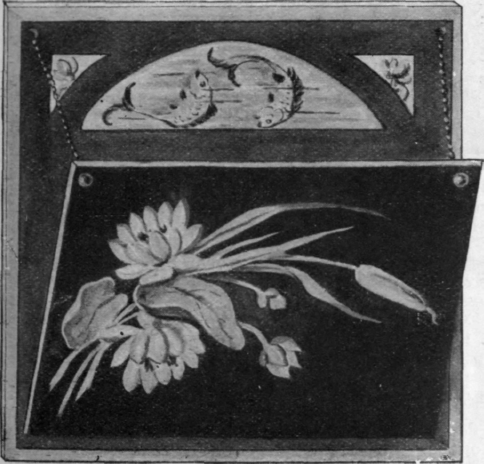
A newspaper rack decorated in German applique is both original and effective, and is a further example of an arrangement of the outline designs

Another application of the designs for German applique is suggested as a decoration for a wastepaper basket
Paper patterns were carefully traced from the design, and the different parts of the leaves, the bulrush heads, petals of lilies, etc., cut out by them in the various coloured cloths. Each flower and bud was fashioned separately on small rounds of stiff muslin, every petal being secured by a few stitches at the base. The numerous pieces forming the design were then arranged upon the linen foundation and lightly pasted in place, one part occasionally overlapping another. A few stitches of orange silk formed the heart of the lilies; veinings of the leaves and of the reeds were also carried out in silk, stem-stitch being employed. The fish were also built up upon foundations of muslin, and the markings and lines of water added after they had been pasted in position.
A Wastepaper Holder
The diagrams of the last-mentioned design may be utilised in other ways. For instance, with very little variation an all-round decoration for a useful wastepaper holder can be contrived. Carried out in subdued shades on a background of pale green this looks uncommonly well. A plain, round wicker basket can be obtained and covered, or, failing this, any drum-shaped cardboard foundation will answer, if neatly lined and relieved by a border top and bottom of velvet or fancy trimming in a contrasting shade
An Original Newspaper Rack
Quite another idea is suggested for the arrangement of the same forms in the illustration of a newspaper rack. The careless spray of water-lilies and bulrushes occupying the lower portion is cut out of light coloured cloth and appliqued on to a dark foundation of peacock blue. The back part of the rack has a semicircular panel, also two triangular corner pieces of pale sea-green, laid on the background and edged with braid. The fish are exactly similar to those described above, and the lilies, leaves, and rushes are all carried out in the same manner. The designing of different combinations of the various forms will be found a most interesting task.
Continue to:


My Books

