


The Art Of Rose Growing
Description
This section is from "Every Woman's Encyclopaedia". Also available from Amazon: Every Woman's Encyclopaedia.
The Art Of Rose Growing
Diploma of the Royal Botanic Society
Roses in Small and Large Gardens - Various Sections - Methods of Propagation - Preparing and Planting - Newly Bought Roses - The Necessary Conditions of Culture
Lovers of roses may be divided, for prac-tical purposes, into two sections - those whose opportunities (and purses) are unlimited, who have extensive grounds and ideal situations - who can, in fact, possess rose gardens - and the smaller, but no less devoted, amateur, who has to content herself with beds of roses in a small garden, or even with specimens introduced into her flower-borders.
Both these conditions are worthy of serious consideration, for both have their special opportunities for the exercise of that beautiful art - the art of making garden pictures. The two classes of growers have, however, this in common, that they both desire to grow good roses. I will, therefore, set out with a few remarks on the chief kinds of roses, going on to their planting, pruning, and general culture, and, lastly, to the best methods of artistic arrangement in owners' gardens, small or large.
Various Sections Of Roses
For convenience' sake, both garden and exhibition roses are divided into various sections. All are descended from different species of the great wild family of Rosa, belonging to the natural order of Rosaceae.
It is interesting to notice that some of these roses are now cultivated in the garden - for instance, the cabbage rose, whose "wild" name is rosa centifolia; the moss rose is rosa centifolia muscosa; rosa rugosa is the large-flowered Japanese rose; rosa rubiginosa, the eglantine, or sweet brier; rosa lutea, the Austrian brier, and so on.
Beyond these sections, however, there are the great classes of garden roses with which we are familiar - namely, the hybrid per-petuals, hybrid teas, and the various sorts of cluster roses, which last are descendants from a cross between a moss and a monthly rose.
The other great groups consist of (1) tea roses, so called from their tea-scented flowers, which are usually small and somewhat formal in shape; (2) hybrid tea roses, a comparatively new class, the result of cross-breeding; (3) hybrid perpetuals, the great and important class from which our gardens are so largely recruited, and which originated by crossing roses, which were themselves crosses between hybrids of Bourbon and Chinese roses, with a damascena hybrid.
Roses are further distinguished according to the stock on which they are budded (e.g., brier or Manetti, or De la Grifferaie) or as "own-root" roses (i.e., those rooted from cuttings taken from the parent rose-tree).
Methods Of Propagation
Roses are but seldom propagated by grafting, except in nurseries, though the method is extremely simple. A close propagating case with slight bottom heat may be used, and the "stock" should be a seedling brier in a small pot. The ripened shoot of the rose it is wished to grow (the scion, as it is called) should consist of a thickish piece of rose-wood, ripe and firm, and bearing a leaf. Take a slice out of the side of the brier-stem (i.e., the stock), and Cut the scion to fit the space, tying them together firmly, but not tightly, with raffia. An even temperature
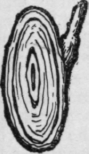
The bud stripped off and prepared for grafting

The T-shaped incision in the stock in which the scion, or shoot, must be placed should be maintained, and the grafts kept just sufficiently moist overhead. As soon as union has taken place the ligatures will be removed, and air and sunshine be admitted gradually. It is best to remove any buds which may form along the stock, or suckers may be thrown up which impoverish the tree.
Budding Roses
Shield-budding, which is the most usual way of increasing roses, only differs from grafting in the scion used being a bud merely instead of a part of a branch, as is seen by the French term of "bud-grafting" - greffage par ceil.
The stock of the wild brier may be used for nearly all roses. The Manetti stock has not proved very suitable for delicate varieties, but is most successful in the case of hybrid perpetuals. The stocks to be grafted should have their strong roots trimmed, and be very carefully planted the previous season. Dwarf stocks must be cut back to a height of six inches, standards being, of course, left proportionately higher. All buds but three or four situated near the top must be removed from the tree as soon as the spring growth has fairly started.
When To Bud
The budding of roses will be carried out about the month of July, very much according to the method of budding fruit trees, described on page 3931, Vol. 6, of Every Woman's Encyclopaedia. Care should be taken in budding roses that the buds are inserted as close to the base of the branch as possible, not near the tip.
To increase roses by cuttings is one of the easiest and safest methods, and may be carried out with great success in the way described on page 3931, or, if preferred, they may be treated in the same way as ordinary shrubs, and struck out of doors in September, as shown in the same place.
Amateur gardeners will find a pleasant task in experimenting with the little "Fairy roses" in pots in the greenhouse, which will flower (with luck) a few weeks after seed has been sown.
Coming now to the subject of rose planting, many people are troubled by the idea that rose trees must be planted in November or not at all. This is a mistake. Roses can be planted satisfactorily during six months in the year - i.e., from October to April - supposing always that open weather is chosen and that both the ground and the trees to be put into it are in a proper state.
Continue to:


My Books

