


The Romance Of Old China - Old Leeds Pottery. Part 3
Description
This section is from "Every Woman's Encyclopaedia". Also available from Amazon: Every Woman's Encyclopaedia.
The Romance Of Old China - Old Leeds Pottery. Part 3
contimted from page 4208, part 35
The Management of Heating Apparatus - How to Lay and Light a Fire Successfully - On Keeping up a Fire - A Popular Fallacy - The Management of a Closed Stove - Hot-water Apparatus - Gas Stoves and Gas Escapes - How to Keep Oil Stoves in Working Order - Electrical Heaters
The full efficiency of any heating device is only obtainable when due attention is given to its proper management.
Indifferent management means not only waste, but discomfort, dirt, and annoyance, and may result in the disarrangement and damage of the apparatus.
Some hints, therefore, will be given on the care needed by the various heating devices which have been passed under review.
How to Light a Fire
Most people believe that they know how to light a coal fire, and if their operations are not at once successful, they blame the wood, the paper, or the chimney, when it is really their method which is at fault. .
The mistake most commonly made is in the arrangement of the paper and wood. The former is folded, so that it bulges out between the grate-bars and prevents free access of air to the lower part of the fire, and the latter is arranged in a horizontal layer which at once sinks down to the cold grate bottom as soon as the paper is consumed, and between the coal above and the iron below its combustion is quenched.
A more scientific and certain method of laying a fire is to crumple the paper loosely into small separate balls, and to drop them lightly into the empty grate, and on them to arrange the wood in a hollow cone, the sticks meeting in a point at the centre of the fire-back, wigwam fashion. The coal is then placed around the cone. The effect of this arrangement is to give a free air space for the paper to burn, and to prevent the coal falling in and swamping the fire.
The management of a fire, when it is once well alight, should consist in removing the ash which accumulates at the bottom, which is best done by inserting the poker horizontally between the bars and moving it laterally, and in preventing the coal from caking together above, by using the poker as a lever to break up the mass from below. Thrusting the poker in from above has. the effect of causing the coals to consolidate in the centre of the fire, and thus to obstruct the free passage of air through it.
Fires are best replenished by laying the coals in separately with tongs. Little and often replenishment ensures a more cheerful and uniform fire than heaping on large quantities of coal at long intervals. It is also more economical, as the action which goes on when a large quantity of coal is added is at first one of distillation, by which large volumes of inflammable gases are produced, and escape unburnt up the flue, and thus their fuel value is lost. At the same time they carry away with them a certain amount of useful heat.
Flagging fires are not to be revived by the practice of resting the poker against the bars, a practice which originated in the dark ages, the hidden signification of which was the use of the cross to exorcise the evil spirit in the refractory fuel. But the poker inserted between the bars to lift up the coal mass, and left there to keep it from again falling together, is effective, because it permits the air to pass through the fire.
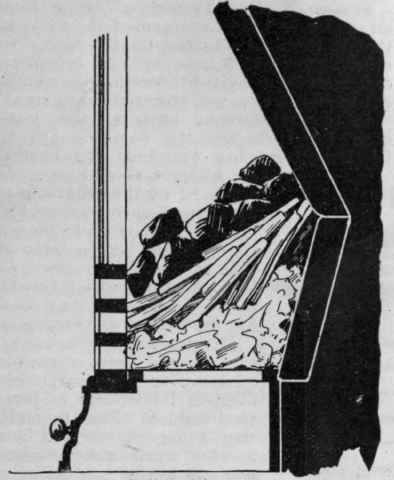
A fire laid as illustrated will light easily and quickly. The paper at the bottom is in loosely crumpled balls. There is free air space for ignition and the stick arrangement keeps the coal in place
A Popular Fallacy
That the sun's rays, falling directly on a fire, will cause it to go out is another popular fallacy that should be abandoned. The idea, no doubt, arose by observing the apparently decreased illumination from a fire in bright sunlight, an effect solely due to the superior power of the sun's rays, which render the fire's light less visible. That they could in any way check combustion is not scientifically possible, but none the less the fallacy lingers in the public mind, and blinds are pulled down, with apparently good effect on the fire.
Neglected fires sometimes need special measures for rescuing them from extinction. One of the best forms of stimulus is a few lumps of sugar inserted into the hottest part of the embers. The heat melts them, and the melted sugar ignites and burns long enough to re-start the fire, if a few small lumps of coal be lightly laid above the flame.
When the wood is damp, a good expedient is to sprinkle a few spoonfuls of mineral oil on the paper lumps when laying the fire, but on no account should oil be poured from the can if the fire has already been lighted, or an explosion may ensue.
The makers of closed stoves issue instruction cards for their management, and the best results are obtained by following their advice. The non-observance of some apparently trifling injunction may make all the difference in successful management of the stove. As a rule, these stoves give no trouble when once understood. Perhaps the most important point is to become conversant with the means of regulating the combustion of the fuel, so that overheating may be avoided. Due attention should be given to the flues, which may become choked with ash, and thus rendered inoperative.
The water-pan, when used, should be replenished at frequent intervals, and should never be allowed to become dry, or an unpleasant smell will be produced.
Ordinary coal should never be used except in stoves constructed specially for burning it, owing to its soot-producing quality.
Stove doors should not be left open, or gases will escape into the room. Damaged mica windows should at once be replaced, some spare pieces of mica being kept at hand for the purpose.
Continue to:


My Books

