


The Romance Of Old China - Old Leeds Pottery. Part 4
Description
This section is from "Every Woman's Encyclopaedia". Also available from Amazon: Every Woman's Encyclopaedia.
The Romance Of Old China - Old Leeds Pottery. Part 4
The management of hot-water systems involves a minimum of trouble. Stoking should be done at regular intervals to ensure an equable temperature, and the boiler flues should receive attention from time to time. Leaky piping should be repaired as soon as discovered. The pipework and radiators, or coils, should be kept clean and free from dust, otherwise unpleasant smells will be generated. This is particularly important with the high-pressure system, in which the piping is at a high temperature.
Similar precautions are equally essential with the steam system of heating.

The "Dowsing" electric heater. Tvs device needs but tittle attention and works efficiently
The management of these has been noticed (see page 4207, Vol.6) and little need be added to the hints already given. Their disarrangement is so soon made apparent that no excuse should exist for faulty burning. Cleanliness and attention to the fuel and burner are the first essentials.
Gas Stoves
Gas escapes are easily detected by smell, when the stove is not alight, and should at once be stopped. A good way of temporarily stopping an escape is to apply ordinary soap to the part, rubbing it well in with the finger.
Serious escapes should be dealt with by at once turning off the gas at the meter, and throwing open all windows, making first sure that no naked lights are near.
Argand burners in stoves require pricking with a fine wire to clear the holes in the ring from time to time, and their glass chimneys should be daily cleaned with a brush and duster. They should not be wetted, or they will break when next used.
Spent matches and other combustible matter should never be thrown upon gas fires.
Oil Stoves
Scrupulous cleanliness is imperative in the management of oil heating stoves. The reservoirs should be fitted with a funnel, or with a special can with long spout. Overfilling, by which oil is allowed to run over the body of the reservoir, should be followed by careful cleaning with a dry rag or "sponge cloth."
If any oil is left on the surface, it will evaporate as soon as the lamp is lighted, and cause smell. It will also collect dust. Wicks should be trimmed by wiping with a cloth, all detached pieces of carbonised wick being removed afterwards.
Central-draught lamps in stoves should be examined occasionally, to see that no obstruction has accumulated in the central tube. Perforated air grids must be kept open. Screw caps to reservoir nozzles should have leather washers to make them oil and air tight, and should be well screwed home after filling. Clean oil should always be used, which is best ensured by storing the oil in a drum, having a tap near, but not immediately on, the bottom of the drum. This arrangement allows the oil to be drawn off without disturbing the sediment.
Wicks often get choked by the fine dust which they absorb from the oil before they are used up. They are best discarded when they reach this stage Before a new wick is inserted, it should be well dried.
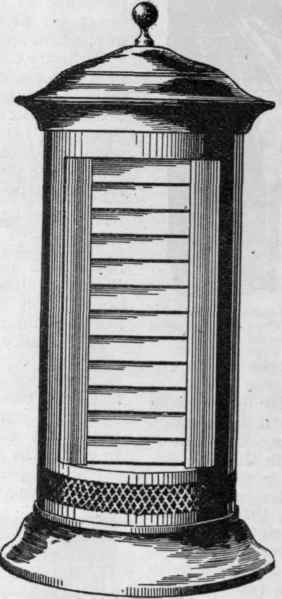
The "Prometheus" electric radiator, a useful method of heating rooms and passages
Glass chimneys of good quality are the cheapest.
The cleaning, as already advised for Argand chimneys, should subsequently be with a brush, duster, or leather, and never with water.
Stoves of the "Perfection" type have means for limiting the travel of the wick, so that it cannot be turned up too high. In other stoves which have not this safeguard care must be exercised to see that the wick is not too much exposed, or smoking will ensue. In central-draught burners, the loose cone for spreading the flame is apt to be forgotten when trimming the burner. Its absence should be made apparent by the behaviour of the flame. Generally speaking, the management of the oil stove should be the same as that of any other mineral oil lamp, the fact that it is usually out of sight being no excuse for the neglect of cleanliness. However, as before stated, the ill-used and neglected oil stove or lamp inevitably avenges its wrongs in practical fashion, either by emitting a most pernicious and horrible smell or by striking work altogether.
Electrical Heaters
These demand very little attention. Care should be taken that the connecting wires are not trodden upon, or broken by rough treatment, to avoid which they should be neatly stowed, and their length should not be greater than necessary.
Stoves which contain incandescent lamps will require the lamps to be renewed as they give out. This should not be done whilst the current is on. Dust and dirt should be removed at frequent intervals. In connection with this question of electrical heating, it is as well to remind the reader of what has been before stated - namely, that such heating is far from being inexpensive. It is therefore always necessary, before contemplating such an installation, to ascertain the price of electricity in the neighbourhood. In practically every town this will be found greatly to exceed the cost of other agents.
On the other hand, of course, the manifest advantages of cleanliness, ease, and adaptability to manifold purposes can be taken into consideration by those whose means are not limited, or who think that the increased comfort is worth its cost. But even then care should be taken to see that there is no waste which can be avoided.
Continue to:


My Books

