


366. General Observations
Description
This section is from the book "The Villa Gardener", by J. C. Loudon. Also available from Amazon: The Villa Gardener.
366. General Observations
This villa may be said to occupy in all about twenty-eight acres. The house, stable offices, and decorated grounds, stand on about two acres; and at the distance of about two or three hundred yards, across the road, are the kitchen-garden, poultry-houses, and piggeries, occupying nearly two acres; and two pasture fields, containing twenty-four acres. The ornamented grounds have an even surface, which has the disadvantage of rising somewhat from the house to the further extremity of the lawn. It is bounded on the south by another villa of the same kind; and on the north and east by grass fields. The disadvantage of the ground sloping to the house is counteracted, by lowering the walk that crosses immediately in front of the house, and sloping the ground from the drawing-room veranda to that walk; beyond which the lawn rises gently and gradually, till, at the cross walk at the farther extremity, it is probably 6 ft. higher than the level of the drawing-room floor. Though, when the lawn rises in this manner from the house, it detracts from the expression of dignity, considering the villa as a whole, yet, viewing the lawn as an arena for the display of plants, statues, and other interesting objects, from the windows of the drawing-room, it has an advantage in that point of view over a falling surface: it is also well sometimes to have a lawn of this kind, in order to produce variety. 367. Description of the grounds.
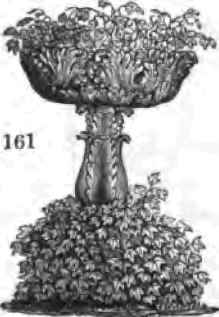
Entering the lawn from the drawing-room (h), we find a gentle descent from the veranda to the walk. Turning to the right, at the angle at 1, we observe the foliated vase fig. 161., the base of which is concealed by a plant of tree ivy; proceeding onwards towards 2, and 4, we pass two ornamental pedestals and vases. We are now at a sufficient distance from the garden front of the house, to see it to advantage by turning round; and, if we step on the lawn to the point 4, we shall find the view fig. 162., to the left of which will be observed the ivy vase, and a basket containing a pyramid of roses; and to the right an elevated rustic basket of pelargoniums. The large window on the left is that of the dining-room.

The margin of plantation on the right is composed partly of evergreen trees and shrubs and partly of deciduous flowering kinds. The groups on the left hand are, in part, of more rare sorts, and contain a great many fine hybrid rhododendrons and azaleas. All these plantations and groups are treated in the picturesque manner; there being scarcely anything in these grounds, except the single plants, such as the standard roses, and some rhododendrons and other shrubs, which can be considered as treated in the gardenesque style of culture.

At 5, there is a fine specimen of double-blossomed furze, and at 6, a rase on an derated pedestal. The walk from 6 to 7 is several feet higher than the floor of the veranda in the front of the drawing-room; and hence the views towards the house, being along a descent, are less interesting than they otherwise would be. The view into the paddock, to the right, consists of a plain grass field, grazed by some fine Alderney cows, and planted with two or three scattered elms, oaks, and aspens and other poplars.
The next scene of interest is the Italian walk (see fig. 98. in p. 182.), arrived at the point 8, in which, and looking back towards the paddock, we have, as a termination to one end of that walk, the rustic arch and vase fig. 168. From the point 9, we have the view of the Italian walk, with a span-roofed green-house as the termination at the farther end, and a fountain on the right hand. The border on the left is planted with the most choice herbaceous flowers, interspersed with standard roses at regular distances; and the wall is devoted in put to the finer fruits, but principally to climbing roses, and other climbing or twining shrubs of fragrance or beauty. At the point 10, there is a rustic archway of rockwork on the right, from which an interesting view across the lawn is obtained. At the point 11. there is a walk across the border to the bath-house, adjoining which is a camellia-house 12, (see fig, 169. in p. 274.;) and beyond that two long sheds, 13,14 (see fig. 169.), for tools, pots, etc.
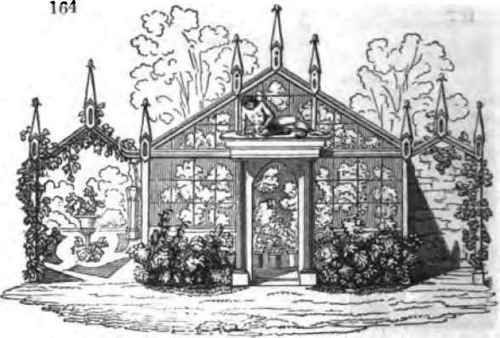
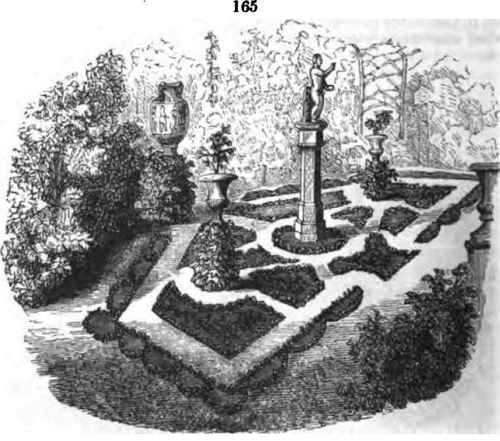
At 15 there is a fountain, and at 16 a stone cistern filled with water by a forcing-pump in the stable-yard. At 17 there is a span-roofed green-house (fig, 164.), and at 18, the French parterre shown In fig'. 165.
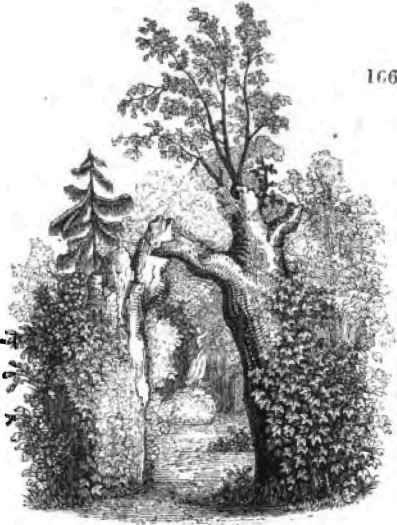
Proceeding towards the house, a view of a handsome weeping ash (20) is obtained from the point at 19; and, at the farther extremity of the walk, the vases placed at 1, 2, 3 on the plan have an excellent effect, backed by the marginal plantation of evergreens. Leaving the walk at 19, and passing the weeping ash at 20, if we advance on the lawn to 21, and look towards the south, we have the pollard vista fig. 166.; and changing the position to 22, we have a view of some rock-work, with a statue of Fame, &e-On the right and left of 23 are two groups of rockwork, with concealed springs, which drop from rock to rock, and from stone to stone, and form curious little moist places for aquatic plants. Advancing to 24, and looking northwards, we have the statue of Mercury in the foreground, and behind it the camellia-house, the wall on each aide of which is heightened with trellis-work for creepers, as shown in fig. 167.
At 2ft, we have the view of the fountain and arch behind, shown in fig. 91. in p. 181. In the basin are nymphaeas and other aquatics; and on one side is a Napoleon willow.

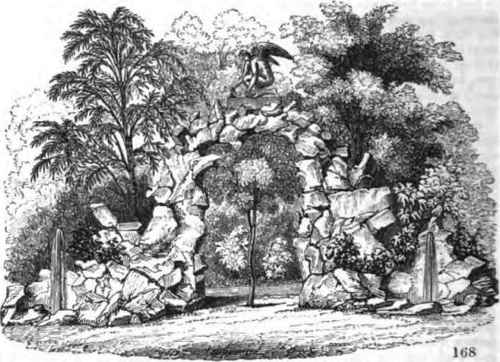
At 26, we have the view of the rustle arch and Cupid, shown in fig. 168.; and, at 27, a tent is frequently pitched in the summer time.
At 28, there is a bed of Rosa indica, in the centre of which is a large plant of Yacca gloribsa; and, proceeding across the lawn to 29, we have a view of a flower-garden; and, at 80, we have a fountain, surrounded by baskets of flowers, with the two guardian nymphs.
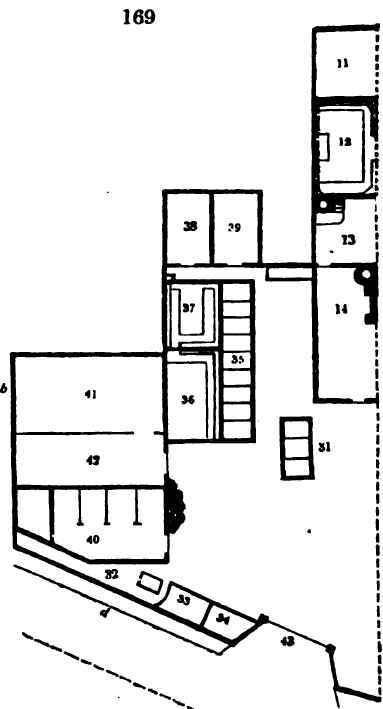
We shall now suppose that the spectator walks across the lawn, and, passing the span-roofed green-house, enters the court of offices by the door at 80. In this court (fig. 169.) he finds: 81. A large pit for plants.
82. A small pit.
88. Dung-pit for the stable.
84. Rubbish-pit, and rot-heap for the garden. 86. Pit for heaths.
86. Green-house.
87. Dry stove.
38. Shed for flower-pots.
89. Rubbish-shed
40. Four-stalled stable, with hay bin at the farther end.
41. Coach-houses, harness-room, and sleeping-room for coachman.
42. Place for plants in pots that have done flowering. 48. Carriage entrance from lane.

368. The kitchen-garden, the gardener's house, the stove, and the poultry-houses, grass fields, and cow-shed, are situated on the other side of the lane, and at the distance of 100 yards from it. These are shown in the plan fig.170., and an explanation of the references is given in pp. 277. and 278.
Continue to:


My Books

