


Plan And Description Of Wimbledon House, Surrey. Part 2
Description
This section is from the book "The Villa Gardener", by J. C. Loudon. Also available from Amazon: The Villa Gardener.
Plan And Description Of Wimbledon House, Surrey. Part 2
Pieces of water of this kind are frequently of such a length as not to be seen all at once, but in succession; and as, from the irregularity of their width, they can never, when so seen, be mistaken for a river, they ought to be treated in such a manner at to give them the appearance of a winding lake; which, being seen in successive portions, each of these ought to have an agreeable shape. These shapes are produced on the principles already laid down, viz., of displaying some obvious figure as a whole, and concealing the water altogether by wood wherever the desired form is interfered with by the opposite shores of the lake or canal approaching, or seeming to approach, each other too nearly. When a winding sheet of water is at such a distance from the eye as to be seen all at once, then all that can be done is, to cause it to wind agreeably, either by directing its bends in a manner more or lew regular or symmetrical, or by creating an obvious allusion to some recognised figure. Thus, the general tendency of the winding may be to produce a crescent-like form; or it may be serpentine; or there maybe one conspicuous bend in some regular form, and the subordinate bends may be comparatively indistinct The safe guide in this case is, the principle already laid down, of producing some form which may take the lead, and be recognised at once; and trusting for variety to the subordinate forms, and to the details.

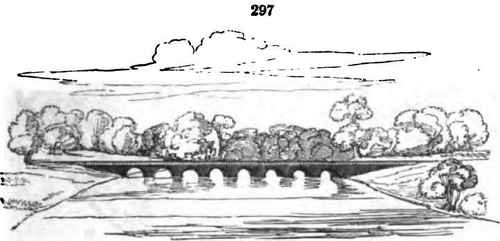
488. As there is no such thing in nature as a piece of water without an outlet, or as a lake from which there does not issue a brook; so, in landscape-gardening, no piece of still water ought to be formed, in which there is not some point indicated, which the brook might be supposed to flow from. In the geometrical style of forming pieces of water, the brook is represented by a formal cascade; and, in natural-looking shapes, there is commonly also a cascade, or something of the kind, in the way of outlet; or, if there is not, a portion of the margin, in what is decidedly the lowest part of the general surface of the ground, ought to be concealed by trees, or by an island, so as to leave the spectator room to suppose that there is an outlet in the proper place. Most lakes are also supplied by brooks; and, for this reason, in all imitations of them, whether gardenesque or picturesque, there ought to be an indication of the point at which the brook or rill expands into a lake, as well as of that where it contracts again into a brook.
Where a rill or small stream runs through a narrow valley, it sometimes happens that a succession of dams are formed across the valley, in order to produce a succession of ponds; and when the dams are not disguised by wood, and the margins properly varied, this is one of the most formal and unartistical appearances which artificial water can be made to produce. In valleys which are nearly flat, ponds formed by throwing dams across are more easily managed; but even in cases of this kind, the dam is frequently left naked, and the margin of the water unbroken by trees or islands.

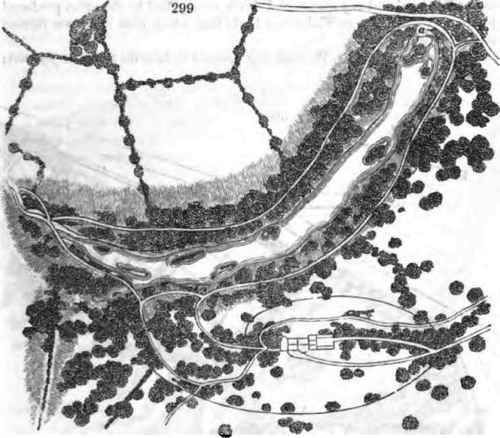
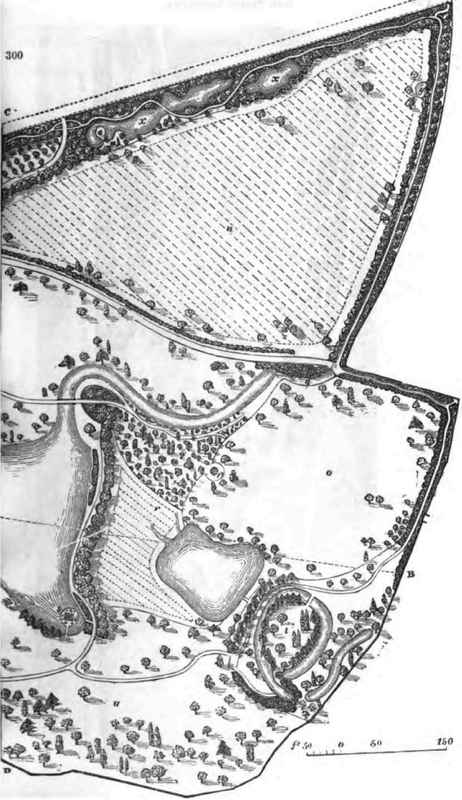
Fig. 298. shows two ponds which existed some years ago in a valley at Lyne Grove, near Chertsey, Surrey; and fig, 299. shows the manner in which we proposed to reduce both pieces to the same level, to vary the margin by islands, and to form a cascade at a in fig. 299.; where also a hydraulic ram might be erected for forcing up the water to a cistern on the top of the dwelling-house. Notwithstanding this digression on the forms of artificial water, yet that element is so great an addition to landscape, that, where it has a clear surface, and is of a sufficient extent to receive a breadth of light, it is admissible in almost any shape; and this is exemplified by the effect produced by the pieces of water in Wimbledon Park, than which none were ever formed of less artistical shapes. 489. Ground plan, etc. - We shall now proceed to describe the plan, fig. 300:


Geometrical Section of the Ground, and Bird's eye View of the Park, Flower-garden, and Kitchen-garden, at Wimbledon, on the Line A B, tooting to the West.

Geometrical Section of the Ground, and Bird's-eye View of the Park, at Wimbledon, on the Line B A, looking to the Bast.
a The entrance lodge.
b, The entrance portico to the mansion.
c. The kitchen-court.
d, The stable-court.
e, The laundry, and brewhouse court.
f The drying-ground.
gt The green-house, with a summer-house at the back.
k, Paddock, containing an ancient building, formerly a mill for raising water, surrounded by a mass of plantation.
i. Flower-garden.
J, Kitchen-garden.
k. Poultry-yard.
l Farm buildings.
m, Rick-yard.
n, Arable land.
o, Paddock, with a beautiful architectural grotto at p (formed by Butthell, who constructed the grottoes at Oatlands, Pain's Hill, and oilier places), and another ornamental building at q.
r. Osier-ground.
s, Island and ruin; the latter used as a Catholio chapel by the Prince de Conde\ who resided at Wimbledon House before it was purchased by the late Joseph Marryatt, Esq.
t Wilderness and fish-stews.
u, Open grove of ancient trees.
v v v. Wire fence, separating the pleasure-ground and mown grass from the park.
w, Hurdle fence, separating the upper from the lower park.
x x, Fish-ponds.
y, Drinking-pond.
z, Well, near which is a hydraulic ram, which, put in motion by the waste of the upper piece of water in its course to the lower piece, forces a supply to the roof of the mansion, and to the sheds of the hot-houses.
Fig, 301. is a geometrical section of the ground, and bird's-eye view of the park, looking to the west.
Fig. 302. is a section and bird's-eye view, taken on the same line, looking to the east.
Fig 303. is a section and bird's-eye view, looking to the northeast.
Continue to:


My Books

