


Osage Orange Hedges (3). Continued
Description
This section is from "The Horticulturist, And Journal Of Rural Art And Rural Taste", by P. Barry, A. J. Downing, J. Jay Smith, Peter B. Mead, F. W. Woodward, Henry T. Williams. Also available from Amazon: Horticulturist and Journal of Rural Art and Rural Taste.
Osage Orange Hedges (3). Continued
We shall have to state briefly our objections to methods generally adopted, as this article is already much longer than we anticipated. Some persons practice cutting off the tops of the plants one foot from the ground the first season. (That we may not appear ambiguous, we will state that in speaking of cutting the plants the first season, we mean in the fall after vegetation has ceased, or the following spring.) Others let the plants grow two seasons, and then cut off the plants two feet from the ground, and the following season add two more feet to it; and more likely than otherwise, it will be the last. The same objection will apply to both of these methods. Those who have seen the Osage Orange growing, can not have failed to notice its tendency to grow upward; no matter whether it is cut off at two inches or two feet from the ground, there will be only two or three vigorous shoots at the top, with a few laterals at the side. Therefore, by adopting the plan of cutting off at one foot or two feet, as the case may be, there will be a space of several inches (more or less, according to the height the canes are cut) that will be entirely bare of laterals.
Besides looking unsightly, the litheness of the wood in its growing state will allow it to be bent to the ground, affording a fine opportunity to any one who might desire to test the quality of the fruit growing in our garden or orchard.
[We have to thank "Out West" for the continuation of his article on Osage Orange hedges, which has enhanced its value very much. His directions are plain enough to enable any body to make a good hedge. We shall be glad to hear from him again. - Ed].
Osage Orange Hedges #1
Two years or more ago, we venturned to suggest that the Osage Orange hedge would rarely be successfully grown in America. The plant comes nearer to what we want than any other yet introduced, but it requires an amount of attention which it rarely receives, and hence, principally, its failure. Our remarks called forth a considerable amount of feeling at the time, and letters poured in upon us in such numbers, that we began to think we had trod upon somebody's corns. We had, however, seen many jobs of planting it, and especially along the Illinois railroads, where the plants were set down and left to their fate; they were overgrown with weeds, and had never been trimmed or attended to; many of the plants were deceased, while those retaining life were growing up into trees.
At Mobile, lately, we were astounded by seeing a great sign with " Osage Orange Hedge Company" painted on it; but we saw no good hedges. Now, a good hedge of this plant should be something like this: -
How many of the vaunted hedges look thus ? And, neglected, they are worse than useless, because they exhaust the neighboring ground. "Bad hedges are a nuisance to the eye, to the pocket, and to any farmer's crops. The sooner we make up our minds to be thorough enough to secure a good hedge," somebody has said, "whether of Osage Orange or not, the better".
The editor of the Northwestern Farmer (Dubuque, Iowa) agrees with us, that, in the main, the Osage Orange will not answer; the region of the Northwest is too cold for it, and he proposes a new plant, which he calls the New Hampshire Thorn, but gives no other name to it. His engraving, however, represents very strong thorns that must be really formidable. " The wood," he says, "is extremely tough and hard, bending like a withe, even after being cut some months." He adds " that he has taken measures to procure and distribute seeds." One of the correspondents of that journal says: -
"The following inferences I drew from information and observation: -
"1. That it is most decidedly the hardiest thorn with which I am acquainted.
"2. That it is the best guarded of any thorn I have seen, its prickles being from two inches in length downwards, and proportionally strong.
" 3. That it will bear cutting) and improve by it the thick shrubby nature of the plant.
" 4. That the size of its growth is just what is required for a hedge exposed to stock.
" 5. That if properly planted and managed while young, it will be impossible for either man or beast to break through it".
The editor of the Prairie Farmer, traveling between Springfield and Alton, says:
"The Maclura Hedge here not only lines the track of the road on either side, but forms, or will soon, the dividing line between fields. They are of all ages, from the first season's setting, to a standing of four or five years, Many of these larger pieces are now the only fence, and no farm animal ventures the trial of passing them. Cattle, horses, mules, sheep, and hogs, all dread them as they would a bed of serpents, and are glad to keep their own side. One or two of the new set pieces are properly cut back; but of the larger ones scarcely a single piece has been suitably thickened at bottom. This is a matter of great importance, and some of them will yet have to be cut to the ground, and thickened over anew. This may be easily done with any poorly grown Maclura Hedge. The cutting should be in the spring before the plants start"
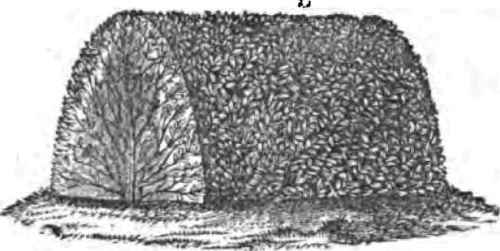
Trimmed Osage Orange Hedge.
Dear Sir: During the past few years I have had very many tumn came, the wood was but imperfectly ripened. I left them entirely unprotected, and in the spring the whole of the tops were completely killed, quite down to the ground. The roots, however, all survived, and during the year 1850 they made a line growth, having thrown up numerous shoots from three to four feet high. I have examined them to-day, and find that the ends of all the branches are killed from one to two feet. We have had a few very cold days during the past winter - yet, on the whole, a rather mild winter than otherwise. Again, there was considerable snow on the ground during the most severe weather, and this no doubt protected the trees. From my little experience, and from observation, I am quite of the opinion, that the Osage Orange cannot be relied on for a hedge in a northern latitude. Will others who have had more experience, give us their opinion?
In conclusion, I would just remark, that in the vicinity of Cincinnati, the Osage Orange succeeds admirably. Such beautiful hedges as I saw there last autumn, are rare indeed, in this country. I fear, however, that for New-York, New-England, Wisconsin, Northern Illinois, etc, it will not answer. Yours very truly, B. Hodge.
Buffalo, March 14,1851.
Continue to:


My Books

