


Pears (12)
Description
This section is from "The Horticulturist, And Journal Of Rural Art And Rural Taste", by P. Barry, A. J. Downing, J. Jay Smith, Peter B. Mead, F. W. Woodward, Henry T. Williams. Also available from Amazon: Horticulturist and Journal of Rural Art and Rural Taste.
Pears (12)
I send you the outlines of some fine fruit forwarded to me by Hon. J. S. Cabot, of Salem, Mass. Owing to European uncertain seasons, a great many fine varieties, once or twice tested (years ago), have since failed to produce fruit. In this climate, however, we are more fortunate, and as soon as the tree is disposed to bear, we may expect some fine fruit, if that fruit be suited to this climate.
Mr. Cabot fruited not only some very little known European pears, but, also, he was fortunate enough to get from his numerous and fine seedlings four different pears, all of the best quality. These are not very large, two being of middle size, the other two below medium, and that is the only objection, in my opinion, to the admission of such fine fruit in our catalogues. Apropos of that, permit me to remark, Mr. Editor, that it is more than time that something be done towards the sifting of all these names and synonymes. It is nearly impossible for the most extensive nursery to cultivate even a small proportion of all the varieties contained in the catalogues, and they are only one-half of all the known varieties. Still, amateurs will stick to some fruits with peculiar flavors, or for some other reasons; and nurserymen must cultivate them often without any possible profit. Everybody, of course, is at liberty to show bis preferences in the choice of fruit-trees; but I believe, after a few years more of experience, amateurs will have to be satisfied by purchasing such varieties from the nurseries specimen-tree* - that is, purchasing the scions for grafting, no trees of the sort being cultivated for sale.
We have over a score of the finest and largest pears, extending almost over all seasons. Those should be selected for general cultivation, and the smaller or less productive varieties left for the amateurs and such as have room and time to spare.
To return to Mr. Cabot's pears, I will only state that his seedlings proved uncommonly fine, some possessing a peculiar spicy taste, with abundance of juice and sugar. As many of them are not named, and perhaps will never be, I will only mention the two large pears which were sent to me.
The one is Auguste de Maraise - a large, fine, pyriform fruit, with a rather rough-looking skin, dotted and patched with deep brown. Stem, rather short, or medium. Calyx, close, sunk in a shallow basin. Flesh, buttery, flavored, juicy, sweet, delicious, partaking a little of the Duch-esse, but more delicate, and of a different flavor. Ripened October 20.
The other is the Beuire* de Konink. Both are seedlings of Van Mons, but little known in Belgium. This fruit is rather larger or more full than the preceding one. It has the same appearance, as far as the color and the patches of the skin are concerned, as the Auguste de Maraise, but its stem is rather longer, more slender, and surrounded at the cavity with fleshy protuberances. Flesh, rather coarse, but juicy, highly flavored, and truly delicious. Both these varieties are among the best I have tasted this season, and they seem to be of such a texture as not to be subject to sporting or changing their quality in ordinary seasons.
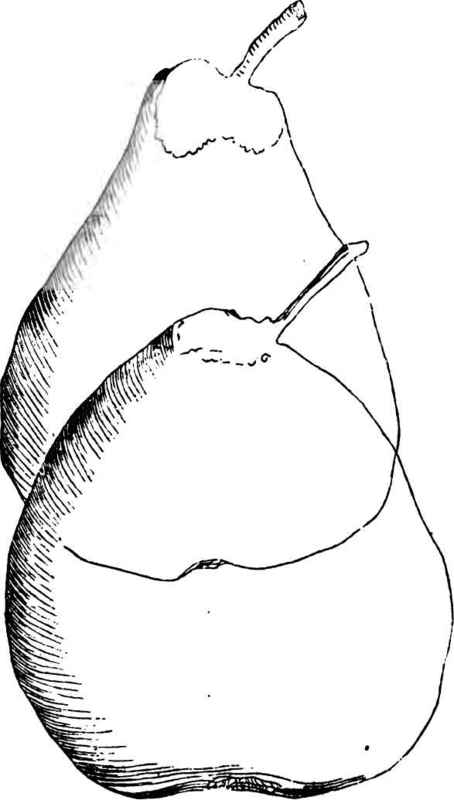
Fig. 1.
Fig. 2.
Fig. 1. Auguste de Maraise.
Fig. 2. Beurrf de Konink.
I believe these sorts so long overlooked in their native country, where perhaps few specimens ripened in proper condition for a number of years, are well worth a trial. If their bearing qualities come up to those of the Duchess and the Louise Bonne, they may certainly be considered as acquisitions, being at least equal, if not superior, to some of our large standard varieties*
A New Pear #1
From Mr. E. Rockwell, of Middletown, Conn., we have received a seedling pear of excellent quality. As our outline is not finished, we defer a description till next month.
Continue to:


My Books

