


Sutton's Ringleader Pea - Sweet Potato Plants
Description
This section is from "The Horticulturist, And Journal Of Rural Art And Rural Taste", by P. Barry, A. J. Downing, J. Jay Smith, Peter B. Mead, F. W. Woodward, Henry T. Williams. Also available from Amazon: Horticulturist and Journal of Rural Art and Rural Taste.
Sutton's Ringleader Pea - Sweet Potato Plants
Sutton's Ringleader Pea
A writer in the London Journal of Horticulture claims the above-named pea to be at least ten days earlier than any other of the early varieties.
Swaar
"First rate, and good bearer when top-worked, but only succeeds in this way."
Swan's Orange - Onondaga
Its fair, smooth skin, of pale yellow, and when fully ripe, rich, golden color, makes befitting the expression magnificent in color as well as in size, of rich, juicy, and aromatic flavor, with flesh fine-grained and buttery. When better known in our cities, will rival the Duchesse. It has less tendency to rot, and is a most vigorous grower on its own stock, and, uniformly, an abundant bearer. Maturing between the Bartlett and Buere Diel, it seems to unite the characters of both. Ripening at such a time, when nothing is comparable to it in size, commends it particularly to the market grower as an orchard pear.
Swans For The Central Park
The swans presented by the city of Hamburgh to the Central Park Commissioners are now on their way here. Water birds constitute a beautiful feature of lake scenery, and we hope they will be freely introduced in the Central Park.
Swans Orange - Some
The White Doyenne, Seckel, Urbaniste and Julienne may be named as not only among the hardiest pear trees, but as having blossoms possessing, in a high degree, the quality of resisting the frost.
The Bartlett, Vicar, Duchess, Glout Mor-ceau and Beurre Clairgeau are scarcely less productive, but are more or less likely to be injured.
Swatara
An early, sweet, little grape. Bunch and berry below medium size, but as compact as corn grains on a cob. Was discovered, many years ago, in a ravine through which the Swatara River flowed. The original vine is now forty feet under water, there being a reservoir built for the use of the Union Canal, now over where it grew.
Sweet Bellefleur
We have received samples of this fine apple from central Ohio. It was first described, and its cultivation advised, by that good Pomologist and friend to man A. H. Ernst, deceased.
The fruit is large, much resembling in outward appearance the old yellow Bellefleur, but the flesh is pleasant, sweet, juicy, and rich.
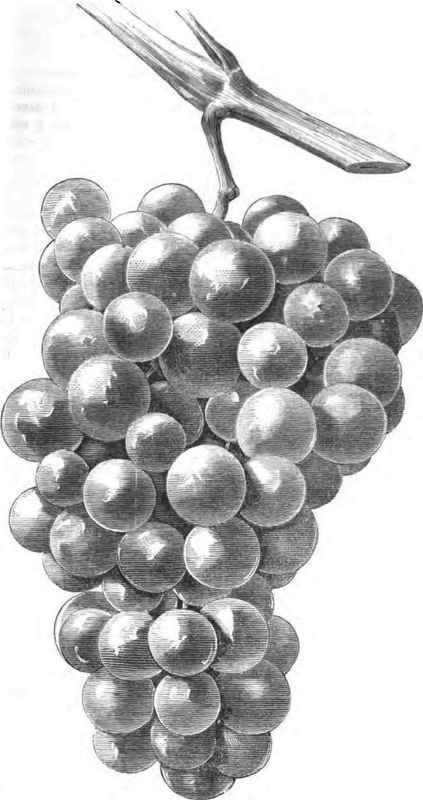
Fig. 32. - The Hine Grape.
Sweet Hard-Shell Almond
Bud it either on Peach or Plum stock.
The Apple Quince, or any Quince, will grow on the Apple, but the practice is not commendable. Better grow it from cuttings or layers, or graft it on seedling Quinces.
(D. F. K., Ill.) Lime Reture from the gas works is worthless as a manure.
The Sweet Potato Culturist
This a small hand-book by J. W. Tenbrook, proprietor of the Parke Nursery, Rockville, Indiana, containing practical directions for cultivating, marketing, and preserving the Sweet Potato, and embracing the experience of a large number of growers. It is a useful little book.
Sweet Potato Plants
We are indebted to Mr. Murray, of Foster's Crossings, Ohio, for a box of Sweet Potato plants. After their long journey, they came to hand in fine condition, an evidence of good packing as well as good plants.
Continue to:


My Books

