


Chapter XVII. Iron Drains
Description
This section is from the book "Plumbing Practice", by J. Wright Clarke. Also available from Amazon: Modern plumbing practice.
Chapter XVII. Iron Drains
Any reader who has noticed my remarks on stoneware-pipe drains will most likely be inclined to think (or he may probably have found out for himself) that although they may be very much better than the old brick drains, still they are very far from being perfection; and his experiences most likely are similar to my own - viz., that they are very costly when done as they should be; that, in spite of all pains that may be taken with them, they very rarely will stand an hydraulic test of only two or three pounds per square inch without leaking somewhere or other. For my own part I should be very sorry to guarantee any stoneware-pipe drains to last any length of time, and, although they may have been left in as nearly a perfect condition as possible, after a time they sometimes are found to be leaky. It is just possible that expansion and contraction of the pipes may have something to do with this, as sometimes hot and cold water alternately passes through, or it may be the traffic in the streets, or, in some instances, railway trains, shaking the earth. At all events, sanitary engineers are now falling back on cast-iron drain pipes as being more trustworthy, especially when fixed inside of buildings. When iron drains are fixed, smaller sizes, in proportion, are used; for instance, where a 6-inch stoneware would have been only 5-inch iron is used, and very often 3-inch and 2-inch iron, where in the ordinary way a 4-inch stoneware pipe would have been laid.
The iron pipes used vary very much in substance and treatment. Some people argue that plain iron does not rust to any serious extent, and answers the purpose very well, provided it is strong enough. A friend of the writer's told him that he had been making an alteration to an iron drain that he laid about twelve years ago. The metal had not been protected in any way to keep it from rusting, and yet he was much surprised to find that scarcely any oxidation had taken place inside the pipe, although it was in constant use. It must be admitted this is in direct variance with ordinary experience. A coating of fresh slacked lime, made into a wash, applied to the inside of the pipes, has been found to prevent oxidation, and to last for a very long time. The Bower-Barff process of protecting iron from rusfing has been much spoken and written about, but the writer has never seen nor fixed any iron drains treated by this means, nor yet been able to hear of anyone who has. He has seen a few instances where ordinary galvanized-iron rain-water pipe has been used, but very little faith can be placed in the zinc coating, which is soon eaten away, thus leaving the iron unprotected. Pipes coated with Dr. Angus Smith's preparation (which consists of immersing them in a mixture of pitch, coal tar, and a small proportion of linseed oil, with, sometimes, a little resin, melted and heated to about 3000 Fahr.) are mostly used in England for drain-work, and in some instances for soil pipes.
Some plumbers are using, for drains, pipes very little stronger than ordinary rain-water pipe. Others use it of the same substance as generally fixed for hot-water heating pipes. A great deal of what is called " light underground pipe" is used, while the best engineers have the heaviest underground pipe. Figures 162, 163, 164, and 165, are drawn to scale, and show the relative thickness of the iron pipes as used by various people. Figures 162 and 163 should never be used when the joints are made with metallic lead, the reason being that the socket, or hub, is not strong enough to resist the lead being " set up." If this is not done the joint will sometimes leak owing to the lead shrinking as it cools. Figure 165 is the sort generally used for the best kind of work, and also for water-mains, which have to withstand a very great water-pressure, also the enormous strain of traffic over them, in some cases dead weight, and in others shocks or sudden strains, when fixed in streets. These pipes are usually cast in 9-feet lengths, with sockets 4 inches deep. This length is a great advantage for drainwork, so many joints not being required as in stoneware pipes. It is true that skilled labour is required to lay iron pipes, but this is an advantage. For laying stoneware-pipe drains an ordinary navvy is very often considered to be quite good enough for the work, but my experience is very different, and I have found that the best tradesmen very often fail to make sound work of them.
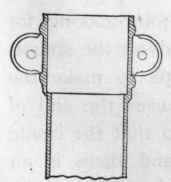
Figure 162.
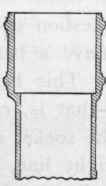
Figure 163.
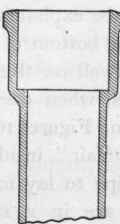
Figure 164.
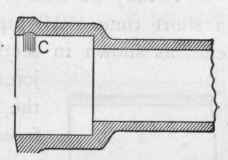
Figure 165.
Iron pipes, where the fall is sluggish, have another advantage, as they are much straighter than stoneware, are smoother, and consequently more water can be discharged through them in a given time, other conditions being equal. It has already been stated that skilled labour is required to lay these pipes - i.e., men who know how to do their work properly. Neglect of this may lead to serious trouble. As an illustration, a foreman in the same employ as myself took on a stranger to lay some iron drains; things were going on very nicely until one day it was found that he took about twenty-eight pounds of lead to make one joint on a 4-inch pipe. It need not be explained that the lead had run through the joint and lain on the bottom of the inside of the pipe.
It may be well to dwell on this question of joint-making for a short time. All pipes, when cast, have a bead on the spigot-end, as shown in section, Figure 166. This helps to make the joint "fair" inside - that is, causes the end of the pipe to lay in the socket so that the inside faces are in a straight line, and there is an equal annular space all around the inside of the socket. This bead does not fit quite tightly in the socket, so that it is possible to force the yarn or gasket past it when the pipe is not tight home in the socket. The result of this is, that there is nothing to prevent the molten lead, used for making the joint, from running through. When it is necessary to cut a pipe to a required length, an unskilful tradesman will do it in such a bungling way that the end is left very ragged and uneven. When this is so, although the spigot-end may be rammed home in the socket, the yarn will very often fall through and so leave no protection for preventing the lead following. Figure 167 explains this. Some men, to prevent this, or if they happen to cut the pips irregular, will cast a lead ring and push it on the end of the entering pipe, and jam it tight to the bottom of the socket; then another, which can be set up or caused to expand until it fits quite tight, and so on until the socket is quite full, when the last one can be worked quite flush with the outside face of the socket. This takes about three or four times as long to make the joint as the ordinary way.
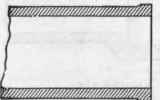
Figure 166.
Continue to:


My Books

