


Chapter XVIII. Iron Drains - Continued
Description
This section is from the book "Plumbing Practice", by J. Wright Clarke. Also available from Amazon: Modern plumbing practice.
Chapter XVIII. Iron Drains - Continued
If drains are properly and carefully laid with an inspection-chamber or manhole at each end, it is not difficult to plug up the lowest end and fill the whole length with water, and so test its freedom from leakages, without actually examining every inch of its length. Another good way for testing drains is to hermetically seal the ends, and pump air into the pipes. An ordinary gas-pressure gauge can be attached, and by watching the column of water it can be seen at once if any leakage is taking place; or the ventilation pipe may be plugged air-tight, and the whole of the drains, soil and other pipes tested at the same time and by the same means. A greater air-pressure than ten or twelve-tenths need not be applied; in fact, a' greater pressure will be found to break through the water-seals of the various traps.
It may be interesting to some readers to know how these pressure-gauges are made. Anyone can make them. I generally buy a piece of 3/8 or 1/2-inch glass tube; smaller sizes are not so good, as capillary attraction causes the water to appear to stand higher in the tube than it actually does. By holding the centre of this tube, which should be about 12 or 14 inches long, in a common gas-flame until it is red-hot, it can be bent to a U-shape; or the tube can be had about 6 inches longer, and bent to  shape. This bent tube can then be fixed to a small piece of board, on which should be pasted a strip of paper divided by horizontal lines into tenths of inches, the centre of the scale being zero. The tube should then have water poured into the U until it stands at zero on both sides of the leg. Figure 173 represents this gauge ready for use.
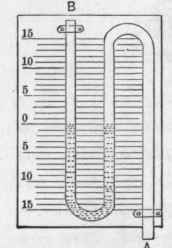
Figure 173.
A piece of indiarubber tube can be attached to the leg, A, and the other end to a pipe securely connected to the drain or pipe to be tested. It is important that the end, B, should be left open, or the water in the gauge would not rise by the pressure applied to the other end, or, more properly speaking, would only rise in proportion to the extent the air in this end of the tube is compressed. As 15/10 represents 1 1/2 inches, a pressure very slightly in excess of this would burst through any water-traps which had only 1 1/2-inch "dip" or "seal," or what North country plumbers would call "drown." I have very often used this gauge to test gas pipes inside of a house when seeking for cause of smells, and have suspected them to proceed from some leakage in the gas pipes or fittings. In these cases it is only necessary to attach the other end of the indiarubber tube to one of the burners, and then turn the cock, when from 10/10 to 20/10 will be registered on the gauge, according to the pressure from the Company's main. Next turn off the main cock, which is generally near the meter, and then watch if the water in the gauge falls back to zero on the scale. A little drop of almost any kind of dye in the water in the gauge renders it easier to see.
There is some peculiarity about this pneumatic testing of pipes that I do not clearly understand, and that is, I never yet saw a pressure-gauge stand steady at any point above zero. I have tested pipes with water which betrayed no leakage, and yet, on applying the air-test, the gauge has fallen to zero in a very short time, varying from ten seconds to three minutes. It is just possible that the indiarubber tubing may have been porous, but still not sufficiently so for water to ooze through. When testing drains and soil pipes, etc, the pressure can be applied with a small air-pump. In the absence of this instrument a small tube, with a cock in it, can be attached, and a person blowing through this will find that he has sufficient power of lungs for the purpose. When testing a considerable length of pipes, it will be found necessary to take several inspirations and subsequent blowing through the tube before the necessary result is attained, the small cock being alternately opened and shut to allow the air to pass through and then retained in the pipes.
To return to our iron drains. The several precautions mentioned in earlier chapters on lead soil pipes and stoneware pipe drains have to be taken with regard to iron drains. This is in reference to the necessity of their being perfectly true and straight. On no account allow what is commonly called "square junctions" to be used. Even when a vertical is branched into a horizontal pipe, a stoppage is always liable to occur, from reasons already given, and also from foreign matters, such as small bottles and sticks of firewood, which would pass around an ordinary bend if at the end of the pipe or Y-junction if at any intermediary position. These articles were discovered in a square junction in a drain, they having previously passed through several bends in a 4-inch lead soil pipe. Although it is not usual to make rubbish-shoots of water-closets, still it sometimes happens that when bedroom slops are emptied down these places other things get thrown down with them. Sometimes these things, when not too large, will get washed away and no harm is dcne, but it is always advisable to have means of access for removing anything that may lodge in certain parts of the drain or other pipes. This remark applies more especially to iron drains, as they cannot be cut into and made good with a cement patch in the same manner as stoneware pipes, or cut open and soldered over again, as can be done with lead pipes. A piece cannot be cut out of a cast-iron pipe without drilling a series of holes around the part intended to be removed. This is the neatest way of doing so, when the necessity arises, as afterward the hole can have its edges filed smooth and an iron plate made to fit over it, with the piece that was cut out riveted to it so as to fit neatly and not leave any serious obstruction inside the pipe to catch passing objects. A series of holes can be drilled near the outer edge of the capping-piece, and others to correspond, on the pipe. These last holes should be a little smaller and tapped with a screw-cutting tap. Brass or gun-metal screws should be used for fixing the cover-plate, as they could be easily removed again should occasion require, whereas iron screws would rust in so as not to be readily taken out again. Care should be taken that the screws for fixing the cover are not too long so as to project inside the pipe. If it is not probable that this plate would want removing at a future time, red-lead cement, or what is better still, rust cement, could be used for bedding it on to the pipe, but if frequent removal is necessary an indiarubber (vulcanized) ring could be used. There are other things that also make a good packing, such as prepared asbestos and a kind of felt which is specially prepared for this kind of work.
Continue to:


My Books

