


Automatic Water Heaters
Description
This section is from the book "Principles And Practice Of Plumbing", by John Joseph Cosgrove. Also available from Amazon: Principles and Practice of Plumbing.
Automatic Water Heaters
This kind of heater, Fig. 130, may be set up in the cellar or any other convenient place in a building. The hot water supply should then be connected to it in such a manner that all water to be heated will have to pass through the coils in the heater. A separate gas service, not less than one inch in diameter, should then be run direct from the gas meter to the heater. The operation of apparatus is as follows: When the gas and water supplies are connected to the heater, and turned on, the pilot light should be lighted and maintained so. The heater is then ready for use. By opening any hot water faucet in the house, the water is started circulating through the heater and at the same moment the pressure is released from the gas valve, thus turning on the gas which is ignited by the pilot light, and the water passing through the coils is heated.
The flow of water and gas are graduated and proportioned to each other by means of an automatic water and gas valve, so that whatever quantity of water is passing through the coils Of the heater, only a sufficient amount of gas is admitted to heat that volume of water': By thus proportioning the flow of water and gas to each other, a uniform temperature to the water is secured regardless of the amount of water being drawn.
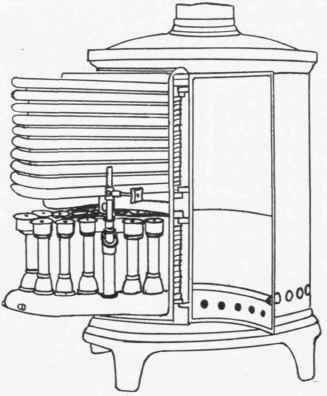
Fig. 130
No storage tank is used in connection with this kind of heater, and, except in the pilot light, fuel is burned only when water is being drawn from the hot water faucets. The water is heated as required by passing through a long copper tube coiled inside of an iron jacket and arranged over the gas burner so as to absorb most of the heat produced by the burning gas.
The capacity of this type of heater varies with the size, from 3 to 7 gallons of water each minute, the temperature of which is raised from 55 to 130 degrees Fahr. with a consumption of one cubic foot of gas for each gallon of water heated. One cubic foot of illuminating gas contains about 700 B. T. U. and when burned in a well designed heater should be capable of heating one gallon of water from ordinary temperature to 130 degrees Fahr.
Tanks for storing hot water
Range Boilers are storage tanks for hot water. They are usually located near the kitchen range, and the water in them is heated by the waterback in the range. Some boilers are made of copper, some of wrought-iron and some of steel. Wrought iron and steel boilers are made plain, painted and galvanized. Range boilers of larger capacity than 200 gallons are not made in stock sizes.
Copper Boilers are made for both low pressure and for heavy pressure water supplies. A low pressure boiler is made of light cold-drawn copper, polished on the outside and generally tinned on the inside. They are tested to about 75 pounds pressure, and are suitable only for systems where the pressure does not exceed 20 pounds per square inch. The chief objection to boilers of this type is their liability to collapse from atmospheric pressure when the water is in any way siphoned from them.
Safety Copper Boilers are made with internal brass ribs to reinforce them. In some types of safety boilers, the internal rib runs spirally around the boiler from one end to the other. Reinforcing boilers makes them proof against collapsing from external pressure.
Safety copper boilers are tested before shipping. There are two grades of safety boilers: one tested to 150 pounds pressure and guaranteed to stand a working pressure of 100 pounds; the other tested to 250 pounds pressure and guaranteed to stand a working pressure of 150 pounds. Both grades are guaranteed against collapsing, provided no check valve is used on the cold water supply to the boiler. If a check valve is used it confines to the boiler the water that would otherwise expand back into the water mains, when the water in the boiler is heated, and expansion might subject the boiler to a pressure far in excess of what it is guaranteed to stand. Copper boilers are the best appearing range boilers made. They are easily stained green, however, and they radiate heat to surrounding objects at a greater rate than do iron boilers.
The capacities and dimensions of stock sizes of copper safety boilers can be found in Table LIV:
Table LIV - Capacities Of Copper Boilers
Capacity Gallons | Height Inches | Diam. Inches |
30 | 60 | 12 |
35 | 60 | 13 |
40 | 60 | 14 |
50 | 60 | 16 |
60 | 60 | 18 |
80 | 60 | 20 |
Capacity Gallons | Height Inches | Diam. Inches |
100 | 60 | 22 |
120 | 65 1/2 | 24 |
125 | 69 | 24 |
150 | 78 1/2 | 24 |
200 | 87 | 26 |
Galvanized Range Boilers are made for both standard and extra heavy pressures. The standard boilers are generally marked tested to 200 pounds pressure and rated to stand a working pressure of 150 pounds.
The extra heavy boilers are marked tested to a pressure of 250 pounds and rated to stand a working pressure of 200 pounds. Galvanized range boilers are made both single and double rivetted. Single rivet boilers have but one row of rivets along the seam, while double rivet boilers have a double row of rivets along the seam. Most extra heavy-boilers have double rivet seams.
Galvanized range boilers are galvanized after being made, and are galvanized both inside and out. The coating of zinc deposited on both inner and outer surfaces by the process of galvanizing helps to make the joints and rivets water-tight. Galvanized range boilers are not guaranteed, and notwithstanding the stenciled statement printed on each boiler that it has been tested to a certain pressure, they are seldom tested before leaving the factory, and are not suitable for pressures of more than one half that which they are marked tested.
Table LV - Capacities Of Galvanized Boilers
Standard | Extra Heavy | ||||
Trade Capacity Gallons | Dimensions over all Inches | Average Pounds | Trade Capacity Gallons | Dimensions over all Inches | Average Weight Pounds |
18 | 12x36 | 50 | 24 | 12x48 | 72 |
21 | 12x42 | 58 | |||
24 | 12x48 | 60 | 24 | 14 x 36 | 67 |
24 | 14x36 | 61 | |||
27 | 12x54 | 68 | 27 | 12x54 | 84 |
28 | 14x42 | 71 | |||
30 | 12x60 | 73 | 30 | 12x60 | 87 |
32 | 14x48 | 75 | |||
35 | 13x60 | 82 | 35 | 13x60 | 98 |
36 | 12x72 | 89 | |||
36 | 14x54 | 84 | 40 | 14x60 | 105 |
40 | 14x60 | 89 | • | ||
42 | 16x48 | 98 | 42 | 16x48 | 115 |
47 | 16x54 | 110 | |||
48 | 14x72 | 106 | 52 | 16x60 | 139 |
52 | 16x60 | 117 | |||
53 | 18x48 | 124 | 63 | 16x72 | 166 |
63 | 16x72 | 140 | |||
66 | 18x60 | 147 | 66 | 18x60 | 165 |
79 | 18x72 | 171 | |||
82 | 20x60 | 174 | 82 | 20x60 | 202 |
98 | 20x70 | 199 | |||
100 | 22x60 | 202 | 100 | 22x60 | 229 |
120 | 24x60 | 260 | |||
144 | 24x72 | 294 | |||
168 | 24x84 | 325 | |||
192 | 24x96 | 375 | |||
The capacities, dimensions and weights of galvanized iron boilers, both standard and extra heavy, can be found in Table LV.
Cold=Weld Range Boilers are made without rivets. They are made plain, painted or galvanized and in standard, extra heavy and double extra heavy grades. The standard grade is tested to a pressure of 200 pounds and rated to stand a working pressure of 150 pounds. This grade is not guaranteed. The extra heavy grade is tested to 250 pounds pressure and is guaranteed for three years to stand a working pressure of 200 pounds. The double extra heavy grade is tested to 300 pounds pressure and is guaranteed for six years to stand a working pressure of 250 pounds and not to collapse from external pressure.
Continue to:


My Books

