


II. Chests
Description
This section is from the book "Colonial Furniture In America", by Luke Vincent Lockwood. Also available from Amazon: Colonial Furniture In America.
II. Chests
AS has often been pointed out, chests have been in use for many centuries. One of the first indications of civilisation in man is the accumulation of property, and this necessitates a place for storing what has been accumulated. Chests or coffers, therefore, are among man's oldest possessions.
In England, where we shall follow their history a little, the chests of Norman times were huge oak boxes, bound and rebound with iron, and sometimes magnificently wrought. These served as receptacles for valuables in both the churches and castles, and were furnished with strong locks the mechanism of which often occupied the entire inside of the chest's cover. For many years these chests served for seats and tables, and for trunks when the lord and lady travelled. Some ancient manuscripts show their tops furnished with chess-boards, a player sitting at either end of the chest.
Carving as an art is also very old; it is referred to in Exodus xxxv, 33, as "in carving of wood, to make any manner of cunning work." Carving was at first employed almost exclusively for the beautifying of cathedrals and churches, for even the castles of kings, up to the time of Henry III, were very bare, and showed nothing in the way of fine wood-work.
During the reign of Henry III (1216-72), however, room-panelling was introduced into England, and the archings and window-frame designs long used in the churches became the models for wood-carvings used in the castles and manor-houses for many generations. Almost every design found on the chests and cupboards preserved in the English museums are those employed in the room-panelling of the period to which the furniture belonged.
The early chests of the thirteenth, fourteenth, and fifteenth centuries had very wide stiles, sometimes as wide as twelve inches. These were frequently elaborately ornamented with carving. Stiles gradually became narrower, so that by the opening of the seventeenth century they had become about the width of the stiles used in the panelling of the period. By the time the American colonisation began the chest in England had reached the last stage of its development and was soon to be superseded by the chest of drawers.
What the chests were which came to the American colonies with tin- first settlers it is now imponiblc to say. There is occasional mention, in the early inventories, of wainscot chesta or great oak chests, hut by far the larger number are recorded simply as chests, or old chests, and their valuation is so slight as to lead us to the conclusion that they must have been of very simple design.
Ship chests or pint boxes were probably brought over by all settlers. Figure 6 shows the ship Just brought by Elder Brewster, and many hundreds of boxes such as this probably came from Holland and England during the years when the colonies were being settled. An entry appears at Boston, in the items of the estate of a man who died on the ship Castle during his voyage to Massachusetts, in 1638, of "An owld pine chest 5s"; and of two other chests without description, of still more trifling value.

Figure 6. Pine Ship Chest, first quarter seventeenth century.
The earliest carved chests found here are decorated with panels carved in arched designs identical with the patterns seen in England on mantelpieces and wall-panellings during Elizabethan and Jacobean times. Without doubt the carved chests that were brought over previous to 1650 served as the models for those made here for a long time, for the writer has identified almost every pattern used on early chests as having been used in England, and there seems to have been no originality shown in the designs employed in this country until after the middle of the seventeenth century.
There are about ten designs that appear repeatedly in the chests, cupboards, and wainscot chairs of the seventeenth century. These are used in many combinations, sometimes eight out of the ten appearing together on the large pieces and from three to five on the smaller ones. The scroll design, for instance, is often found used in single form for a border and entwined and doubled for a panel. Once familiar with these designs, a close observer will find furniture belonging to the carved-oak period in this country very easy to identify. These designs will be pointed out as they are met with in the specimens to be spoken of later.
A chest, cupboard, or chair is occasionally met with which has carved designs not traceable to England, but showing French or Dutch influence. Almost without exception such pieces will be found to be made of foreign wood, and the designs were not copied here to any extent, as were the familiar English ones.
The chests are constructed with stiles and rails, mortised and tenoned, held in place with wooden pegs made square and driven into a round hole. The edges of the stiles and rails toward the panels are usually chamfered, and the panels, which are sometimes made of pine, are fitted into the frame. The ends are also panelled in various designs, and the back is formed of pine or oak planks nailed or framed in and occasionally panelled. The tops of American chests are usually of a single plank of pine with a slight overhang at the ends and front. Under the ends are fastened cleats which hold the top and prevent warping. When made of oak, they are in strips finished and fashioned as the pine ones. The edge of the top, except the back, is finished with a thumb-nail moulding. The hinges are composed of two iron staples interlocked, one driven into the rail and one into the top and clinched. On the inside, within the chest at one end, is usually found a small till.
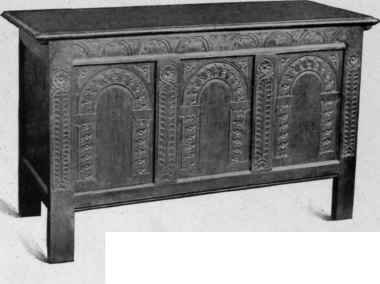
Figure 7. Oak Chest, about 1650.
Figure 7 shows a chest with the characteristic arching and pattern detail used throughout the Elizabethan and Jacobean periods. Burton Agnes Hall, built in 1601, shows this arched carving on the staircase in the great hall. This chest is constructed in the usual manner; the stiles and rails are joined with mortis .ind tenon (all wood-work fastened in this way is spoken of as joined ), and the panda are fitted into the frame. The top rail is carved in .1 lunette design, and on all four stiles are carved laurelling, each surmounted by a rosette. The pilasters and archea on the panel are carved in guilloche design. This cheat is the property of the Hon. and Mrs. Morgan G. Bulkeley, of Hartford, Connecticut.
The chests following the general form of Figure 7 are found in different sizes, some is large is five feet in length, and vary in size from twenty to thirty inches.
The arches are sometimes elaborately carved, sometimes merely indicated by slight tracery. Space between the arches is sometimes carved and sometimes inlaid in foliated designs, and any and all of the foliated border patterns are used to decorate the stiles and rails.
Continue to:


My Books

