


VII. Chairs
Description
This section is from the book "Colonial Furniture In America", by Luke Vincent Lockwood. Also available from Amazon: Colonial Furniture In America.
VII. Chairs
IN no article of furniture is the development of style so easily traced as in chairs, for, although they have no mouldings, handles, or other such earmarks of the period as chests of drawers, each style is distinct, and its variations through gradual changes to a later form are so marked that step by step the evolution can be traced in no uncertain manner. In order, therefore, to emphasise this development it has been thought well in this chapter to show each style in its period and carry it through its various stages until it disappears or is absorbed in a succeeding style. The result of this method will be to interfere with the chronological arrangement, but it is believed that this loss will be more than compensated for by keeping before the reader the trend of development. For, after all, a knowledge of the style brings with it a knowledge of the dates.
If chairs had all been made in a single fashion the task would have been easier, but every country village had its own chair-makers, and often they were so out of touch with the prevailing fashions that their creations formed independent variations of a style which was carried only in the memory, and this is probably the reason that we find the continuance of a style in pieces which date long after the style had become old-fashioned. The date of a chair in a pure style is not a very difficult task to determine, but when a style covers a long period one is often puzzled to know whether to place the piece early or late in that period. No unfailing rule can be given, for the form, decoration, and other elements enter into the problem, but the general proposition can be laid down, other things being equal, that the heavier the frame and the underbracing of a chair in a given style the earlier the piece.
We find chairs mentioned sparsely in the earliest inventories of New England and the South, for they were not yet in common use in England, and the idea of the chair being a seat of honour was still general. "The Gate of Language Unlocked" (sixth edition, printed at London in 1643) has the following: "The chair belongeth to the teacher, the lower seats (fourms & benches) to the learner." Forms were for many years used almost exclusively in the place of chairs, and we constantly find mention of "short form" and "long form and table" in the inventories. These forms were popular in England, and were similar to those Mill found in the dining-halls of some of the English colleges and schools, benches heavily supported, as shown in Figure 402, which is the dining-hall at Christ Church College, Oxford.

Figure 402. Dining-Hall, Christ Church, Oxford.
The short form was a short bench, sometimes called in the inventories joined stool, for the ends of the tables, and the long forms were used on the long sides, those shown in Figure 402 being all long forms. Thus we find at New York, in 1680, "a long table and 2 long formes," one apparently for each side of the table; at Providence, in 1712, occurs the following entry of furniture in the parlour: "a great table, 3 formes, a great chair and 2 cushions," a form for each side and one end, and the chair for the head of the house, with one cushion for the seat of the chair and the other for a footstool.
Figure 403 shows a short form, the property of Mr. H. W. Erving, which is made of American oak. It is strongly built, with legs slightly raked, and the heavy stiles and bracing are mortised and tenoned and fastened with draw-bore pins in the method usually employed in oak pieces. American short forms arc scarce, and the writer has never seen an American long form, although the English ones are fairly common.
In nearly all of the early inventories we find stools and joined stools commonly mentioned; thus, at Plymouth, in 1641, "2 joined stools," and in the same inventory, "4 joyned stools and 2 joined chairs," which recalls a definition in Watts's "Logick," written early in the eighteenth century: "if a chair be defined a seat, for a single person, with a back belonging to it, then a stool is a seat for a single person, without a back." We also find the expression joint or "joynt" stools, which old dictionaries define as folding three-legged stools. Thus at New York, in 1677, we find "the table in the parlor and the five joynt stools"; at Yorktown, in 1658, "3 joint stools"; at Philadelphia, in 1694, "3 old 3 legged stools." A description of such stools is given by Cowper in "The Task":
"Joint stools were then created; on three legs Upborne they stood; three legs upholding firm A massy slab."
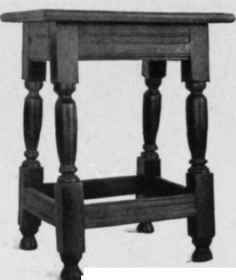
Figure 403. Joined Stool or Short Form, about 1650.

Figure 404. Turned Three-Legged Stool, early seventeenth century.
Figure 404 shows an example of such a three-legged stool as was above described. The turning is in a simple early style, the only break in the surface of each leg being three beads. The stretcher between each pair of legs is joined to the seat with a spindle, and the stool has generally a very substantial yet light appearance. It is in the Bolles Collection in the Metropolitan Museum of Art.
Stools continued to be used all through the seventeenth century, and although abundantly mentioned in the inventories, they are to-day extremely rare and few are to be found in this country.
Figure 405 shows another stool such as are found among the Dutch settlers. The rail is painted and the skirt is cut in two arches with engrailed edges. In the spandrels are carved rosettes. The legs are turned in the vase fashion and the seat finished in the thumb-nail moulding. This stool is in the Bolles Collection.
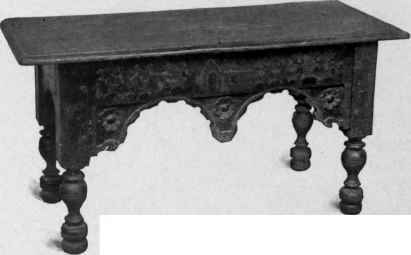
Figure 405. Dutch Stool, about 1650.
In the American colonies down to 1650 there were two distinct styles of chairs in use, both of which had been long in use in England. They were the turned chairs and the wainscot chairs. The turned chairs are subdivided into two kinds, the spindle back and the slat back.
Continue to:


My Books

