


VI. Looking-Glasses. Part 13
Description
This section is from the book "Colonial Furniture In America", by Luke Vincent Lockwood. Also available from Amazon: Colonial Furniture In America.
VI. Looking-Glasses. Part 13
Figure 393 shows another style of small looking-glass of the same period. Quite a number of looking-glasses like this one and the one shown in the next figure arc found in this country, and they appear to be of European make and wen- probably inexpensive looking-glasses which were brought over by the seacaptains. At the top of this looking-glass frame are C scrolls within which is a painting of a lady.

Figure 393. Small Looking-Glass with painting at top, 1790-1800.
Figure 394 shows another of these looking-glasses at the top of which are carved in wood, and coloured, flowers, leaves, and fruit, and at the base are C scrolls and flowers. These frames quite closely resemble in form those shown in Figures 328, 363, and following figures. Both of these two last-described looking-glasses are in the Bolles Collection, owned by the Metropolitan Museum of Art.

Figure 394. Small Looking-Glass with carved and coloured frame, 1790-1800.
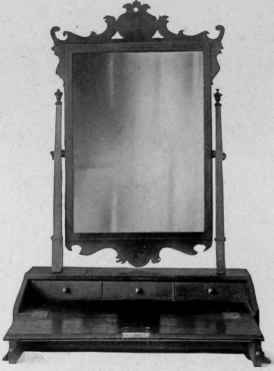
Figure 395. Dressing-Glass, 1780-90.
It was the fashion throughout the eighteenth century to place upon dressing-tables or low chests of drawers dressing-glasses attached to two uprights which enabled them to swing back and forth. The earliest example we have found in this country is shown on the knee-hole dressing-table shown in Figure 113, which is practically the same as that in the middle room on the top floor of the doll house shown in Figure 1.
Figure 395 shows a dressing-glass the top and bottom of the frame of which is in cut-work, and the stand has a small slant-top desk containing three drawers with a drawer below. At the centre of the top and bottom, around the glass, on the uprights and desk front are inlay. A dressing-glass very similar to this, except without inlay, is shown in a woodcut in an advertisement of Weyman & Carne,of Queen Street, Charleston, in the copy of the South Carolina Gazette dated Octobei 31, 1765. This piece, because of the character of inlay, appears to be of a little later date.
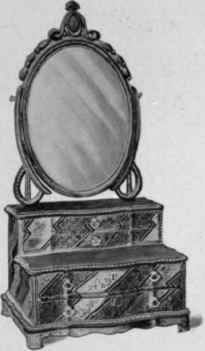
Figure 396. Dressing -Glass, about 1790.
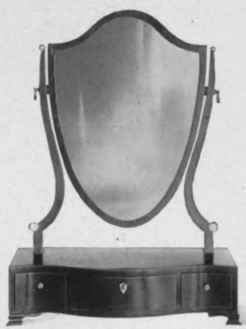
Figure 397. Dressing-Glass, 1785-95.
A japanned dressing-glass is shown in Figure 396. This piece is of Chinese-origin, and quite a number were imported to this country just prior to 1800. In the base are two long drawers below a small shelf and then two more drawers.
During the Hepplewhite and Sheraton period these dressing-glasses became very plentiful in this country, and by far the greater part of those found here belong to that period.
Figure 397 shows a typical dressing-glass of the Hepplewhite period. The frame is of mahogany and is shield-shaped. The lower section has a serpentine front with three drawers and stands on small bracket feet. This dressing-glass is the property of the Tiffany Studios of New York.
Figure 398 shows another glass of the same period in the same collection. The frame of the glass is oval, placed horizontally, and the base contains three drawers, the outer ones with a convex curve and the inner one with a long, con cave curve. The piece stands on short stump feet.
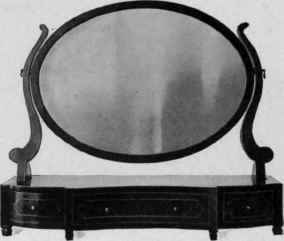
Figure 398. Dressing-Glass, 1785-95.

Figure 399. Dressing-Glass, 1785-95.
Another dressing-glass in the same collection is shown in Figure 399. The frame is oval, placed vertically. The base is serpentine and the fronts of the drawers are decorated with parallel fluting. The piece stands on small ogee bracket feet.
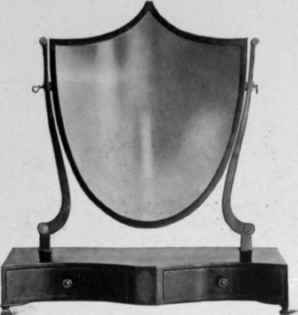
Figure 400. Dressing-Glass, 1785-95.
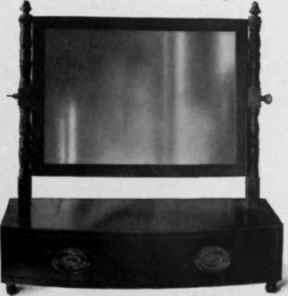
Figure 401. Dressing-Glass, 1790-1800.
Still another shape of the dressing-glass of this period in the same collection is shown in Figure 400. It is shield-shaped, coming to a point at the centre of the top instead of having a serpentine curve at the top. In the base are two drawers with concave fronts and the piece stands on small ogee bracket feet.
Figure 401 shows another of these dressing-glasses which is in a little later style and of which many are found in this country. The frame of the glass is rectangular and the base has two drawers with swelled fronts. The handles are of the oval variety and the piece stands on small ogee bracket feet.
Continue to:


My Books

