


V. Desks And Scrutoires. Part 12
Description
This section is from the book "Colonial Furniture In America", by Luke Vincent Lockwood. Also available from Amazon: Colonial Furniture In America.
V. Desks And Scrutoires. Part 12
All of these pieces, with the exception of the bombe feature, are very similar to early Chippendale designs, and may have been made by the same cabinetmaker, who undoubtedly was familiar with Chippendale's book.
Figure 282 shows a cabinet-top scrutoire from the Pendleton Collection, belonging to the Rhode Island School of Design, which represents the Philadelphia type and has many of the characteristics of the Philadelphia high chests of drawers (Figure 105). The top is scrolled and hooded, the inner ends of the scrolls being finished with well-carved rosettes. The mouldings are of the usual type in these pieces, a fillet, a cyma recta, a fillet, a cove, and a small quarter-round. Above the doors is applied a shell carving with foliations and flowers similar to that shown in the figure above mentioned. Urns and flames finish the ends and centre. The two doors have semicircular tops and the mouldings about the panels are carved in leaf design. The lower carcass is plain with four drawers, and the base mouldings are the usual cove, fillet, quarter-round, and fillet. The piece stands on four bird's claw and ball feet.
Figure 283 shows an interesting cabinet-top scrutoire, in the collection of Mr. George S. Palmer, which closely resembles some of the Chippendale designs. The top is finished with a scroll pediment, the inner ends of the scrolls being finished with rosettes having outstanding foliations. The mouldings are a fillet, a cyma recta, a fillet, a wide fillet or corona, soffit, a fillet, a quarter-round, a fillet, a dentil moulding,a fillet, a cove, and an astragal. Below this is a Chinese fret frieze and then an astragal and a fillet. About the two panel doors is a Chinese fret <>l the same design, and below the doors, separated by an astragal, is another Chinese fret in the same design. In the lower carcass is the slant-top desk, and below that is onedrawer below which are two doors concealing sliding shelves. On the doors are planted carved scrolls and leaves in a characteristic Chippendale pattern. The base moulding is the usual Chippendale one, a cyma reversa and a fillet, and the piece stands on carved ogee bracket feet. Were it not for the fact that the interior of this piece is finished with American pine, we should pronounce it English of the Chippendale school.

Slant-Top Scrutoire with cabinet top, 1760-75.

Slant-Top Scrutoire with cabinet top, 1760 75.
Before leaving the subject of cabinet-top scrutoires, it has been thought well to show two examples of English scrutoires of the same period by way of comparison.

Figure 284. Slant-Top Scrutoire with bookcase top, 1750-70.
Figure 284 is a beautiful example from the Pendleton Collection. It has a scrolled pediment, the inner ends of the scrolls being finished with beautifully carved acanthus-leaf rosettes finer than any we have found in this country. The mouldings are a quarter-round, a fillet, a cove, a pearl bead moulding, a wide fillet or corona, soffit, a small fillet, a quarter-round, a fillet, a dentil moulding, a fillet, a quarter-round, and a fillet. The frieze is plain and below it is a cove, a fillet, and a cyma reversa carved in a leaf design. Around the outer edges of the glass doors is applied a beautifully carved design of foliated scrolls and flowers. On the upper edge of the frame of the lower carcass is a cyma reversa carved in a leaf design, and below the top drawer is a small torus or astragal carved in a similar design. The base moulding is a cyma reversa carved in a flowing foliated design and a fillet. The piece stands on well-carved ogee bracket feet. The handles are silvered.

Slant-Top Scrutoire with bookcase top, 1750-70.
Figure 285 shows another English cabinet-top scrutoire which is the property of Mr. Marsden J. Perry, of Providence. The top is finished with a scroll pediment with acanthus-leaf foliations extending over the entire scrolls. Beneath the scrolls is a lattice design. The mouldings are a fillet, a cyma recta, a small fillet, a large fillet or corona, soffit, a small fillet, a quarter-round, a fillet, a dentil moulding, a fillet, and a small cove. The frieze is ornamented with a beautiful fret below which is an astragal. Each door has eight panes of glass and the frame about them is carved in a leaf design. Below the upper drawer in the lower carcass is a small torus or astragal carved in a leaf design. The base is particularly beautiful. There is a small plain torus moulding, and the skirt is enriched with a finely carved rococo scroll design. The piece stands on scroll feet with an acanthus leaf projecting from the outer surfaces.
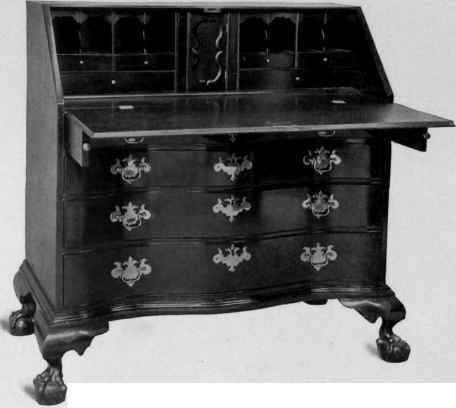
Figure 286. Serpentine-Front, Slant-Top Scrutoire, 1765-80.
A form of scrutoire quite common in New England is shown in Figure 286. The front of the drawers is in the serpentine curve raised at the centre and depressed at the two ends. The base mouldings are a cyma reversa and a fillet, and the piece stands on bird's claw and ball feet. These pieces are found made of mahogany, cherry, and maple, and occasionally have cabinet tops. The table of the desk part is usually a little higher than in any other forms of scrutoire. This piece is in the Bolles Collection.
Figure 287 shows another form in which these pieces arc found. The drawer front is in a reverse serpentine curve; that is, with the centre depressed and the two ends swelled. The base moulding is the cove, fillet, quarter-round, and wide fillet, and the piece stands on bird's claw and ball feet. It is the property of Mr. William Meggat, of Wethersfield, Connecticut.

Reversed Serpentine-Front Scrutoire, 1765 - 80.
Continue to:


My Books

