


V. Desks And Scrutoires
Description
This section is from the book "Colonial Furniture In America", by Luke Vincent Lockwood. Also available from Amazon: Colonial Furniture In America.
V. Desks And Scrutoires
DESKS, in one form or another, have been known from the eighth century.
In his "Natural History," Bacon makes the following remark: "Some trees are best for planchers, as deal; some for tables, cupboards and desks, as walnut"; showing that at the beginning of the seventeenth century desks were apparently in common use in England.
The word desk, in the early inventories in England and this country, had a different meaning from that now given to it. It meant a box which held the writing materials, the lid of which was sometimes used as a smooth surface upon which to write. These early desks were inventoried at very low figures, anywhere from is. to £1. The highest prices we have found are: At Salem, in 1647, "His deske £1"; one at 30s. at New York, in 1691; a walnut desk at Philadelphia, in 1705, 30s.; and at the same place, in 1706, "a walnut tree deske inlaid £6," which is so far above the highest valuations elsewhere found that if it were not for the early date, and the fact that a distinction was made all through these years between desks and scrutoires, we should believe it to have been a scrutoire and not a desk-box.
Most of the desk-boxes were undoubtedly perfectly plain deal, maple, oak, or walnut boxes, and it is safe to assume that they have been lost because not considered worthy of care. Consequently, nearly all that are now to be found are carved more or less, and some so beautifully that it is difficult to reconcile the low inventory valuation with the pieces.
These boxes or desks were apparently used for two purposes: one as a place in which to keep books, more especially the Bible, and the other for valuable papers and writing materials.
In the early days, when the Bible was a treasure possessed by but few, it was kept under lock and key in a box of this kind, often beautifully carved, to be taken out and read at a gathering of the neighbours. By some these boxes are called "Bible-boxes" to this day. Thus at Philadelphia, in 1726, we find "Escritore, small table, deske Holy Bible £5 10s," the desk very likely being on the table and the Bible either in or on the desk. Again, in the same place, the same year, "a book desk 26s."
Some of these boxes were carved on the front, sides, and top; sometimes the top was flat and sometimes slanted. We are inclined to believe that the boxes with carved or steeply slanted tops were, as a rule, Bible-boxes, the slanting top being of a convenient slope to hold the book while it was being read, while the flat-top or slightly slanted ones, uncarved on top, were for desks.
The boxes vary in size from seventeen to thirty inches in length, and the inside, especially in those intended for desks, often contained the small till or compartment so frequently found in the chests, which was doubtless intended to hold the writing materials, and sometimes they contained pigeon-holes and sometimes a shelf running the long way of the box. This style of box is sometimes spoken of in the inventories as a "paper-box," as recorded at New York in 1691,"a small black walnutt paper box," and in 1702, "In the writing closett 1 old desk for papers."
The first mention in the inventories of anything to do with writing is at Plymouth in 1633, which is the earliest year for which inventories are given in this country: "A writing table of glass 4d." This word here probably means tablet, and it was, we believe, a plate of glass, perhaps framed, which was laid on the lap or table to obtain a perfectly smooth surface, in much the same way as is sometimes done to-day; and in Philadelphia, in 1687, appears "A writing slab & frame 8d," clearly indicating such a piece.
Probably the first mention of a desk in this country is that at Plymouth, in 1644, " 1 little desk is," which modest price would lead us to suppose it was but a pine box. Again, at Boston, in 1676, "2 cedar desks i£"; and in New York, in 1689, "one desk 16s"; and in 1691, "one desk or box 30s."
These pieces are not constructed like the chests with stiles and rails, but the sides are composed of slabs of wood, occasionally dovetailed at the corners, but generally simply nailed together. The bottom is also nailed and the top is usually of pine and made like chest tops with the thumb-nail moulding and with the staple hinges.
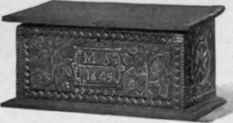
Figure 224 is a good example of a Bible-box in the possession of the Connecticut Historical Society. It is made of English oak throughout and is, therefore, probably of English make. It bears the inscription "M. S. 1649" on its front panel. The carving is of a very early pattern, and the circles on the sides and top suggest a design popular in Holland early in the century, while that on the front suggests an English design first appearing in James I's reign.
Figure 224. Bible-Box, 1649.
Figure 225 shows a desk-box, the property of Mr. H. W. Erving, of Hartford. The lid is slanted and fastens to a straight strip forming a part of the top. On the ends are carved flowers and leaves suggestive of the outer panels of the Connecticut chest (Figure 18), and a rosette, and the front design is two groups of two branches of flowers and leaves springing from a single stem. Between the two groups are rosettes.
A well-made small desk-box is shown in Figure 226. The front and sides are decorated with foliated scrolls, and at the centre of the front is an entwined cruciform scroll. The edges are notched as is usual. This box is the property of Mr. William J. Hickmott, of Hartford.

Figure 227. Desk-Box, 1650-75.
Figure 227 shows a box from the Bolles Collection. The front and sides are carved in a guilloche pattern in series of three circles with rosettes in the centre and foliations about them. There is a border of scratch carving above and below. The pattern quite closely resembles that found on the drawer fronts of the chest (Figure 17).
Continue to:


My Books

