


III. Chests Of Drawers. Part 2
Description
This section is from the book "Colonial Furniture In America", by Luke Vincent Lockwood. Also available from Amazon: Colonial Furniture In America.
III. Chests Of Drawers. Part 2
Figure 45 shows a chest of drawers, the property of the writer. The top drawer is divided into two plain rectangular panels with heavy moulded edges. The next drawer has two octagonal panels with a rectangular panel between, and the designs repeat on the lower drawers. Between each two panels are a pair of applied split spindles, and four pairs of split spindles are applied on each stile. The rails between each drawer and at the top and bottom arc moulded. The front feet are ball-turned and the rear feet are straight.
Figure 46 shows a chest of drawers which quite strongly suggests the chest shown in Figure 25. The piece is made in two parts and separates below the second drawer. The top and third drawers have narrow rectangular panels with chamfered corners, while the second and fourth drawers have heavy raised bevelled panels with the surface in rectangular indented panels. The frame is of oak and the top of Virginia walnut. The centers of all the panels are of rosewood and the mouldings are red cedar. The moulding about the bottom is also red cedar. The resulting contrast of woods is very pleasing. The backs and sides of the drawen are of American oak, which denotes its origin. I he ball feet are in the type found on the desks and other pieces of the period. This chest of drawers is the property of Mr. H. W. Erving. Such a piece as this was, perhaps, described at York in 1696 as "A chest of draws with balls at the feet £l. 16s."
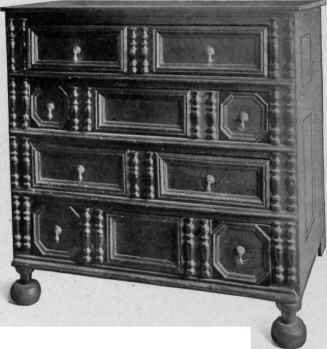
Figure 45. Oak Chest of Drawers, 1675-1700.
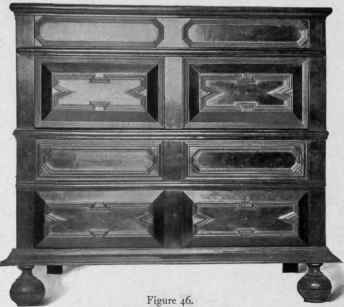
Panelled Chest of Drawers, 1675-1700.
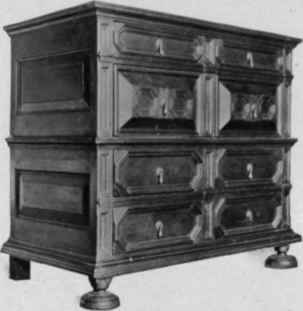
Figure 47. Panelled Chest of Drawers, 1675-1700.
Figure 47 shows another chest of drawers quite similar to the foregoing. The frame is of oak and in two parts, and the mouldings and the drawer fronts are of walnut, except the second drawer, which has a front of pine with walnut panels and mouldings. The second drawer has a raised bevelled panel on the surfaces of which are four octagonal panels. The other drawers have rectangular panels with chamfered corners. On the stiles and separating the panels of the drawer fronts are sunken panels and on the ends are two bevelled panels. At the top is a moulding quite suggestive of the late style when chests of drawers were elevated on frames, and consists of a fillet and a cyma reversa, and at the base the moulding is a cavetto, a fillet, a quarter-round, and a fillet. The feet are in the flat onion turning and the rear legs are the extension of the stiles. The handles are of the drop type with circular plates. This piece is the prop-erty of Mr. Hollis French, of Boston.
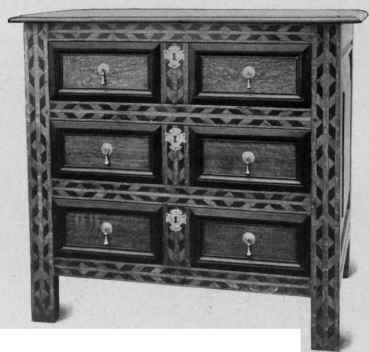
Figure 48. Inlaid Chest of Drawers, 1690-1700.
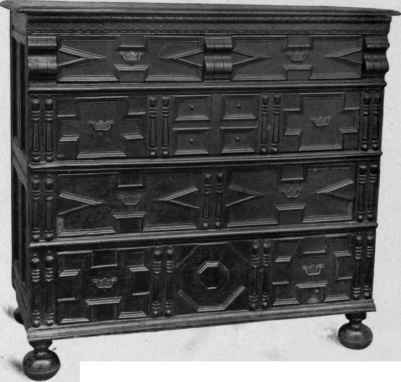
Figure 49. Panelled Chest of Drawers, 1675-1700.
Figure 48 shows an inlaid chest of drawen in the Bolles Collection. The rails and stiles and the section separating the panels on the drawen are ornamented with hands of broad inlay set diagonally and separated by a Straight strip of oak. The edges of the panelx are bevelled. The handles are of the drop type with round plates.
Figure 49 shows a very fine panelled cheat of drawers in the Bolles Collection which quite closely reseinhles the lower portion of some of the press cupboards of the period. (See Figure 169.) Just below the top is a quarter-round moulding cut in diagonal and vertical lines, and below is a carved serrated edge with small stars. Well-proportioned corbels, three in number, are on the stiles and at the centre of the top drawer. The panelling is very elaborate; the top and third drawers are in the design of an indented rectangle with blocks inserted at the centre of the long sides; the second drawer has three panels, the outer ones with square blocks inserted in the four corners and the centre one with four small rectangular panels. The lower drawer has also three panels. The outer ones have blocks inserted at the centre of the sides of the rectangle, while the centre one is an octagon with a small octagonal panel inside. On the stiles and separating the panels on the drawers below the top ones are applied split spindles. The piece stands on four ball feet.
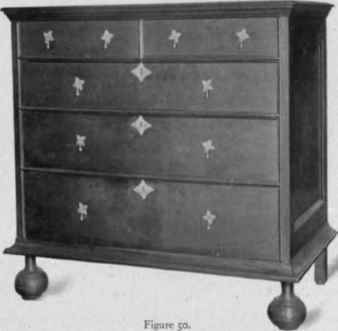
Walnut Chest of Drawers, 1690-1700.
Figure 50 shows the latest development of the chest of drawers which foreshadowed the upper section of the six-legged type. (See Figure 54.) In fact, except for the mouldings, it is the same. The piece is made of walnut throughout. There are two short drawers at the top, and below are three long ones, all on bottom runners. A single-arch moulding is on the frame about the drawers, and the handles are of the drop variety. The top is finished with a thumb-nail moulding, and below is the usual moulding found on the earliest form of the six-legged pieces, a fillet, a cyma reversa, and an astragal. At the bottom is a flaring moulding consisting of an astragal, a cavetto, a narrow and a broad fillet. The piece stands on ball feet at the front and the rear feet on extensions of the stiles. It is the property of Luke Burnell Lockwood.
We now come to the consideration of the high chests of drawers commonly known as high-boys, though this name is never used in the records and probably was given in derision after their appearance had become grotesque to eyes trained to other fashions.
The evolution of the high-boy from the chest of drawers was just as natural as the development of the chest of drawers from the chest. The lower drawers could only be reached by bending, and some of the chests of drawers had been made on tall legs probably for that very reason. (See Figure 43.) It must have become apparent that raising the chests of drawers from the floor on a table or frame would place all of the drawers within easy reach, and so probably the style arose. It was but a step to utilise the space in the upper part of the frame for drawers and the perfected style of the early high-boy was born. The chest of drawers having been raised to such a height, the top could not be conveniently utilised for toilet purposes. A smaller piece which matched the lower or table part of the high-boy was made and the low-boy came into existence. The style apparently at once became popular and for good reason, for its convenience and appearance left nothing to be desired.
Continue to:


My Books

