


III. Chests Of Drawers. Part 12
Description
This section is from the book "Colonial Furniture In America", by Luke Vincent Lockwood. Also available from Amazon: Colonial Furniture In America.
III. Chests Of Drawers. Part 12
Figure 105 shows another high chest of drawers quite similar to the preceding one, which is the property of Mr. William W. Smith, of Hartford. The cornice mouldings and the flame finials are in the characteristic form, and at the centre is an ornament composed of a rococo cartouche. In place of the shell drawer at the top is applied a carved shell with streamers, filling the space above the three small drawers. The corners are finished with the usual quarter-fluted columns. The edge of the skirt is carved in a foliated scroll design and at the centre is a shell. Acanthus leaves are carved on the legs, which terminate in bird's claw and ball feet.
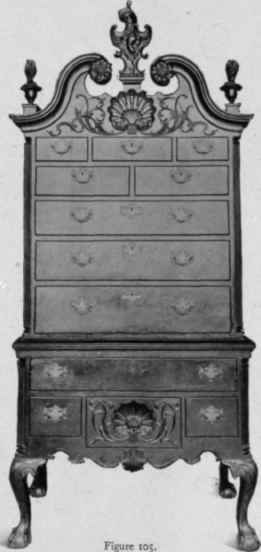
Scroll-Top High Chest of Drawers, 1760-75.
Figure 106 shows the second type of these high chests of drawers. It will be seen that it has a pediment top and the mouldings are a trifle lighter. They consist of a narrow fillet, a cyma recta, an astragal, a fillet, a large fillet, a short fillet, a quarter-round, a fillet, a dentil moulding, a fillet, a cove, and two astragals and fillets bordering a broad applied fret. These mouldings to the fret are repeated in the scroll top. It will be seen that the top also differs from the other and is not hooded. Rosettes finish the scrolls, and at the centre of the top is a cartouche similar but less elaborate than that shown in the preceding figure. A lattice finishes between the scrolls, another characteristic of the type. Upon the upper centre drawer is carved a shell without streamers. A shell in the same design is repeated in the lower outer drawers at the bottom, and at the centre of the skirt is carved a large shell. The corners of the stiles of the upper part have square recessed edges and quarter-fluted columns are inserted. The knees are carved in a shell and pendent flower design and the legs terminate in bird's claw and ball feet. The handles are of the open-work pattern. This piece is in the Pendleton Collection, owned by the Rhode Island School of Design, Providence, Rhode Island.
Figure 107 shows another high chest of drawers in the second type which is the property of Mr. George S. Palmer. The mouldings of the pediment are less in number than those in the preceding piece and consist of a fillet, a cyma recta, a small fillet, a large fillet, a small fillet, a dentil moulding, a short cove, a fret, an astragal, and a fillet. The fret does not extend on the sides. The rosettes are beautifully carved with foliated streamers extending above the top, and the lattice under the scrolls is foliated. At the centre is a carved bust and on each end is a draped urn in pure Chippendale style. The edges of the stiles are recessed, and a Corinthian capital and quarter-round, with surface carved in foliated scrolls, are inserted. The fret design is carved at the top of the frame. The lower drawer is beautifully carved in a design of foliated scrolls, in the centre of which are two swans, and the edges of the skirt are carved in rococo foliations very suggestive of Chippendale designs. On the knees are carved foliated scrolls and the legs terminate in bird's claw and ball feet. The handles are missing, but they were probably of the large willow type.
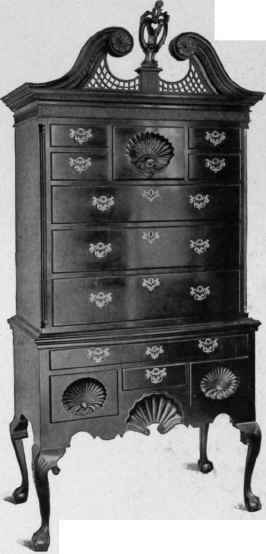
Figure 106. Scroll-Top High Chest of Drawers, 1760-75.

Figure 107. Scroll-Top High Chest of Drawers, 1760-75.
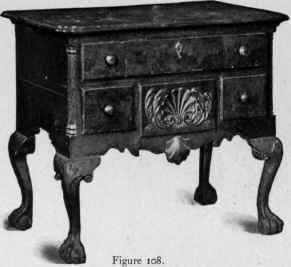
Dressing-Table, 1760-75.
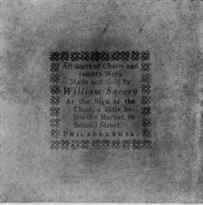
Figure 108a. Advertisement in drawer of preceding figure.
It is a surprise to many that beautiful pieces, such as these which are described and the dressing-tables following, could have been made in this country. They were certainly the work of cabinet-makers of the first rank, and not only are such pieces found, but chests on chests, desks, and tables with piecrust edges of the same quality are to be found, all traceable to Philadelphia. Who the cabinet-maker was, or whether there was more than one, is not known, but a dressing-table of this type has been found (Figure 108) in which is pasted an advertisement of the maker (Figure 108a), which reads as follows: "William Savery, at the Sign of the Chair, near the market on Second Street." He, at least, was one of these cabinet-makers.
This last-mentioned dressing-table is the property of Mr. John J.Gilbert, of Baltimore. The corners of the top are cut in the usual curves. The ends are recessed, with quarter-fluted columns inserted, and on the knees and centre of the skirt are carved shells. The centre drawer has the usual shell, but the streamers are more feathery than usual.
Figure 109 shows a dressing-table, a companion piece to Figure 102. On the lower drawer are the characteristic shell streamers and the skirt is cut in scrolls. At the centre is a carved shell. The same design is repeated on the knees. The edge of the top is moulded in a cove, a fillet, and a quarter-round. The edges are recessed and quarter-round fluted columns inserted. This piece is the property of Mr. Richard A. Canfield.
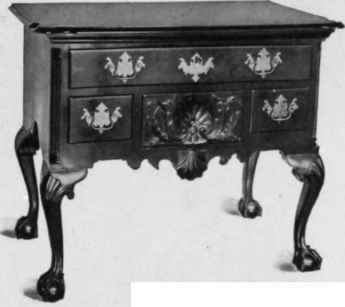
Figure 109. Dressing-Table, 1760-7 5.
Figure no shows another dressing-table, the property of the writer. The top is moulded in the usual manner, described in the preceding figure, and below the top is a moulding consisting of a cyma recta and quarter-round; the outer edges of the stiles are chamfered and fluted. The skirt is elaborately cut and a shell is carved at the centre. There is the usual shell and streamer drawer, and on the knees is carved an acanthus-leaf design extending well down the legs, which terminate in bird's claw and ball feet. This piece is made of Virginia walnut.
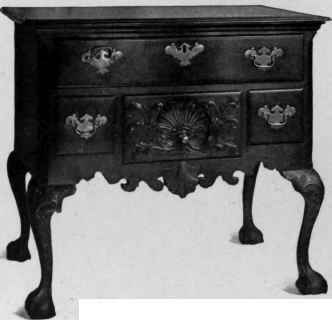
Figure 110. Dressing-Table, 1760-75.
Continue to:


My Books

