


III. Chests Of Drawers. Part 10
Description
This section is from the book "Colonial Furniture In America", by Luke Vincent Lockwood. Also available from Amazon: Colonial Furniture In America.
III. Chests Of Drawers. Part 10
Figure 92 shows the regular type of a scroll-top high chest of drawers which is one of those purchased by Dr. Ezekiel Porter in 1730, above referred to. The cornice is composed of the following mouldings: A quarter-round, a fillet, a cyma recta, a fillet, a large cove, an astragal, a fillet, and a small cove. At the ends and the centre of the top are the original turned finials. At the front of the top and lower drawer are carved the rising-sun pattern. All of the drawers overlap and-the skirt is cut in cyma curves separated by straight lines. The handles are in the willow pattern.

Scroll-Top High Chest of Drawers, 1730.
Figure 93 shows a high chest of drawers and its companion dressing-table of walnut, the property of Mr. G. W. Walker, of New York. The cornice is in the next later pattern than that shown in the preceding figure, consisting of a quarter-round, a fillet, a large cove, an astragal, a fillet, and a small cove. The turned flame finials are original and unusually fine. The outer drawers at the top are curved with the cornice, and the centre one is carved in the rising-sun pattern, as is also the centre drawer at the bottom. The skirt is cut in two quarter-rounds separated by a straight line, the same as shown in Figure 86. The drop pendants on the dressing-table are original. The handles are in the willow pattern.


Figure 93. Scroll-Top High Chest of Drawers and Dressing-Table, 1725-50.
Figure 94 shows a scroll-top high chest of drawers in the Bolles Collection. It is made of walnut veneer, and a border of checkered inlay is on the drawers and a simple band of inlay outlines the top and bottom. On either side of the top drawer is inlaid in light and dark woods a cruciform ornament. The piece is very beautifully made. The cornice consists of the usual quarter-round, a fillet, a large cove, an astragal, a fillet, and a small cove, and each stile is finished with a fluted pilaster which carries through the cornice and forms the base for the acroterium.

Figure 94. Scroll-Top High Chest of Drawers, 1725-50.

Figure 95. Scroll-Top High Chest of Drawers, 1725-50.
The finials are urn-shaped with spiral flames. The centre drawers at the top and bottom are both carved in a well-executed shell pattern such as appears on the mirrors of the period. The skirt is cut in the same design as that shown in Figure 93.
Figure 95 shows another scroll-top chest of drawers in the same collection which in general appearance is similar. The cornice and pilasters and the cutting of the skirt are the same as in Figure 94. The piece, however, is not veneered or inlaid. The drawers, instead of overlapping, are flush, with a bead moulding finishing the frame about them, and the top and lower centre drawers arc carved in the rising-sun pattern. The finials are urns with long spiral flames.
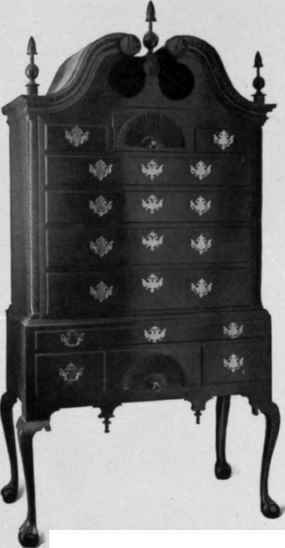
Figure 96. Scroll-Top High Chest of Drawers, 1750-60.
Figure 96 shows a scroll-top high chest of drawers, the property of Mr. H. W. Erving. The cornice mouldings are unusual, consisting of a cyma rcversa, a dentil moulding, a cove, an astragal, a fillet, and a small cove. On the inner ends of the scroll and on the centre acroterium are carved rosettes. The corners have square recessed edges and quarter-spiral columns are inserted. The drawers at the centre of the top and bottom are carved in a fan pattern. The legs terminate in bird's claw and ball feet and acanthus leaves are carved on the knees. The skirt is cut in the design of quarter circles separated by straight lines.
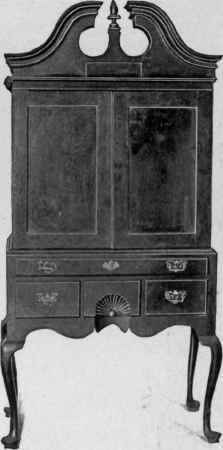
Figure 97. Cupboard on Frame, 1730-50.
Figure 97 shows an interesting cupboard on frame which was part of the purchase of Dr. Ezekiel Porter about 1730, above referred to. The cornice has the same mouldings as those shown in Figure 93, and a narrow moulding extends horizontally across the piece about three inches below the cornice, giving the suggestion of a pediment. A small drawer is in the cornice. The skirt is cut in two long cyma curves and the rising-sun pattern is carved on the centre drawer.
A low-boy in the same collection, all of which belonged to the late Miss Bidwell, of Wethersfield, Connecticut, is shown in Figure 98. There are four drawers, the centre lower one ornamented in a shell pattern, and the skirt is cut in two long cyma curves with two small cyma curves in the centre. The skirts of the last two pieces are so cut that no pendent drops are required, and thus the last suggestion of the six-legged high-boy disappeared.
A crudely made but rather interesting scroll-top high chest of drawers is shown in Figure 99. The cornice is composed of a quarter-round, a fillet, a cyma recta, a fillet, a large cove, an astragal, a fillet, and a small cove. Large, coarsely carved rosettes finish the inner ends of the scrolls. On the stiles and front are carved scrolls and other designs. On the lower drawer is carved a shell pattern with a double edge; the legs are bandy, terminating in bird's claw and ball feet, and the knees are slightly carved.
An interesting block-front high chest of drawers, the property of Mr. G. G. Ernst, South Norwalk, Connecticut, is shown in Figure 100. A very heavy and unusual cornice finishes the top, composed of a fillet, cyma recta, fillet, cove, wide fillet or frieze, cove, cyma reversa, fillet, large cove, astragal, fillet, and small cove. The large cove conceals a drawer. The blocking carries through the cornice and the cornice is broken at the centre by a carved shell. On the stiles of the upper part are fluted pilasters and the stiles of the lower part are also fluted. A double-arch moulding finishes the frame about the drawers. The upper section has two raised blockings and the frame part has three with six small drawers. The skirt is curved in the same design as found on the early bandy-legged type. (See Figure 86.) At the centre is a carved shell. The legs terminate in bird's claw and ball feet. Block-front high chests of drawers are very rare, and this example is the earliest block-front piece of any description that has come under the writer's observation. It is a puzzling piece to date, but considering its various features it can safely be placed about 1750.
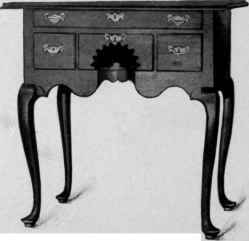
Figure 98. Dressing-Table, 1730-50.


Figure 100. Block-Front High Chest of Drawers, about 1750.
Continue to:


My Books

