


III. Chests Of Drawers. Part 11
Description
This section is from the book "Colonial Furniture In America", by Luke Vincent Lockwood. Also available from Amazon: Colonial Furniture In America.
III. Chests Of Drawers. Part 11
Figure 101 shows a block-front dressing-table which is the property of Mr. A. W. Wellington, of Boston. The top is cut in the shape of the block-front chests of drawers. There arc six small drawers with overlapping edges, and on the skirt, which is also blocked, are three handles to carry out the appearance of drawers. The skirt is cut in the same pattern as in the preceding figure. The bandy legs terminate in club feet with wide shoes.
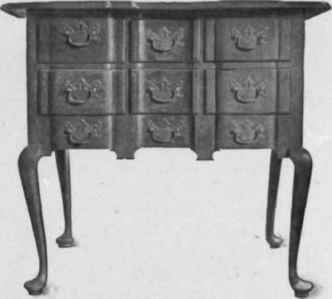
Figure 101. Block-Front Dressing-Table, about 1750.
Block-front pieces became popular during the third quarter of the eighteenth century and appear to have been of American origin, or if not at least they were more developed here than elsewhere. The drawer fronts were cut from a large piece of wood of sufficient thickness to take the convex and concave surfaces. The blocking was never applied. They are most commonly found in desks or chests on chests, and the vast majority have come from New England. Many of the simpler varieties have come from New Hampshire, and the best examples come from Rhode Island. This subject will be more fully discussed a little later in this chapter.
Between 1760 and 1770 the form of the high chest of drawers became much more ornate, Chippendale motifs being worked into the simpler forms of the earlier types. This development was also American, and the late high chests of drawers have no counterpart in any other country. The best of these pieces came from Philadelphia, and the type is so pronounced that they are commonly called "Philadelphia high-boys and low-boys." They are found in two types, one where the front carries into the scroll cornice and the other where the cornice is separated from the front by a moulding, making a pediment.
Figure 102 shows a very good example of the first style. The chief characteristics are the shell carving on the lower centre drawer, which was usually repeated on the upper drawer under the cornice. The shell is carved into the surface, while the scroll foliations, as a rule, are applied, or partly applied and partly carved. There are usually three small drawers at the top, two below that, and then three long drawers. Another characteristic is the beautifully carved rosettes finishing the inner edge of the scrolls. The legs are shorter and the enclosed part is higher than in the New England pieces. These pieces are very tall and represent the last development of the high chest of drawers. The cornice of this piece is also characteristic of the first type and is composed of a fillet, a cyma recta, a fillet, a large cove, and a quarter-round. The corners have square recessed edges and quarter-fluted columns are inserted. The uppermost and lower drawers are carved in shell pattern with foliated streamers. It is a little unusual to have the carved drawer at the top above the three short drawers. It is usually the middle drawer of the three top ones, as in the next figure. The finials are urns with flames. The skirt is cut in scrolls with a shell at the centre, and a carved shell is on the knees. The bandy legs terminate in bird's claw and ball feet. This piece is the property of Mr. Richard A. Canfield.
Figure 103 shows another high chest of drawers of the first type which is in the Pendleton Collection, owned by the Rhode Island School of Design. The cornice is composed of the same mouldings as appear in the preceding figures but the top is not hooded. Well-carved rosettes finish the inner ends of the scrolls and the finials are the usual urn and flame found on these pieces. The corners have square recessed edges and quarter-fluted columns are inserted. The shell drawer at the top is inserted between two small drawers in the manner most commonly found. The mouldings separating the two carcasses are a fillet, cyma reversa, fillet, torus, fillet, and cove. Occasionally a cove, fillet, and quarter-round are substituted for the cyma reversa, as in the next figure. At the centre of the skirt is carved a shell and on the knees are carved acanthus leaves. The legs terminate in bird's claw and ball feet.
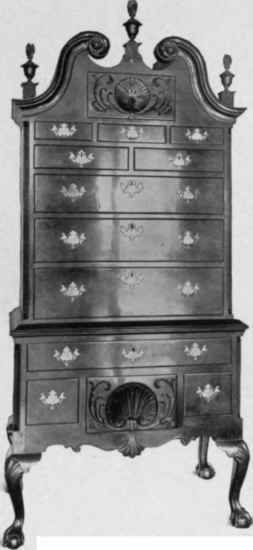
Figure 102. Scroll-Top High Chest of Drawers, 1760-75.

Figure 103. Scroll-Top High Chest of Drawers, 1760-75.
Figure 104 shows a slight variation of this type. The cornice is composed of the usual fillet, cyma recta, fillet, cove, and quarter-round. The rosettes are beautifully executed five-petal flowers. The end finials are urns with flames, while at the centre is a foliated and rococo cartouche, showing very strongly the Chippendale influence, and probably suggested by the cartouche which is over the pulpit at Saint Peter's Church, Philadelphia. The shell-carved drawer at the top is replaced by beautifully carved foliated scrolls applied. The corners have square recessed edges and quarter-fluted columns are inserted. The lower drawer in the frame is carved in the characteristic shell design with streamers, and the knees are Carved in acanthus-leaf design extending well down the legs. The legs terminate in bird's claw and ball feet. This piece is made of fine-grain mahogany. The handles are of the large willow type. It is the property of Mr. George S. Palmer, of New London.

Scroll-Top High Chest of Drawers, 1760-75.
Continue to:


My Books

