


III. Chests Of Drawers. Part 13
Description
This section is from the book "Colonial Furniture In America", by Luke Vincent Lockwood. Also available from Amazon: Colonial Furniture In America.
III. Chests Of Drawers. Part 13
Figure 111 shows one of the must elaborately carved dressing-tables that has been found which belongs to the Pendleton Collection. The top is moulded in the usual way, and below is a fillet, a cove, and two astragals separated by an applied carved fret of scrolls and shells extending across the front and sides. The outer corners of the stiles have square recessed edges, and quarter-round columns with surfaces carved in sprays of leaves are inserted. The edge of the skirt is carved with foliated scrolls and at the centre is a group of flowers. The knees are carved in an acanthus-leaf design. The handles are in the open-work pattern.
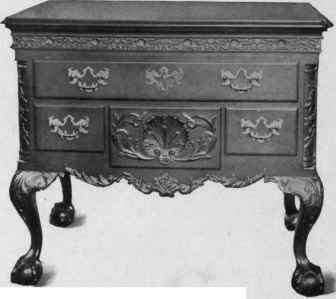
Figure 111. Dressing-Table, 1760-75.
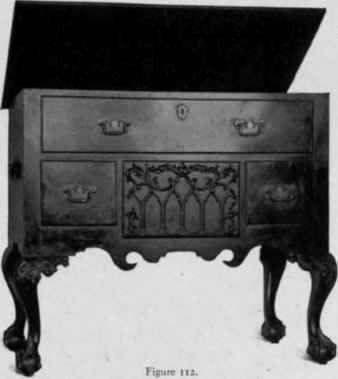
Cellarette in Form of Dressing-Table, 1760-75.
A very unusual piece in the form of a dressing-table is shown in Figure 112, the property of Mr. George F. Foster, of Hartford. It will be seen that the drawers are blind but have overlapping edges to aid the deception, and the upper section is a chest with a lid. It was apparently intended to hold bottles and to be used in a dining-room as a cellarette. The panel, which corresponds to the drawer which is usually carved in the shell and streamer design, is carved in a series of Gothic arches with Chippendale foliated scrolls above. The knees are carved in acanthus-leaf designs and the skirt is plain with irregular cutting. On either end are handles.
Not all of the dressing-tables prior to this time were of the low-boy variety. In England, where the high-boy early went out of fashion, the knee-hole dressingtable, such as is shown in the upper centre bedroom of the doll house (Figure i), was substituted for the low-boy, and a few of these tables have been found here.
Figure 113 shows such a dressing-table with its dressing-glass, which is in the home of Professor Barrett Wendell, at Portsmouth, New Hampshire. The wood is walnut and the interior is of American pine which denotes its origin. There is one long drawer and on either side of the recessed portion are three small drawers, and a shallow drawer is above the cupboard. The feet are of the straight bracket type. The dressing-glass is in the second type of cut-work mirrors. These dressing-tables are also made with a desk drawer, and occasionally they are found with a baize top, in which case they were intended to be used as writing-tables. Knee-hole dressing-tables were never popular in America, and but few are found until the time of their revival in the block-front type (Figure 121) in the third quarter of the eighteenth century.
Chests on chests differ from the high chests of drawers above described in that the lower part is a chest of three or four drawers upon which is placed another chest of drawers. They, of course, have more room, but because they are close to the floor are less graceful than the high chests of drawers. They became popular about 1750, and the various cabinet-makers and designers, from Chippendale to Sheraton, give designs for them, but not for high chests of drawers, which would indicate that they were of later date. In 1768, at New York, a mahogany fluted double chest of drawers was advertised and in 1769 chests on chests were offered. The cornices on these pieces are made up of the same mouldings as are found on contemporaneous high chests of drawers, and flat tops, scroll tops, and broken or interrupted pediment tops are found.
Figure 114 shows an example of the early chest on chest. The cornice is the usual one found on the high chests of drawers after 1730 - a quarter-round, a fillet, a cove and an astragal, a fillet and a small cove. The lower drawers arc curved under the cornice and on the upper centre drawer is carved a rosette. The lower section hat three long drawers and the piece stands on ball and claw bracket feet. The wood is cherry and the drawers overlap.
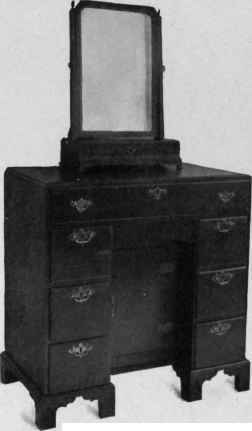
Figure 113. Knee-Hole Dressing-Table, 1725-50.
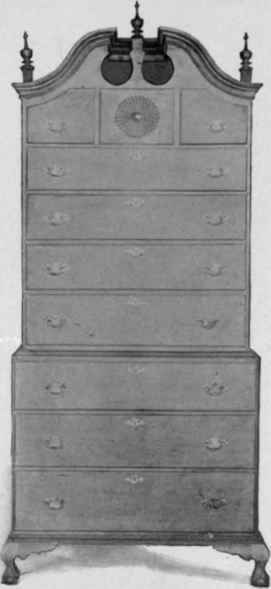
Figure 114. Chest on Chest, about 1750.
Figure 115 shows a chest on chest, the property of Mrs. Anna Babbitt, of Wickford, Rhode Island. The corner mouldings, the finials, and the astragal, fillet, and small cove mouldings of the cornice finishing the circles at the centre of the top are all peculiarities of the Rhode Island pieces. The corners have square recessed edges and quarter-round fluted columns are inserted. The feet are of the ogee bracket type.
High chests of drawers with these same characteristics are occasionally found.
Pieces of furniture having what is known as blocked fronts were very- popular in this country during the third quarter of the eighteenth century. They are usually found on chests on chests, desks, chests of drawers, knee-hole dressingtables, and occasionally on cabriole-leg dressing-tables, and rarely on high chests of drawers, probably because the style did not become popular until after the high chests of drawers had disappeared. It seems to be the fact that while in the South the high chests of drawers were being extended and enriched (Figure 102), in the North the development of such pieces had stopped, and in their place were substituted either the chests on chests or the later low chest of drawers, and the best of these had block fronts. The origin of the style is not known, but it is probably American. We find practically nothing in England or on the Continent which suggests it, except that one or two pieces have been found in England, but these could have come from America with some Tory family at the time of the Revolution. They are found all through New England. Those found in the north are plain, without a carved shell at the top of the blocking, while in the southern part, especially in Rhode- Island and Connecticut, they are frequently found with carved shells. There is one unusually fine type which is found in Rhode Island, and it is possible that block-front pieces of this type were made by John Goddard, of Newport, because in a letter by Goddard to Moses Brown, dated "ye 30th of ye 6th mo 1763" (Moses Brown papers, Vol. I, document 81), he writes with reference to an order from Jabez Bowen, "if he inclines to wate for me I would know whither he means to have them differ-int from what is common - as there is a Sort which is called a Cheston Chest of Drawers & Sweld front which are costly as well as ornimental." This must have been a block-front piece, as that was the only form at that time to which the adjective swelled could have referred. The mouldings on these so-called Rhode Island pieces are unusual and consist of a fillet, a cyma reversa, a fillet, a cove, an astragal, a fillet, and a small cove, while those found on the other pieces consist of a quarter-round, a fillet, a large cove, an astragal, a fillet, and a small cove.
Continue to:


My Books

