


V. Desks And Scrutoires. Part 11
Description
This section is from the book "Colonial Furniture In America", by Luke Vincent Lockwood. Also available from Amazon: Colonial Furniture In America.
V. Desks And Scrutoires. Part 11
Figure 278 shows another block-front, cabinet-top scrutoire in which the pediment effect was obtained by a fret extending across the ends and front. The top is scrolled and hooded. The scrolls terminate in a carved rosette. The mouldings consul of a quarter-round, a fillet, a cove, an astragal, a fillet, and a small cove, the fret frieze, a fillet, a cyma reversa, and a broad fillet. The finials are unusually beautiful with carved urns and flames which are cut through and wave in a realistic manner. On either side of the two doors are fluted pilasters. The panels of the doors are cut in ogee curves. There are four drawers below in the usual blocking, and the base mouldings are a cove, a fillet, a quarter-round, and a fillet. The piece stands on bird's claw and ball feet. This piece is in the Pendleton Collection, owned by the Rhode Island School of Design.
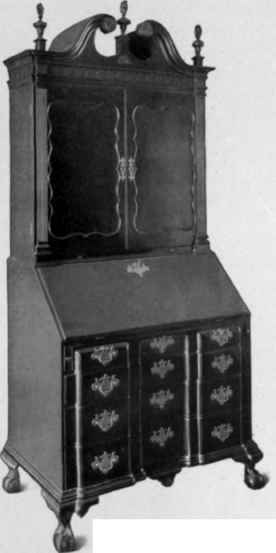
Figure 278. Block-Front, Slant-Top Scrutoire with cabinet top, third quarter eighteenth century.
Another form of cabinet-top scrutoire is the bombe type, of which three beautiful examples are shown in the following figures.
The simplest one is shown in Figure 279 and is in the Pendleton Collection, owned by the Rhode Island School of Design. The top is in the form of an interrupted or broken-arch pediment. The mouldings are a fillet, cyma reversa, wide fillet or corona, a soffit, narrow fillet, quarter-round, fillet, dentil moulding, fillet, cyma reversa, and a frieze. The moulding returns at the centre of the top to the back of the piece and a wide cove is added. On the capitals of the fluted pilasters on either side of the doors are the fillet, cyma reversa, wide fillet, and cyma reversa, which is repeated below, except that an astragal takes the place of the lower cyma reversa. It will thus be seen that the dominant theme of the mouldings is the use of the cyma reversa, which gives the piece a certain reserve and adds greatly to its beauty. An unusual feature of the pediment is that the cymatium does not extend over the top of the horizontal mouldings. The panels of the doors are bevelled and cut in a series of cyma curves in a manner found on many of the mirrors. The lower section is beautifully made. It is not only bombe, but the fronts of the drawers are also in serpentine form and the sides of the drawers follow the curves on the frame. This necessitated cutting the sides of all of the drawers on a curve. The base mouldings are the same as those appearing on many block-front pieces, a cove, a fillet, a quarter-round, and a fillet. The piece stands on bird's claw and ball feet. This scrutoire was found at Portsmouth, New Hampshire, and the drawers are of American pine, which would rather indicate its origin. The urn at the centre of the top is not original.
Figure 280 shows another bombe-shaped, cabinet-top scrutoire somewhat more ornate than that shown in the preceding figure. The top has an interrupted or broken-arch pediment and does not carry through, making the enclosed hood, as does the one shown in the preceding figure. The mouldings consist of a fillet, cyma recta, fillet, small cyma reversa ornamented with a leaf carving, wide fillet or corona, soffit, narrow fillet, quarter-round ornamented with egg-and-dart pattern, fillet, dentil moulding, fillet, small cyma reversa ornamented with leaf carving. It will be seen that the mouldings are the same as those shown in the preceding figure except that on this one are added at the top the extra fillet and cyma recta. The mouldings below the frieze are the same as those in the preceding figure, the cyma reversa being, however, ornamented with a leaf carving. The capitals of the pilaster are a long cyma recta carved in an acanthus-leaf design. The panels of the doors are bevelled and cut in series of cyma curves, as in the preceding figure, and the mouldings about the edges of the panels are carved in a leaf design. The lower part is not only bombe-shaped, but the fronts of the drawers are blocked, making an unusual combination. The sides of the drawers, however, do not follow the curve of the sides, as in the preceding figure, but the width of the frame takes up the swell, leaving the sides of the drawers straight. The base mouldings are the usual cove, fillet, quarter-round, and fillet, and the piece stands on ogee bracket feet with carved surfaces. On the edges of the lower part is carved a leaf design. This piece is the property of Mr. George S. Palmer, of New London.
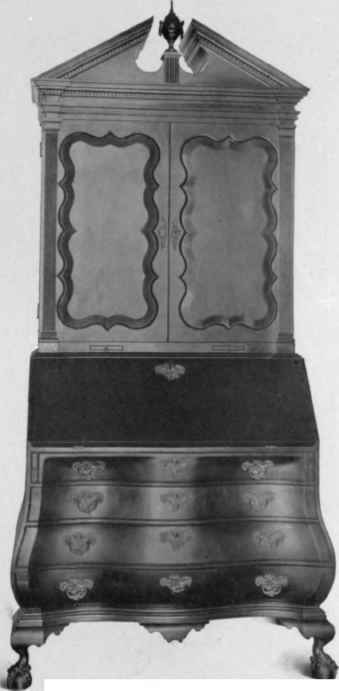
Figure 279. Bombe-Front, Slant-Top Scrutoire with cabinet top, 1750 75.
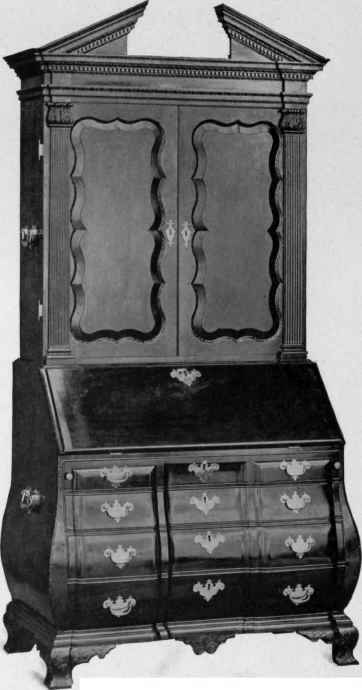
Figure 280. Bombe-Front, Slant-Top Scrutoire with cabinet top, 1750-75.

Figure 281. Bombe-Front, Slant-Top Scrutoire with cabinet top, 1750-75.
Figure 281 shows another bombe-fcont, cabinet-top scrutoire, in the Bulkeley Collection, which is more ornate than any of the foregoing. It has the same interrupted pediment top, and the mouldings are a fillet, a cyma recta, a fillet, a cyma reversa ornamented with leaf carving, a wide fillet or corona, soffit, a narrow fillet, a quarter-round ornamented with the egg-and-dart pattern, a dentil moulding, a fillet, a cyma reversa ornamented with a carved leaf pattern. It will be seen that this cornice is identical with that shown in the preceding figure. Below the frieze is a fillet, a cyma reversa carved, a wide fillet, a reel and bead moulding. Above the reeded pilaster on either side of the door is a well-carved Corinthian capital. In each door is a mirror with upper edges cut in the cyma curves with a carved moulding. A carved moulding finishes the base of the cabinet top. The lower section consists of a plain bombe carcass, the drawers having straight sides instead of following the curves of the frame, and in that respect is the same as that shown in the preceding figure. The base moulding consists of a fillet, a large ovolo or quarter-round carved with a flower-and-leaf design with a large shell at the centre, and the piece stands on animal's claw and ball feet.
Continue to:


My Books

