


V. Desks And Scrutoires. Part 10
Description
This section is from the book "Colonial Furniture In America", by Luke Vincent Lockwood. Also available from Amazon: Colonial Furniture In America.
V. Desks And Scrutoires. Part 10
The second type of these scrutoires are those in which the mouldings on the inner ends of the scroll are finished with a returned moulding instead of a rosette.
Figure 273 is an example of this kind, the property of Mr. B. E. Helme, of Kingston. This piece is the simplest of the scrutoires and was probably an early example of the type. The mouldings are the usual ones on these pieces, a fillet, cyma reversa, fillet, cove, astragal, fillet, and small cove. The two panels at the top are not finished with the raised sections, although it is possible these were applied and have fallen off. There is the usual three-door construction and shells, but the edges are plain and are not finished with the usual square recessed edge with quarter-column inserted. The interior is as fine as in any of the pieces. The legs have been cut off as has also the centre urn and flame. This second type of Rhode Island scrutoire differs from the first type in that it is generally enclosed directly back of the centre acroterium and also in that it has a slide on the inside of the desk opening into the top drawer.
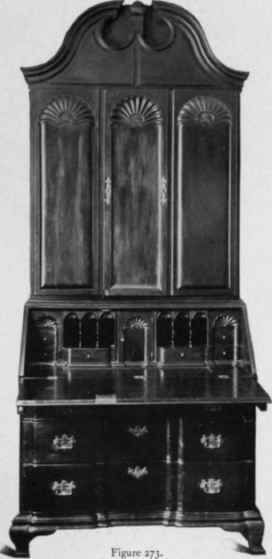
Block-Front, Slant-Top Scrutoire with cabinet top, third quarter eighteenth century.
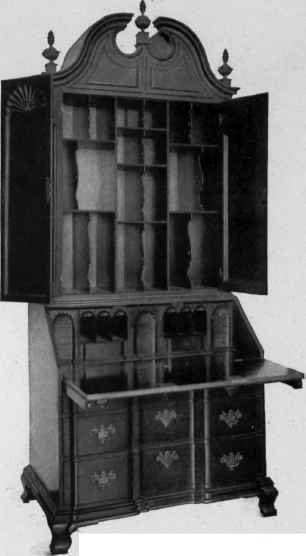
Figure 274. Block-Front, Slant-Top Scrutoire with cabinet top, third quarter eighteenth century.
Another of these scrutoires is shown in Figure 274, from the Pendleton Collection, owned by the Rhode Island School of Design. The top is scrolled and hooded and the inner ends of the scroll are finished with a returned moulding instead of a rosette. The mouldings are the same as those appearing in the last figure, and there are two raised panels with rounded edges above the doors in the usual manner. The urns and flames are also in the usual form. This piece is shown open. On the left are two doors and on the right is one. The key which locks the doors will be seen on the inside of the two doors. The interior is finished with pigeonholes with movable slides set in grooves. The front of these slides is cut in a long ogee curve and a half-round. The interior of the desk part has three doors at each end with depressed blocking and carved shells, and the door at the centre is in the same form. Three pigeon-holes are on each side of the centre and above each is a depressed half-round. The drawers below the pigeon-holes are in raised blocks. The interior of the piece is practically the same as that shown in the preceding figure, the only important variation being that the hood top is not backed at the centre and the centre acroterium is not as large and is not reeded. There are three flush drawers below with bead moulding on the frame about them, and the base mouldings and the feet are in the usual form.
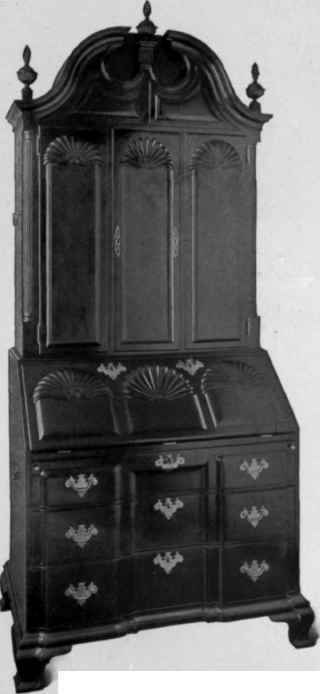
Figure 275. Block-Front, Slant-Top Scrutoire with cabinet top, third quarter eighteenth century.
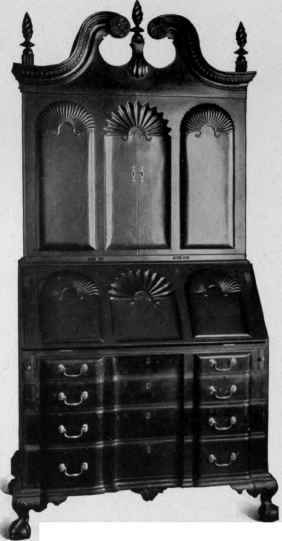
Figure 276. Block-Front, Slant-Top Scrutoire with cabinet top, 1760-75.
Another of these scrutoires is shown in Figure 275 and is the property of Mr. Richard A. Canfield. A number of refinements show that this was probably the last made of those shown. The top is scrolled and hooded and the inner ends of the scroll are finished with a returned moulding instead of rosette. The opening at the centre of the top is backed. The mouldings are the same as those on the preceding figure, as are also the two raised panels with rounded edges above the doors. The finials are also in the same design. The doors are three in number, arranged in the usual way above described, and the shells have thirteen radiates at the top and sixteen on the lid. The corners have square recessed edges in which are inserted quarter-round reeded and fluted columns. There are three flush drawers in the lower part with a bead moulding on the frame. The base moulding is in the usual style found on these pieces, a cyma reversa and a wide fillet. The piece stands on the usual bracket feet, but the carved scroll on the inner edge comes to a point.
An interesting variation of the Rhode Island type is shown in Figure 276, the property of Mr. George M. Gunn, of Milford, Connecticut. The cabinetmaker apparently had either seen or heard of a Rhode Island piece and was copying it from memory. The cornice is composed of a quarter-round, a fillet, a cyma reversa, a dentil moulding, a cove, an astragal, a fillet, and a small cove, but the astragal, fillet, and cove do not extend about the circular openings at the top as they do in the Rhode Island pieces. The cabinet is concealed by but two instead of three doors, consequently it was necessary to cut through the centre shell and depressed blocking. The shells are not made like those on the Rhode Island pieces, but are exactly like those on the chest on chest (Figure 120), as is also the carved support for the centre acroterium. There are four drawers set flush with a bead moulding on the frame about them, and the piece stands on bird's claw and ball feet with shells carved on the knees and at the centre of the skirt. The base mouldings are a cyma recta and a fillet instead of the cyma reversa and fillet found on the Rhode Island pieces.
A different type of block-front, cabinet-top scrutoire is shown in Figure 277. In those above shown the top is simply scrolled, but in this one there is a pediment top with a hood and scroll. The mouldings are more elaborate than is usual, consisting of a quarter-round, a cyma recta, a fillet, and a small cyma reversa, a clentil moulding, a cove, an astragal, and a fillet. The cymatium has the quarter-round, the cyma recta, a fillet, and a cove with a dentil moulding, and the section carrying acroat the front has the same mouldings, commencing with the cyma reversa. On either side of the doors are fluted pilasters the capitals of which extend through to the top of the mouldings. The two doors are panelled with ogee curved edges. The lower part has four drawers with a bead moulding on the frame about them, and the blocking is in the type where the depressed sections are in the plane of the drawer, giving the appearance of the double blocking as in Figure 263. The base mouldings are the cove, a fillet, a quarter-round, and a wide fillet, and the piece stands on four bird's claw and ball feet. This piece was made in New Hampshire in 1778 and is the property of the writer.
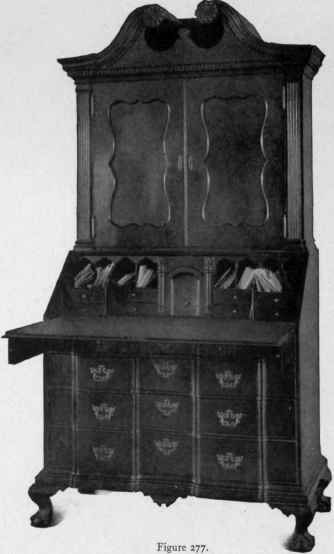
Block-Front, Slant-Top Scrutoire with cabinet top, 1778.
Continue to:


My Books

