


V. Desks And Scrutoires. Part 9
Description
This section is from the book "Colonial Furniture In America", by Luke Vincent Lockwood. Also available from Amazon: Colonial Furniture In America.
V. Desks And Scrutoires. Part 9
A southern New England block-front, cabinet-top scrutoire is shown in Figure 269. The top is scrolled and hooded, and the mouldings are a quarter-round, a fillet, a cove, an astragal, a fillet, and a cove. The doors are panelled and at the top of each is carved a raised shell. The usual candle-stick slides are below the cabinet. The lid is blocked, and at the top are shells, the outer ones raised and the centre one depressed. There are four drawers in the lower part with overlapping edges, which is rather unusual, as the drawers are usually flush with the beading on the frame. The legs are of the ogee bracket type and the base mouldings are the cove and a wide fillet. This piece may be an early example of the Rhode Island type, as it has some of its characteristics. It is the property of Mr. Richard A. Canfield.
We now come to a consideration of the Rhode Island pieces, so called because they can all be traced to Rhode Island and appear to have been made by the same man. It is thought that they were made in Newport by John Goddard, a cabinet-maker of that place. There are several cabinet-top scru-toires of this type known, and they are probably as fine pieces of cabinet work as are found in the country and differ only in minor details. These scrutoires are found in two forms, those where a rosette finishes the inner ends of the scrolls and those where the inner ends are finished with a returned moulding. Probably the earliest of these pieces is the one owned by Brown & Ives, of Providence, and is shown in Figure 270. The cabinet section is tall and stately. The top is scrolled and hooded and the inner ends of the scroll are finished with carved rosettes. The mouldings are a quarter-round, a fillet, a cyma recta, a fillet, a cove, an astragal, and a fillet. This form of moulding is found only on this scrutoire and the chest on chest (Figure 119). The astragal and fillet carry around the circular openings at the centre. This is common to all the Rhode Island pieces. Above the doors are three raised panels with rounded edges. On all the other pieces there are but two. At the corners are boxes on which are placed the acroterium with urns and flames. This feature only appears in this piece and on the chest on chest (Figure 119). The cabinet top, third quarter eighteenth century. corners have square recessed edges and quarter-round fluted and reeded columns are inserted. There are three doors, two of which are hinged together, and the doors lock in the hinge, the inner door fastening to the outer one with a metal tongue. The beauty of this construction is that the blocking can thus be carried from the bottom to the top of the piece. The outer doors are raised with a shell carved at the top and the centre one is depressed with the sunken carved shell.
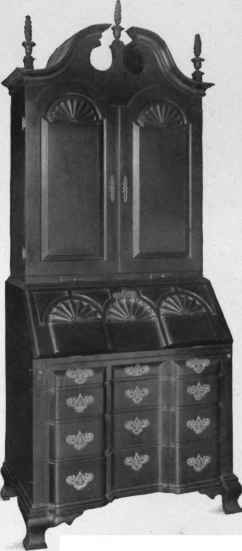
Figure 269. Block-Front, Slant-Top Scrutoire with.
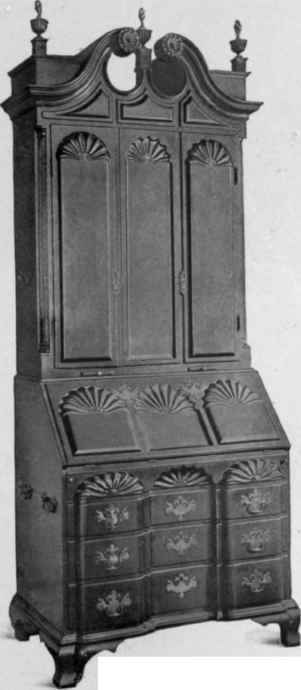
Figure 270. Block-Front, Slant-Top Scrutoire with cabinet top, third quarter eighteenth century.
The lid is also blocked with two raised shells and one depressed shell. There are four drawers and all overlap. This feature also appears only in the chest on chest (Figure 119). The upper drawer is carved with the raised and depressed shells, a feature unique in this piece. The blocking is of the usual type, carrying down to the ogee bracket feet, on the inside of which is carved a scroll, a feature found only in the Rhode Island type. The base mouldings are composed of a cove, a fillet, and a quarter-round, which differ from the regular type which are a cyma reversa and a fillet. At the ends of both the upper and lower sections are handles. The urn-and-flame pattern used on all of the Rhode Island pieces is of a distinctive character and aids in identifying them.
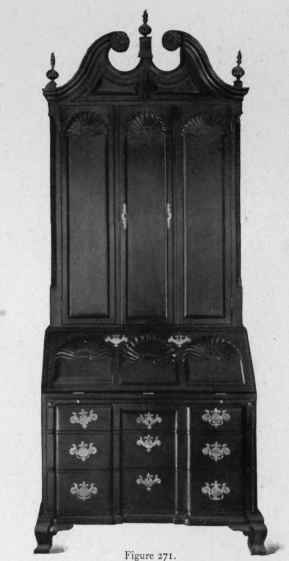
Block-Front, Slant-Top Scrutoire with cabinet top, third quarter eighteenth century.
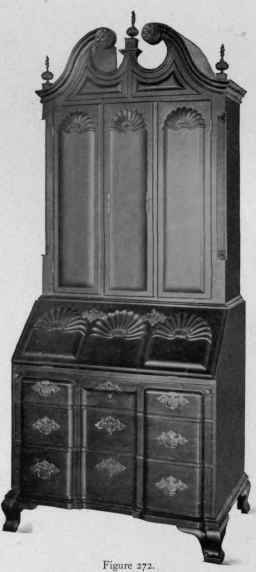
Block-Front, Slant-Top Scrutoire with cabinet top, third quarter eighteenth century.
Figure 271 shows another of these Rhode Island block-front scrutoires, the property of Mrs. A. S. Chesebrough, of Bristol. The cornice is composed of a fillet, a cyma reversa, a fillet, cove, astragal, fillet, and small cove, and these mouldings appear on all of the pieces known except the two above mentioned. The astragal, fillet, and cove carry about the centre openings in the usual manner. Above the doors are two raised panels with rounded edges. The three doors with the carved shells in the centre are the same as in the preceding figure, as is also the lid of the desk. The corners have square recessed edges with quarter-round fluted columns inserted. There are but three drawers in the lower part without any shell carving, set flush with a bead moulding on the frame about them, which is the usual construction for Rhode Island pieces. Above the drawers is a sliding shelf, a feature unique with this piece. The base mouldings are a cyma reversa and a wide fillet, mouldings found on all of these pieces except the two above mentioned. The feet are the same as those shown in the preceding figure.
Another example of these scrutoires is shown in Figure 272 and is the property of Mr. Marsden J. Perry, of Providence. With the exception of the slide above the drawers, this piece is identical with the preceding one, except that there are eleven radiates in the upper shell and twelve radiates in the lower shell, while in the preceding piece there are fourteen and fifteen radiates respectively.
Continue to:


My Books

