


VI. Looking-Glasses
Description
This section is from the book "Colonial Furniture In America", by Luke Vincent Lockwood. Also available from Amazon: Colonial Furniture In America.
VI. Looking-Glasses
THE use of mirrors dates from prehistoric times. They were of polished metal, small, and generally intended to be used in the hand. It was not until the early sixteenth century that glass was used for mirrors, and at that time Venetian workmen received state protection for the manufacture of looking-glasses, and for more than a century Venice supplied practically the whole world. The word looking-glass in the place of mirror occurs throughout the American inventories. In England the first looking-glass plates for mirrors were made in the year 1673 at Lambeth, and from that time were in general use. The records throughout the colonies for the first few years mention looking-glasses valued at from two to five shillings. As these must have been Venetian ones previous to 1673, and consequently expensive, the inference is that at that low estimate of value they must have been mere hand-glasses. After 1680, however, the records show them to have been of considerable value, very much above most of the furniture. Other records are: at Salem, in 1684, "a large looking glass and brasses" valued at £2, 5s.; at New York, in 1689, "a large looking glass 36s," and in 1696 one at £5; at Boston, in 1698, "a large looking glass," £2, 15s.; at Philadelphia, in 1686, "a square looking glass with diamonds," and in 1687, "an olive wood diamond cut looking glass"; at New York, in 1696, "a looking glass with a gilded frame and one with an ebony frame," and in 1697, "one large looking glass with a walnut tree frame."
The descriptions above enumerated cover practically all the hints that the records give of the character of looking-glasses previous to 1700. Fortunately, however, a number of these looking-glasses have survived and will be illustrated in the following pages. The glasses, of course, were all imported in colonial times, .md, as might be expected, the advertisements frequently contain notices of their importation, giving the sizes and sometimes the prices. For instance, the following advertisement appears in the Newport Mercury, May 13, 1765: "To be sold by Peckhm & Gould at their shop in Thames Street, an assortment of looking-glasses, viz: mahogany, sconce, gilt edge and shell, thirty inches by seventeen, plain ditto twenty five inches by thirteen, twenty three by twelve and down to seven by five." Mention is also made of the importation of the looking-glasses in their frames as early as 1686, and a number of looking-glasses found here still bear the London maker's name. The Boston News Letter for August 10, 1719, advertises "looking glasses of divers sorts and sizes lately imported from London to be sold at the glass shop Queens Street."
It has been thought by many that practically all of the glass and frames were imported. This hardly seems probable, not only because glasses are mentioned as separately imported, but because there were good cabinet-makers, japanners, and gilders here who were undoubtedly able to construct such a simple thing as a looking-glass frame. Stephen Dwight, of New York, had his place of business between the Ferry Stairs and Burling Slip, and in 1755 advertised to carve picture and looking-glass frames. The truth probably is that many of the better frames were imported and the large number of plainer ones were made by local men who copied the imported designs, limited only by their skill and the price at which the looking-glass was to be sold. The earlier plates were so expensive that probably many persons could not afford an expensive frame, and doubtless some of them were simply enclosed in a plain frame for the protection of the glass.
It also seems to have been the fashion to have old looking-glasses remodelled, and many advertisements to this effect are found in the newspapers. In 1730 James Foddy advertised "to alter and amend old looking glasses."
The following characteristic advertisement appears at New York, in 1775, of "Minshiells looking glass store, removed from Smith Street to Hanover Square (opposite Mr. Goelet's, The Sign of the Golden Key)." He advertised, "an elegant assortment of looking glasses in oval and square ornamental frames, ditto mahogany; the greatest variety of girondoles ever imported to this city; brackets for busts or lustres, ornaments for chimney pieces, as tablets, friezes, etc. Birds and baskets of flowers for the top of book cases or glass frames, gilt bordering for rooms by the yard. Engravings by Strange, Woollet, Vivans and other eminent masters. A pleasing variety of mezzotintoes well chosen and beautifully colored. Also an elegant assortment of frames without glass. Any lady or gentleman that have glass in old fashioned frames may have them cut in ovals or put in any pattern that pleases them best. The above frames may be finished white or green and white, purple, or any other color that suits the furniture of the room, or gilt in oil or burnished gold, equal to the best imported."
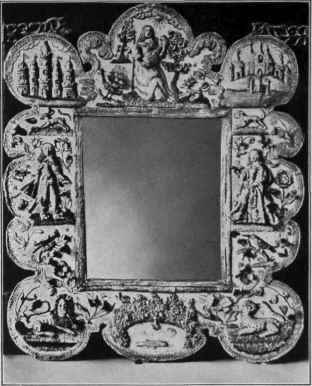
Figure 309. Looking-Glass with stump-embroidery frame, about 1640.
An early form of looking-glass frame is shown in Figure 309. The edges are cut in curves and the entire surface is ornamented with very fine stump embroidery. On the sides are represented Charles I and his queen and at the two upper corners are castles. At the centre of the top is an angel playing on a musical instrument, and the remaining spaces are filled in with birds, animals, trees, and flowers. The frame is fastened into an oak box. This frame was sold at the sale of the property of the Right Honourable the Viscountess Wolseley and is the property of the Rosenbach Company, Philadelphia.
The earliest frames mentioned in the American inventories were of ebony. A little later walnut and olive wood were freely mentioned.
There are two kinds of early looking-glasses, those having the square or slightly rectangular glass, and those having long frames with two glasses, one above the other. The latter type is called a pier-glass.
Continue to:


My Books

