


Dutch Furniture Under French And Oriental Influence. Part 4
Description
This section is from the book "Dutch And Flemish Furniture", by Esther Singleton. Also available from Amazon: Dutch and Flemish Furniture.
Dutch Furniture Under French And Oriental Influence. Part 4
The furniture was due to Marot and Wren.
The comparatively small amount of furniture now to be seen in the show-rooms of Hampton Court belongs mainly to this period. It consists principally of chairs, stools (tabourets), beds, card-tables, mirrors and chandeliers.
Many of these specimens are extremely interesting, showing the Marot taste. Of the latter, there are stools, chairs and tables with the heavy scroll foot and stretchers, the latter joining in the centre and supporting there a carved ornament; other tables have four scroll supports and stand on bulb feet. Some of the stools and tabourets have gilded woodwork. Among the later style we may note a chair in William Ill's Presence Chamber, with tall back, jar-shaped splat, cabriole leg, hoof feet and straining-rails, the front one higher than the other; and also two card-tables in the King's Drawing-room, with slender legs ending in the hoof foot, and the tops supplied with wells for the counters and slight depressions for the candles.
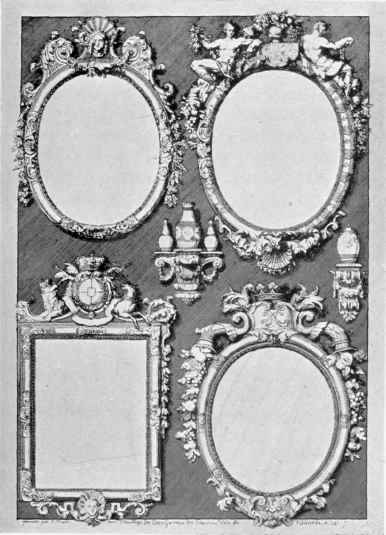
Plate L. - Mirrors, by Marot.
About thirty handsome looking-glasses of the period are there. Many of them are pier-glasses hung, of course, between the windows. One of the most noticeable of these is a fine pier-glass in William Ill's State Bedroom, dating from his time. This has a border of cut blue glass, the edges are bevelled, and the centre contains the monogram W. R., surmounted by the crown in blue and white glass. A similar mirror hangs over the fireplace.
Another looking-glass with a blue glass frame hangs between the windows in Queen Mary's Closet.
Another beautiful chandelier hangs in William Ill's Presence Chamber: this is of silver, with eight lower and four upper arms. It is decorated with the harp, thistle, etc. A still more ornate one hangs in the Queen's Audience Chamber. This is a magnificent combination of silver and crystal, with silver sea-horses and lions supporting the silver branches, crystal balls and drops, and a crystal crown on top.
The mantelpieces are extremely interesting, as many of them are of the old inverted funnel shape, and are supplied with tiers of shelves - sometimes as many as six - for the reception of ornaments. Upon these now stands a good deal of blue and white china, many pieces of which belonged to Queen Mary. Pieces that are known to have belonged to her are two blue and white jars and two goddesses in Queen Mary's Closet, and two goddesses and two vases, about eighteen inches high, on the mantelpiece of William Ill's Presence Chamber.
Charles II, who, while a royal refugee, spent much time in Holland, had acquired the new taste. It was there, doubtless, that he saw visions of wealth in the Indies that later led him to grant the English East India Company a charter, and to embark on a disastrous and inglorious war, which resulted in London hearing foreign guns for the first time since England was a nation. His keen appreciation of Oriental works of art, however, was somewhat dulled when his bride, Catherine of Braganza, brought him a shipload of cabinets and ceramics in lieu of the dowry her mother had promised, although Evelyn, in his description of Hampton Court (1662), says: "The Queen brought over with her from Portugal such Indian cabinets as had never before been seen here."
It is frequently asserted with apparent authority that Mary carried the Dutch taste for porcelain and the manufactures of the Far East into England; but, as we have seen, this idea is not well founded. Herself a china-maniac, she merely set the royal stamp of approval on contemporary taste, and made Hampton Court a model of the style refugie. That style dominated English and Dutch homes before she heartlessly danced in the Palace of Whitehall from which her father had fled.
Hampton Court, remodelled under her directions, was not completed till 1693. Many documents show that the style refugie was popular in English aristocratic homes before that date.
Under William and Mary, London swarmed with Dutch merchants and refugee Huguenot arts and craftsmen, and was almost as much of an Eastern bazaar as Amsterdam was. Mary set the pace, and wealth and aristocracy gladly followed. As an example of the vogue, we cannot do better than take the diary of the wealthy John Hervey, afterwards Earl of Bristol, and quote a few entries of expenditure.
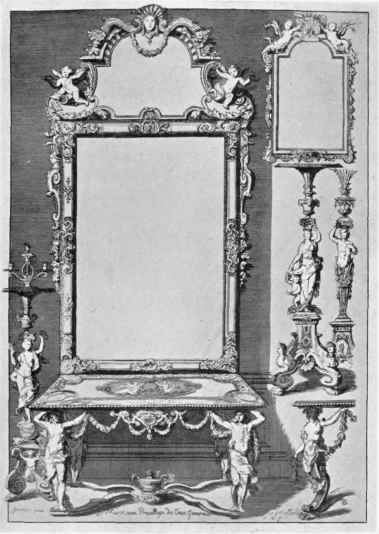
PLATE LI. - Mirrors, Console Table and Candlestands, by Marot.
He was always buying porcelain and other Oriental wares "for dear wife." On July 6, 1689, he notes: "Paid to Katherine Scott for 12 leaves of cut Japan skreens, 2 pieces of India damask and 6 Dutch chairs, £65." In the following July, he also bought from John van Colima, a Dutchman, who had probably followed William III to London, "a parcel of old China for £3 2s. 6d." Though the Earl dealt more extensively with "Medina ye Jew," "Leeds ye mercer," "Seamer ye goldsmith" and many "India houses" in the New Exchange, we find him still patronizing the Dutchman after the death of his first wife, as is shown by the following entries: "1696, Jan. 11: Paid Calama, ye Dutchman in Green Street, for a parcell of china for my dear wife, £31 8s. 4d. May 4: Calamar, ye Dutchman, for another parcel of China, £10 4s." Two years later he also pays "John Van Collema, for an Indian trunk, £35." Another Dutchman who enjoyed this nobleman's patronage was "Mr. Gerreit Johnson, ye Cabinett-maker," who, on May 25, 1696, was paid £yo "for ye black sett of glass, table and stands, and for ye glasses, etc., over ye chimneys and elsewhere in my dear wife's apartment."
Gerreit Johnson, whom the Earl patronized, was a fashionable cabinet-maker who made the china-cabinets for Queen Mary that were placed in a room at Hampton Court called "the Delft Ware Closett." It is interesting to note that the mirrors and cabinets in the Countess of Bristol's boudoir had black japanned framework.
Continue to:


My Books

