


Second Period of The Renaissance. Part 7
Description
This section is from the book "Dutch And Flemish Furniture", by Esther Singleton. Also available from Amazon: Dutch and Flemish Furniture.
Second Period of The Renaissance. Part 7
Guicciardini continues: "The others it would be prolix to enumerate," and informs us that most of these artists visit Italy. "Some return loaded with wealth and honour to their native country," while "others go to Great Britain and Germany, but chiefly to Denmark, Sweden, Norway, Poland and even Muscovy, not to mention those who, allured by honours and rewards, visit France, Spain and Portugal."
The younger De Vries (Paul), was born at Antwerp in 1554. He designed Plusieurs menuiseries comme Portaulx, Gar Aerobes, Buffets, Chalicts, Tables, Arches, Selles, Bancs, Escabelles, Rouleaux a pendre, touailles, Casses a vertes et beaucoup d'autres ouvrages. The style of furniture shown in the works of the De Vrieses lasted till Rubens arose.
Crispin de Passe, or Van der Passe the elder, was born in Arnemuiden about 1560, and was a pupil of Dirk Coornhert (born in Amsterdam in 1522, died in Gouda in 1590). He left a great number of compositions and many remarkable portraits painted in Germany, France, and England, as well as in Holland. A writer, too, of considerable merit, he published many works which he illustrated with his own engravings. In 1585, he became a member of the Guild of St. Luke of Antwerp. Being such a fine engraver, it is not astonishing to find that he excelled in niello-work. His composition in this medium, representing "The Five Senses," resembles in its delicacy the lace, embroidery and incrustations of ivory of the same period. His patterns, sometimes in relief and sometimes in depression, sometimes in white and sometimes in black, are very beautiful. Crispin de Passe had three sons: Crispin (born in Utrecht in 1585); William (1590); and Simon (1591), all of whom were excellent engravers. His daughter, Madeleine (born 1583), was also a good engraver.
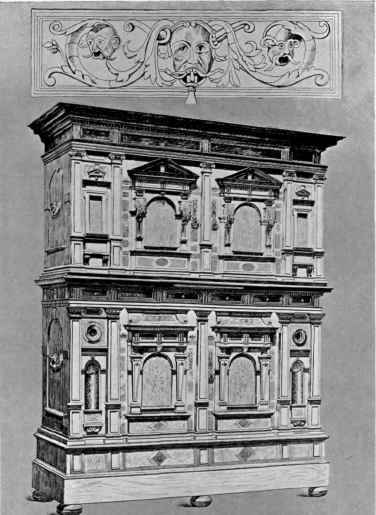
Fig. 26.
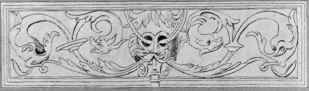
Fig. 27. Plate XVIII. - Flemish Armoire.
Figs. 26 - 27: Hispano - Flemish Drawers.
Among the famous engravers also were the Collaerts. Adrian Collaert, born in Antwerp in 1560, was admitted to the Guild of St. Luke in 1580, and died in 1618. He studied in Italy and on his return composed and engraved many designs of great merit. His son, Hans, born in Antwerp, was also a designer and engraver of note. He worked until 1622. His son, William, was a famous engraver.
Adrian Collaert's designs for goldsmith's work, silver plate and all artistic products of that nature had a great vogue, and worthily represent the decorations of the Flemish Renaissance. Two of his characteristic designs are reproduced in Plate XXI and Plate XXII.
Wood-carving continued to be one of the glories of Flemish Art. Sixteenth century pulpits, bishops' thrones and choir-stalls still exist in many of the old churches. The names of some of the masters of the chisel who executed these beautiful works have been preserved, and may properly be recalled here.
St. Martin's Church at Ypres contains beautiful stalls carved by Victor Taillebert. He received four thousand florins in payment for his work.
Colyn van Cameryck made a magnificent marble mantelpiece for the Kampen Town Hall. The work was done between 1543 and 1545.
Jean van der Scheldein, carpenter and sculptor, made a monumental door in the Hotel de Ville, Oudenarde, in the Renaissance style in 1531. This is ornamented with columns, a pediment, figures and rectangular panels adorned with arabesques in the best taste and with masterly execution.
Peter van Dulcken carved the beautiful stalls for the echevins, and the balustraded screen of the Nimeguen Town Hall, in the second half of the sixteenth century. These are the finest that have escaped destruction except those of the Kampen Town Hall, which are even more elaborate.
The Netherlands early enjoyed a reputation for music, and from about 1450 to 1550 the most celebrated "maitres de chapelle" came from the Low Countries. They were engaged in the churches and in the courts of kings and establishments of the nobility in France, Germany, Italy, Hungary, Denmark and Spain. Guicciardini says they had brought music "to a state of perfection," and praises the melodious songs of the men and the skill of the women who played all kinds of instruments. He also pays tribute to their knowledge of harmony and proficiency in composition and says that Flemish musicians are at the "Court of every Christian prince," and he then gives a list of famous musicians of the Low Countries. These are "Giovanni del Tintore di Nivelli, Iusquino di Pres, Obrecht Ockegem, Ricciafort, Adriano Willaert, Giovanni Monton, Verdelot, Gomberto Lupus Lupi, Cortois Crequillon, Clementi non Papa and Cornelio Canis." To these, "who are now dead," he adds the following list of living celebrities: Cipriano de Rove, Gian le Coick, Filippo de Monti, Orlando di Lassus, Mancicourt, Iusquino Baston, Christiano Hollando, Giaches di Waet, Bon-marche, Severino Cornetto, Piero du Hot, Gherardo di Tornout, Huberto Waelrant, Giachetto di Berck-emvicino d'Anversa, Andrea Peuermage and Cornelio Verdonk and "many other masters of music who are celebrated throughout the world."
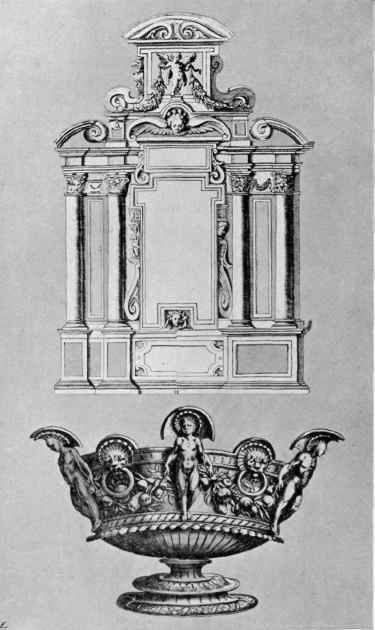
Plate XIX. - Cabinet, or Armoire, by De Fries; Design for Goldsmith's Work, by Jerome Cock.
This universal love of music is attested by the Dutch and Flemish masters. In tavern scenes, as well as scenes of domestic and social life, musical instruments are frequently introduced. To catalogue the works of Jan Steen, Terborch, Teniers, Metsu, Van Mieris and other painters of the seventeenth century directly inspired by music, such as musical parties, harpsichord lessons, duets, lute-players, ladies at the spinet, etc., would be quite a task.
Continue to:


My Books

