


The Dutch Home. Part 6
Description
This section is from the book "Dutch And Flemish Furniture", by Esther Singleton. Also available from Amazon: Dutch and Flemish Furniture.
The Dutch Home. Part 6
One has only to glance at the contemporary inventories to realize the wealth and luxury of the period. It is only in a few instances, such as the old Castle of Devel-stein, when occupied by Cornelius van Beveren, that the old simplicity rules; for the old grey town on the Merwede (Dordrecht), although the richest and oldest, was not the most luxurious in Holland. It conserved its own customs, while Amsterdam, Rotterdam, Delft and other cities vied with The Hague. One or two large chests always stood in the bedroom. In these linen and clothing were kept. As a rule, the chest was of sacredaan, with brass or silver mounts, and neatly lined inside with cloth.
Linen was also kept in the great hasten. These were ornately carved or panelled, made of different woods, and often inlaid with mother-of-pearl. Some of them cost as much as 1,000 fl. Rare porcelain was always placed on the top of the kas.
The great linen chest or coffer, and the great cupboard in which household linen and articles of clothing were kept, were among the most important articles of furniture in a Dutch household. The chest was tall and wide, and made, as a rule, of lignum vita, or sacredaan, or other East India wood, frequently covered outside with leather and lined inside with linen or some other textile. It was often mounted with brass or silver, sometimes richly wrought.
The cupboard, or kas, was very broad and very tall, and was made of oak, ebony, or walnut, and stood on four heavy balls, which were often repeated on the four corners of the top, and are described by Van Nispen as "guardians of the porcelain ornaments," which adorned the top.
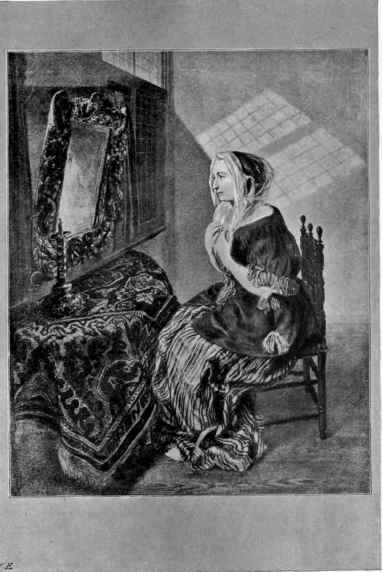
Plate XL. - Interior, by J. B. Weemx, Brussels.
As many as ten or twelve each of chests and kasten have been noticed in old inventories in one dwelling, and they are described according to the wood of which they are made, or the name of the room in which they stood. Accordingly, we read of coffers and cupboards of oak, sacredaan, cherry, and plum-tree wood, blue and red grained East India wood, iron coffers, Prussia leather and lacquered coffers, the office coffer, the office cupboard, the kitchen cupboard, the cupboard of the green painted room, of the gold leather room, of the tapestry room, etc., etc. Let us examine some of the cupboards in the home of Sara de Roovere, second wife of Adriaan van Blyenborgh, Keeper of the Count's Mint, and known as a Latin poet. This home is in Dordrecht.
In the "gold leather room" stand several cupboards, some of which are of rare wood and richly carved. These cupboards contain a rich store of snow-white linen, damask tablecloths, napkins, bed-clothing, towels, shirts, bibs, neckerchiefs, frills, handkerchiefs, etc., "saved from grandmother's time with economy, or inherited from great-aunt and kept as precious treasures," all for her own use, or as wedding gifts to her children, Jacob, Adriaan, Charlotte, or Adriana. Like many another Dutch lady, every penny won at play, every present, and everything that could be saved from the household money, this thrifty housewife devoted to increase the treasure. A great part of the day she spent with her daughters in the front room (voorhuis), or with the maids in the kitchen, at the spinning-wheel, the sewing-cushions, the work-table, or the ironing-board. She considered it an honour to have a rich Linnenkast, and she was proud of being called a "house jewel careful of the third part "and deserving of the name, as she possessed "mountains of her own make and foreign produced stuff." Her inventory shows that she possessed no less than twenty-four dozen chemises, forty dozen tablecloths and napkins, and coffers full of uncut linen.
Some burghers' wives had their linen made up by the seamstress.
In another cupboard, called the "scalloped," owing to the many St. James' shells carved upon it, J offer van Blyenborgh kept one of the most costly articles of her attire - the breast or forepiece. These breast-pieces, or stomachers, were worn on the corsage, to which they were fastened by means of pretty silk cords. They were made of silk, satin, or velvet, and often profusely decorated with pearls or jewels, and sometimes cost as much as £10,000.
Vrouwe van Blyenborgh had coffers filled with petticoats of scarlet cloth and also of wool cloth, coarse grey, black and white linen under petticoats, jackets, hoop skirts, mantles and rain cloaks. Her cupboards and coffers also included: rich robes of sarcenet and serge of fire colour, rose colour and ground colour, covered with ribbons, bows, galloons; bodices embroidered and trimmed with lace and fringe; petticoats garnished with fringe of fire colour; grey cloth dresses lined with blue serge; and Japanese night robes of dead leaf colour, embellished with aurora hued flowers and lined with wadding. Neatly folded among these rich articles were white satin robes lined with amaranth taffeta, black velvet robes with cloth of silver, and petticoats embroidered with golden flowers and lined with taffeta d' Avignon. She also had some cloth of gold valued at £16 a yard.
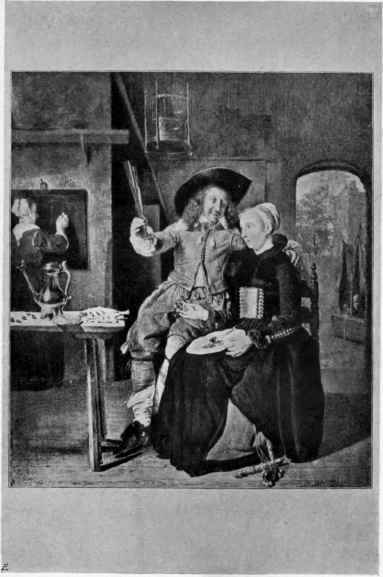
PLATE XLI. - Breakfast, by G. Metsu, Dresden,.
Dress and furniture became so extravagant during this period that the stage ridiculed the lavish expenditure, and the other censor of public morals - the pulpit - denounced the needless splendour as degrading before God and men. The Dordrecht preacher, Joh. Becius, exclaimed: "Are the pride and splendour of to-day more extreme than with the people of Israel? Certainly not; but rather worse; for women go about, not only with bare necks, but half-bared bosoms partly covered with a thin net or cambric cloth - and in the robes and dresses they are more splendid than the proud peacock, more changeable than the chameleon or the weather-cock on the church steeple. They almost dance along the streets dressed up as dolls for a kermesse; and these creatures, so gaily attired, vie with each other to enter the Lord's House where is preached Christ born in a manger and wrapped in swaddling clothes."
Continue to:


My Books

