


The Dutch Home. Part 7
Description
This section is from the book "Dutch And Flemish Furniture", by Esther Singleton. Also available from Amazon: Dutch and Flemish Furniture.
The Dutch Home. Part 7
Among the other vanities carefully preserved in the drawers and on the shelves were the fans, masks, lace and jewels; chatelaines, ribbons, hats, bonnets and caps; silk, cloth and serge stockings richly embroidered; fancy shoes and slippers with high heels, and leather and silk gloves sweetly perfumed. Vrouwe van Blyen-borgh had a number of thin, beautiful, scented, leather gloves; a large stock of "shoework" of silk, satin, gold and silver leather, and yellow, green and scarlet stockings. We must not forget to mention the round silver mirrors suspended from gold hooks at the belt, and the delicately painted miniatures worn as lockets or breast-pins.
The great kas was as conspicuous in the houses of the Dutch colonists as it was at home. Every inventory of the prosperous burgher of New Amsterdam mentions it, and it is highly appraised. To take a few instances: "One great case covered with French nutwood and two black knots (balls) under it, £13" (1685); "a cupboard or case of French nutwood, £20" (1686); a white oak cupboard, £2 5s. (1688); a large cupboard, £6 (1690); cupboard for clothes, a press and porcelain, £5; and a "Holland cubbart furnished with earthenware and porcelain," £15 (1692); a great black walnut cupboard, £10 (1702); a Dutch painted cupboard, £1 (1702); a black walnut cupboard, £9 (1703); and a case of nutwood, £10 (1712). The kas was often a valued bequest: Mrs. van Varick had one "great Dutch kas that could not be removed from Flatbush"; and, therefore, was sold for £25.
In the rooms of the Castle of Develstein were standing mirrors and mirrors in ebony, metal and crystal frames, on the walls; and in the "salon" was a mirror of Venetian glass. In this room was, seen the "king-wood hall buffet," where, on festive or ceremonial occasions, the family silver and crystal were exhibited, such as silver plates, dishes, spoons, knives, beakers, decanters and mugs, silver-mounted horns and night cups - all engraved with the family arms, or with conventional rhymes or mottoes. In the "salon" or "show salon" was placed the "root-wood (root of the walnut tree) table," formed like steps (a survival of the dressoir), on which the rarest and finest porcelains were shown. Here also was the richly carved walnet kas containing a rare display of fine china, while on the wall walnut racks, beautifully carved and ornamented with gold, the handsomest plaques were arranged. There was also a pewter table in this room, on which stood many pewter dishes, cups, tankards, etc., engraved with the family arms * but most of the pewter was kept in the pewter cupboards (tinkaster), in the pewter room, or in rows upon the dresser in the kitchen, ready for immediate use. Silver table-ware was not in general use, for pewter took its place as an everyday article.
Among the glassware shown in this room were cordial, wine and beer glasses, chalices and loving-cups of white and green glass, engraved with arms, ornaments, proverbs, and shell-like Venetian glasses, supposed to be proof against poison.
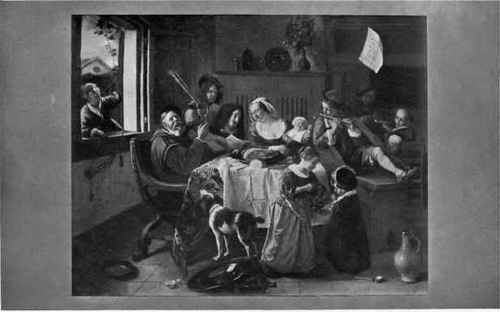
Plate XLII. - Interior, by Jan Steen. The Hague.
Two interesting examples of hasten are given on Plates XLIII and XLIV.
Plate XLIII represents a large Dutch kas, or buffet d deux corps, from the Rijks Museum, Amsterdam. This magnificent specimen is of solid ebony inlaid with ivory. Its grooved columns, panels and niches break up the plain surface with much variety. It stands on eight bulb feet. It is similar in shape to the English "court cupboard" of the same century.
Plate XLIV represents a large armoire, or kas, from the Cluny Museum, Paris. This was made in Holland. The front is ornamented with three pilasters with carved capitals, between which are the two doors or wings decorated with carved panels. The cornice is ornamented with three lions' heads. Beneath the columns are drawers with simple knobs. This piece of furniture stands on flattened bulb feet.
In the latter part of the seventeenth century, the cabinet was found in every home of moderate wealth. In an inventory of 1679, "a root-wood cabinet, with Japanese small dishes and 'colossol' (very large) pots under its high feet "is mentioned. These cabinets stood on high legs, sometimes with only one drawer underneath. They were frequently made of rough pine-wood painted red; but often they were very handsome (see Plate XXXI). In the bedroom of Lady Reepmaker in the Castle of Develstein there was a "cabinet-maker's small cupboard to put dresses in, one one-drawer cabinet on a high base, one hair-dressing table, one ditto chair, one ditto mirror with ebony frame, one gold leather comb-holder, and the "nachtbouquet" (night bouquet), a piece of furniture used by the upper classes after 1672, in which everything relating to the toilet of the period was found, such as: a silver framed mirror, powder boxes, silver trays, pin-books, patch-boxes, hair and clothes brushes, and other small toilet articles, as well as silver candlesticks, snuffers and snuffer-trays.
When a wealthy lady sat in front of her "dressing-cloth," as her dressing-table was familiarly called, she had before her an array of bottles and boxes containing perfumes, powders, paints and beauty patches, as well as a treasure-house of pearls, diamonds, rings and bracelets set with glittering stones, ear-rings, necklaces, chains of pearls, gold and silver pins, spangles, half-moons, so that she looked like "a sun surrounded by suns," or a "diamond surrounded by rubies."
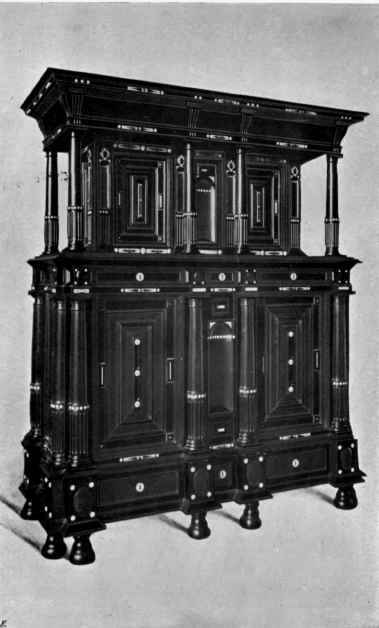
PLATE XLIII. - Kas of Ebony and Ivory. RIJKS MUSEUM, AMSTERDAM.
Her innumerable toilet-boxes of tortoiseshell and mother-of-pearl, her silver and gold scent-boxes, her boxes of filigree, her ivory, ebony and porcelain boxes and trays for her patches and cosmetics, her rich jewel cases of gold, silver, tortoiseshell or ivory, lined with velvet, her brushes and her shoe-horns, and her beautiful work-boxes supplied with thimbles, bodkins, knitting-needles, hooks, scissors, and everything that could be used for sewing and fancy needlework are displayed on her toilet-table and in her cabinets.
Continue to:


My Books

