


The Dutch Home. Part 8
Description
This section is from the book "Dutch And Flemish Furniture", by Esther Singleton. Also available from Amazon: Dutch and Flemish Furniture.
The Dutch Home. Part 8
The table-cover or "carpet" was a most important decorative feature of the Dutch room. It was generally a handsome Oriental rug. This was thrown over the dining-table, the ordinary table in the hall or kitchen (see Plate XXVII and Plate XXXVI), in the bedroom (see Plate XXVI and Plate XXXVII), and used also for the toilet-table (see Plate XL). Often it was ornamented with handsome fringe (see Plate XXVI and Plate XXVII). When an impromptu meal was served, it was the custom to cover the handsome cloth with a white cloth, of which the Dutch housewife always had a large supply (see Plate XXXVI and Plate XLII). Four exceptionally handsome table "carpets" appear in Plate XL, Plate XXXIX, Plate XXVI and Plate XXXVII.
In nearly every Dutch interior one notes the presence of the foot-warmer or foot-stove - a little wooden box with a perforated top and sometimes perforated sides of wood or brass. In this, glowing embers were placed.
One of these is seen in Plate XXVI and another in Plate XXXVII, while in Plate XXXVIII a cat is seen comfortably keeping itself warm. On Plate XXXIX the lady playing the double-necked lute has her foot on one of these universally used articles.
These foot-warmers that served as footstools, and were carried to church, are described in Roemer Visscher's Sinnenpoppen (Animated Dolls). He calls them "mi-gnon des dames," and says: "Een stoef met vier daer in,is een bemint juweel by onse Hollandsche vrouwen, bysonder als de sneeuwvlocken vlieghen ende hagel ende rijp het lofj van de boomen jaeght."
("A stove with fire in it is a beloved jewel of our Dutch wives, especially when the snowflakes are flying and the hail rattles.")
The author of the Dutch Mercurius calls it "a small wooden piece of carpentry with four holes in the top."
The "Looking-Glasse" that attracted Owen Felt-ham's attention was a luxury. The spiegel-maker (mirror-maker) was only to be found in the large cities. He was not allowed to make the frames, nor to gild them; for this was the work of the Carpenters' and Gilders' Guild. The signs, however, read - "spyeghelwinckel," "de nyeuwe spyeghelwinckel,"; "spyeghel-magazijn," "allerley spyeghels groot en clijn," and "de Venetiaense spyeghelwinckel." (The "mirror shop," "the new mirror-shop," "mirror magazine," "all kinds of mirrors, large and small," and "Venetian mirrors.")
The glass mirror was a novelty, for, until the seventeenth century, polished metal was used; but at this period a method of silvering glass with a mixture of quicksilver and pewter was invented in the celebrated factory of Murano. The Venetians monopolized the trade until the end of the century, when Abraham Thevart made mirrors (84 x 50 inches) in Paris. Both Venetian and French mirrors adorned the reception rooms of the rich stadhouders and mayors of Holland, and hung above the toilet-tables of ladies {see Plate XL). The archives of the Castle of Develstein mention: a "very large mirror from France," "Venetian mirrors," "a small coarse mirror in a black frame," "a fine Venetian mirror in the Salon, with flowered crystal border"; "an Amsterdam mirror of medium size," and "one French mirror, large and beautiful."
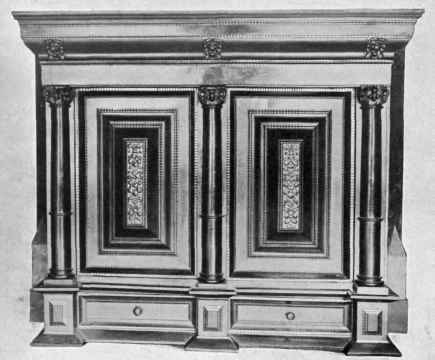
PLATE XLIV. - Dutch Kas. CLUNY MUSEUM, PARIS.
Mirrors were not only valued for their thick glass and fine silvering, but on account of their choice frames. Inventories speak of scroll frames, openwork frames, frames with lions or griffins supporting a coat-of-arms, etc. Ladies also carried German and English mirrors suspended from their waists, for the purpose of arranging their coiffure, ruff, or patches.
The mirror, like other expensive luxuries, was often prohibited by the clergy of the Protestant Church; and many a rich burgher was reprimanded for spending so much money on mirrors, porcelain and furniture, and giving so little to the Church.
The most beautiful mirrors were probably found in The Hague, where the reception rooms and bedrooms were usually decorated in the "style Louis XIV." Some of these were of Venetian glass with beautiful crystal borders and crystal lustres at the side. Frequently these were placed above the richly carved mantelpiece.
The bedsteads, often richly carved, were of oak, walnut or sacredaan, and were always hung with curtains. A deep valance often decorated the base. The centre of the canopy was ornamented with the family coat-of-arms, and each corner with a bouquet of many coloured plumes. Sometimes the bedstead was on a platform, and the rich hangings were supported by caryatides and the festoons of the canopy by carved cupids. The bedsteads were high, and a ladder or steps was required to climb into them. Little steps or foot benches stood in front of the bedstead and were sometimes used for seats or tables, somewhat like the old escarbeau of Mediaeval days.
One species of bedstead was known as the "coach," or "rolling coach." This was intended for children, and the name "coach" was extended to include the children's sleeping-place. Mention is made in a treasurer's account of Dordrecht (1586) of "three bedsteads with a coach underneath," which shows that the coach is the trundle or truckle bed.
Continue to:


My Books

