


Growth Of The Chest Of Drawers
Description
This section is from the book "English Furniture", by Frederick S. Robinson. Also available from Amazon: English Furniture.
Growth Of The Chest Of Drawers
In the cabinet upon heavy spiral legs belonging to Mr. R. W. Partridge, of St. James's Street (Plate lxxvii.2), we are not so much impressed by a contrast between small curved inlay and straight general lines. The reason of this lies, I think, first in the fact that the spiral-turned frame below makes, in itself, sufficient contrast to the straight vertical lines above. Secondly, the eye is so irresistibly attracted by the large size of the inlaid panels as scarcely to notice how rigid is the shape which includes them.
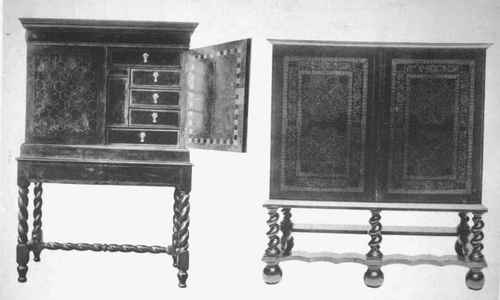
Plate LXXVII Cabinets, Inlaid Late 17th Century
LXXVII. (1) Cabinet, inlaid. Late seventeenth century. Mrs. Edmund McClure.
(2) Cabinet, inlaid. Late seventeenth century. Messrs. Partridge.
These two pieces of furniture are fine examples of the inlaid cabinets of the period 1680-1700, and are exactly suited to mate with the long clocks. It is curious to notice how with these the long pendulum has dictated a slenderness of shape which is not a characteristic of the cabinets.
When once our ancestors had discovered the advantages of turning the chest with a lid into a chest of drawers - which, as we have seen from examples partaking of the nature of both, was a tentative process - they carried on the system until they evolved furniture of a considerable size. The low chest of drawers might suffice for the wants of a presumably simpler age, as far as household goods and linen were concerned, but it was destined to grow taller. In time, perhaps, men forgot that the chest, its progenitor, had been used as a table and a seat. Then they elevated the chest upon a low 'frame' or stand, and by that means made it more important in appearance. At the period which we have reached that frame itself contained a single tier of drawers, and had some pretensions to shapeliness. In this state its general appearance was better than when later it was recognised that turned legs are a merely useless adornment. The last step was to do away with the open space occupied by the legs, and fill it up with drawers.
Thus we arrive at the monumental 'tall-boy' of the mahogany period, with its pretty splayed edges and fretted decorations.
This, however, is to anticipate. The chests of drawers we have to deal with at present are of walnut veneer or of oak, and for the most part of a type which does not allow of great varieties. The upper part has a flat front and contains very often six drawers, arranged in four tiers. The upper tier has three drawers, the centre one of which, with an oblong front, is flanked by two square-fronted ones. The other three tiers contain each one long drawer. The handles of these are likely to be of the pear-shaped drop species, of brass, and there are key-plates pierced and shaped to set off the brown veneer. There is a very light cornice, chiefly of ogee moulding. Similar light mouldings, but turned the other way, that is with the most projecting member the lowest, form a plinth for the upper part resting on the lower. This contains three drawers in one tier. The centre is again an oblong, but for variety the two outer square ones are deeper. They fit into a shaped frame which rests upon six legs, four being in front. The centre drawer being shallower, the open space between the two centre legs is cut into a rounded arch which rises higher than two similar arches between the outside leg spaces. Thus we have a three-arched front supported on four legs.
Between the front outer legs and the back legs there is either a plain, rounded arch or a double one unsupported in the centre. The legs are turned with a large acorn-shaped member, and rest on bulbous feet. A flat, plank-shaped rail joins the six legs. That between the two back legs runs straight. Those at the sides and front are curved, and recall, horizontally, the arch shapes above.
Occasionally the two smaller arches under the front assume the ogival shape - that is, are formed of a concave and convex curve on each side, which curves meet at a sharp point in the centre of the arch. This original shape is again found in the plank rails or stretchers between the legs, but of course in the horizontal plane.
Continue to:


My Books

