


Types Of Mouldings
Description
This section is from the book "English Furniture", by Frederick S. Robinson. Also available from Amazon: English Furniture.
Types Of Mouldings
There is not much doubt that the two parts of these early high chests of drawers have come to be separated and regarded as two pieces of furniture. The lower part is found to form an admirable dressing-table, and indeed the difference between the dressing-table proper and the lower part or frame of a tall chest of drawers is slight enough. If there are six legs, strong leg-rails, and but one tier of drawers, the object is probably the lower part of a tall-boy. If the leg-rails are absent, the legs but four in number, and the tiers of drawers increased to two, then the piece is a dressing-table. The chief difference between the two is that in the dressing-table the legs are nearly always of a somewhat slender cabriole type with pad feet.
Certain fashions of moulding or beading the furniture of the late seventeenth and early eighteenth centuries give us some clue to approximate dates.
I. The chests of drawers or tables earliest made in these periods succeed those with raised and splayed centres for their panels, many heavy mouldings arranged in geometrical shapes, and applied half-pendants, pilasters, diamond prisms, and round or oval bosses, which were made towards the end of the carved oak period. Very generally they have a single plain bead upon the framework which surrounds the drawers. This form may be seen in the half-opened interior of the elaborately veneered cabinet upon a stand with spiral-turned legs belonging to Mrs. Edmund McClure (Plate lxxvii.i).
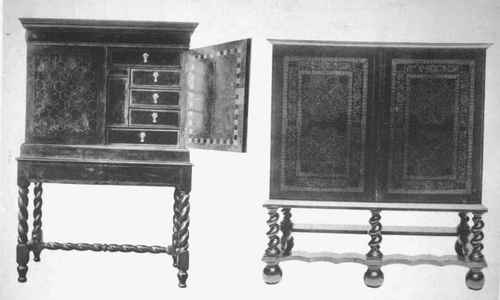
Plate LXXVII Cabinets, Inlaid Late 17th Century
LXXVII. (1) Cabinet, inlaid. Late seventeenth century. Mrs. Edmund McClure.
(2) Cabinet, inlaid. Late seventeenth century. Messrs. Partridge.
2. It is probable that next in date are those walnut-veneered or oak tables and chests of drawers with a double bead upon the frame which contains the drawers, and not upon the drawers themselves (Plate lxxx.i). This is to be well observed on the tall example with six octagonal legs belonging to Messrs. Waring.
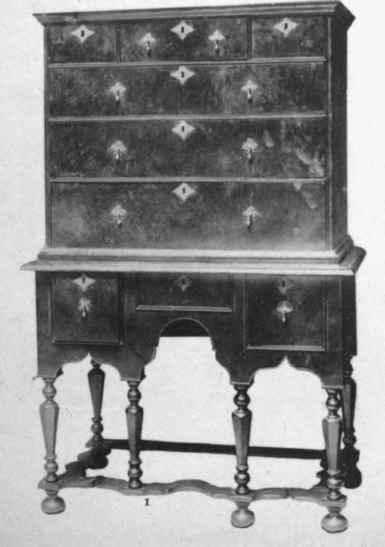
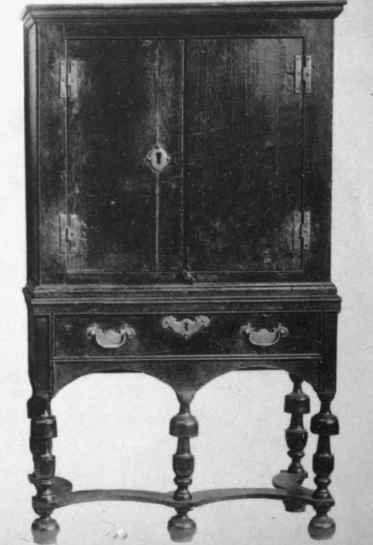
Plate LXXX. I - Chest Of Drawers On Stand, Walnut Veneer
LXXX. (1) Chest of Drawers on stand, walnut veneer. 1690-1710 circa, Messrs. Waring.
(2) Cabinet on stand, oak. 1690-1710 circa. Within there are two shelves and three vertical partitions. Hon. Sir S. Pon-sonby-Fane, K.C.B.
3. After this we find a single bead upon the drawers themselves, no longer on the frame. This is the case upon the Welsh dresser illustrated (Plate xliii.2) and upon much of the later eighteenth-century furniture. In all these three cases we are dealing with a bead of segmental section projecting beyond its groundwork.

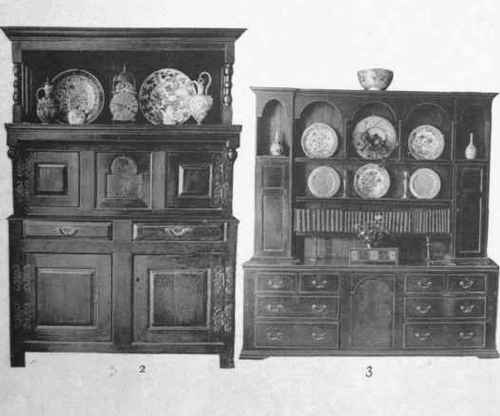
Plate XLIII.
1 - Dresser, Oak 17th Century
2 - Welsh Court Cupboard, Oak Late 17th Century
3 - Welsh Dresser, Oak, Inlaid With Mahogany 18th Century
XLIII. (1) Dresser, oak. Seventeenth century. Rev. F. Meyrick-Jones.
Length 60, Height 29, Depth from front to back 18½ inches.
(2) Welsh Court Cupboard, oak. Late seventeenth century. Shows the ' raised and splayed' panel, and three tiers or stages. The property of the author.
Dimensions: Height 77¼, Breadth 54⅝, Depth from front to back 21⅛ inches.
(3) Welsh Dresser, oak, inlaid with mahogany. Eighteenth century. The property of the author.
Dimensions: Height 89¼, Length 83⅜, Depth from front to back 19¼ inches.
4. The last stage shows us a drawer with an edge moulded but not projecting. The front of the drawer thus moulded is made to overlap the framework so that the cracks between the drawers and the frame are invisible. This arrangement is found on the knee-hole table illustrated (Plate lxxix.2).
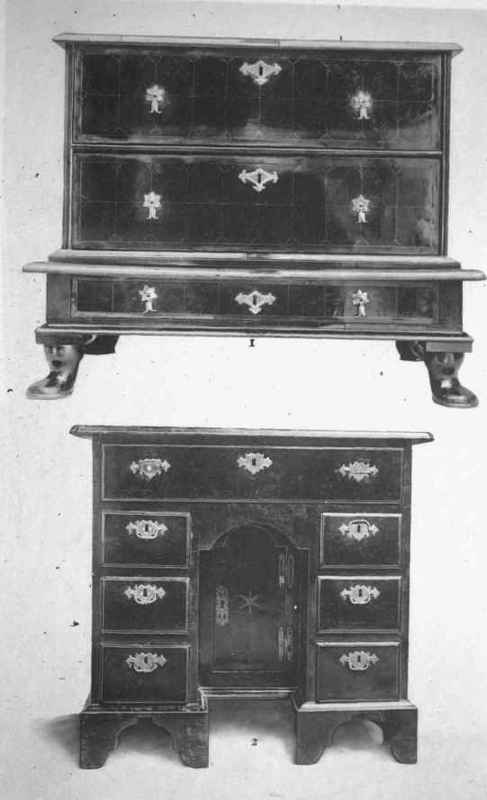
Plate LXXIX.
I - Dwarf Chest Of Drawers, Veneered
2 - Knee-Hole Writing Table, Veneered
Both Late 17th Or Early 18th Century
LXXIX. (1) Dwarf Chest of Drawers, veneered. Late seventeenth or early eighteenth century. Carcase of oak and pine. V. & A. M.
(2) Knee-hole Writing - Table, veneered and inlaid. Late seventeenth or early eighteenth century. Mrs. Collier.
Chests of drawers of the first type are generally, perhaps, of plain walnut veneered, or oak. In those of the second class, with the double bead on the frame, there is often to be found a special type of inlaid border known as the 'herring bone.' An example of this before me is rather less than half an inch wide, and is formed of two parallel strips of light wood difficult to identify, but possibly light-coloured oak or sycamore. These strips have been so cut that the grain, instead of running along the length of the wood, shows in short lines crossing diagonally. By opposing the two strips, the end of each line of grain in one meets the end of each line in the other. Allowing for the irregularities of the grain, we then get a succession of V or arrow heads, which produce in wood the effect of an em-broideress's herring-bone stitch. A table I have seen thus fitted has its drawers and carcase of pine veneered with walnut, and cabriole legs of solid walnut. It has drop handles across rather plain brass plates. In the same house is another table which belongs to the third style mentioned. It has a single bead on the drawer, no longer on the frame. The handles are of the same type as those on the other, but have made an advance in the ornamental open-work of their plates.
This table is of walnut veneer, and the fronts of the drawers are of pine. For inlay there is a quarter-inch banding of light wood with diagonal grain - the herring-bone, in fact, without its other half. This and the more elaborate handles are indications that the table is rather later in date than the first, Georgian, perhaps, rather than Queen Anne. Also belonging to the third style - with a single bead on the drawer - and in the same house, is the lower part of a tall-boy - many of which have been made, as this has been, to serve as tables - constructed of solid oak. In this case the frame round the drawers is banded with oak; the grain is not diagonal, but goes straight across as is the case with the tulip or satin-wood cross banding of the Sheraton and Heppelwhite styles.
Continue to:


My Books

