


Illogical Construction
Description
This section is from the book "English Furniture", by Frederick S. Robinson. Also available from Amazon: English Furniture.
Illogical Construction
An early example of the fourth style in which the drawers are moulded without any projection is afforded by a tall chest of drawers on short cabriole legs. This is of solid oak, and the drawers have heavy oak fronts, the rest being of pine. This construction may be set down as illogical, since it makes the drawers as weighty as possible in front.
It is quite possible to find furniture of the period to which all the first three classes belong without any bead at all either on the drawer or on the frame. This is the case with an elm table in the writer's possession. Its inferiority in style to that of the fourth class with overlapping moulding is sufficiently obvious when one observes the cracks between drawers and frame. This method of the fourth class is not of a late date in the eighteenth century. I find it on an oak cabriole leg table and upon a very well-made mahogany bureau in my possession. Its merits lie in the fact that as it is not a projection the same shape can be used to edge the table top as is found on the drawer below, and so produce a certain sense of completeness in the design. The same is the case with the bureau. The edges of its slanting top, the drawers and the top of the plinth, are all finished off in the same manner.
These may appear to be but trivial points, but it must be remembered that we are dealing just now with perhaps the plainest period of English furniture, when the incised carving of oak had died out, together with the elaborate inlay of Charles II. and William III.'s Dutch style. Mahogany was coming in, and as yet, perhaps, the cabinetmakers did not know quite what use to make of it. It remained for Chippendale, inspired by his quite immediate predecessors, to elaborate that carving in which a drawer moulding here or there is not to be taken into account. This interregnum, so to speak, or lull in furniture decoration from 1700-1730, or thereabouts, is a period at which small points such as those we have been considering may be more legitimately discussed. There is also so much of this simple style of furniture in oak, or walnut veneer, still to be found, that possessors of it will not object to its characteristics being examined and differentiated.
A word should be said about the small knee-hole tables such as that of our illustration, a remarkably good specimen, the property of Mrs. Collier, Willow Bank, Elgin (Plate lxxix.2). This is of walnut veneer inlaid round each drawer - the edges of which, as I have mentioned, are moulded to overlap in the manner of the fourth of our classes - with small rectangles of dark and light wood. In the centre recess is a cupboard. What appears to be the upper drawer is a turn-down front which discloses, when pulled forward, a series of small drawers inside. The top is covered with leather. These are somewhat bijou pieces of furniture. Greater convenience for writing is obtained when, as in some cases, there is a sliding slab which draws out at one side, leaving the fixed top free for papers or books of reference. The engraved handles of Mrs. Collier's specimen are original and complete. It is not uncommon to find these knee-hole tables made of elm and oak.
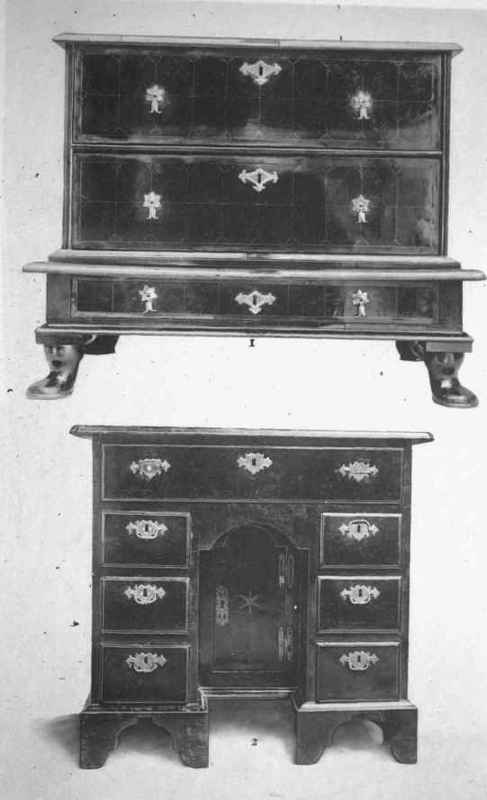
Plate LXXIX.
I - Dwarf Chest Of Drawers, Veneered
2 - Knee-Hole Writing Table, Veneered
Both Late 17th Or Early 18th Century
LXXIX. (1) Dwarf Chest of Drawers, veneered. Late seventeenth or early eighteenth century. Carcase of oak and pine. V. & A. M.
(2) Knee-hole Writing - Table, veneered and inlaid. Late seventeenth or early eighteenth century. Mrs. Collier.
Kensington Palace and Hampton Court Palace still retain interesting examples of the furniture of this period. In Queen Mary's privy-chamber at Kensington is a work-table with top apparently of laburnum, showing the rings of growth. The legs are cabriole, but of harshly rectangular section. A spiral-turned card-table has six legs, and is elaborately inlaid with tulips and other flowers. Ivory is used to some extent, and the inlay on the frame is picked out, as to some of its leaves, with green paint or composition. To be compared with this there is a German escritoire, No. 4908 in the Victoria and Albert Museum, which displays much ivory and green and red paint - or perhaps shellac - in its inlay. The herring-bone inlay is to be seen on a burr walnut side-table. A walnut-veneered escritoire table with a cartonniere upon it has the same rectangular-sectioned cabriole leg, and curved stretchers to match. The feet are carved with acanthus leafage, and the three drawers in the frame have brass drop-handles of the pear-shaped type.
At Hampton Court Palace, in the second presence-chamber, there are two side-tables of burr walnut veneer, and with cabriole legs. These have the herringbone inlay for bordering. One is nicely carved with acanthus leafage on the top of the legs, and has upright flutes in the frame. The King's drawing-room contains two nice card-tables of the period. These also are of walnut and display the herring-bone. The tops are shaped with a round at each corner, convenient for placing a candle, and on each side is a sunk oval for counters or money. They are covered with green velvet fastened with gold braid or gimp, and round-headed gilt nails. The rounded corner is the typical shape for the tops of card-tables in this period and later, in the early days of mahogany. The legs of these tables are somewhat too straight to be classed as cabriole, and have pad feet.
Continue to:


My Books

