


Types Of Cabinets
Description
This section is from the book "English Furniture", by Frederick S. Robinson. Also available from Amazon: English Furniture.
Types Of Cabinets
The second type has an upper cupboard with a straight front. The cornice overhangs it boldly for the whole of the length, and in place of the pillars at the corners there are merely pendants of circular or acorn-shape. Occasionally a short stump finial is placed on the cornice top above the pendants. Of the first of these two classes there is (Plate XXXVIII.) a pretty little example in the Victoria and Albert Museum (No. 540), dated on the centre of the frieze of the cornice, 'A. 1603 D.' The mouldings of the cornice are elegantly toothed and beaded, and the frieze on each side of the date is decorated with S-curves linked together with a straight strap. The front of the cupboard has one large panel with a circular arch, under which appears the full-face bust of a young woman in a ruff. The supporting pillars are carved with a deep spiral flute, and the slanting sides of the cupboard with a scroll and flower ornament. The ornament of the lower part consists of similar S-curves to those on the frieze, disposed on a long panel just below the cupboard, and on two drawers which are divided by an inlaid panel With an upright and branching flower. This lower part is supported on four legs joined by rails from front to back and by a long cross stretcher.
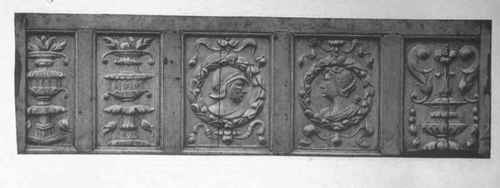
Plate XXXVIII. Panelling Early 16th Century Plate Xxxviii.
XXXVII. Panelling. Early sixteenth century. From a house at Waltham Abbey. V. & A. M.

Plate XXXVIII. Court Cupboard, Oak Inlaid, 1603
xxxviii. Court Cupboard, oak, inlaid. 1603. Said to be from Derby Old Hall. V. & A. M.
Dimensions: Height 50½, Length 46¼, Depth from front to back 2½ inches.
The back legs are plain, those in front turned, and the rails also are turned with a succession of members knob-shaped and of the same size, varied with rectangular pieces for the junctions of one rail with another. There is a considerable amount of well-disposed chequer inlay on this example - the usual modest arrangement of dark squares and light. As the whole tone of the piece is somewhat dark, the effect is better than usual. There is good iron-work on lock-plates and handles, the latter being drop loops with the open ends pinched well together. A chair and a swing looking-glass of the same style and en suite with this little cabinet are also in the Museum. The bust on the central panel is probably that of the owner of the cabinet, which may have been made for her wedding. It is very well executed, especially as regards the dress and ruff, and compares not unfavourably in this respect with the medallion portraits upon the panelling illustrated from Waltham Abbey.
Quite as early, if not earlier, but intermediate between our two classes, is the next example communicated by Messrs. Gill and Reigate, a remarkably good specimen of inlaid work (Plate XXXIX.). This has the straight-fronted upper cupboard (with three panels well inlaid with leafage and flowers) in which the advantages of extra space counterbalance the greater monotony of shape and light and shade consequent upon the abandonment of the slanting sides. It is supported, however, by complete pillars with Ionic capitals similar to, but not nearly so pronounced as, those upon the bed, No. 316 in the Victoria and Albert Museum. There is a lower cupboard upon which appear two rather squat-shaped arches enclosing geometrical inlaid shapes, similar to those upon the chests illustrated in Plates XXVIII.2 and xxxii. 1. Besides the arch, several of the usual decorative motives are well exemplified, such as elegantly elongated S-curves on the frieze, gadroons, and acanthus leafage on the pillars, the guilloche on the upper cupboard stiles, and a variety of the short flute or ' scoop' on the lowest tier of panels.

Plate XXXIX. Oak Cabinet, Inlaid Late 16th Century
XXXIX. Cabinet, oak, inlaid. Late sixteenth century. Messrs. Gill and Reigate.
Of the second type of straight-fronted cabinet, in which pillars give way to pendants, are reproduced two excellent specimens from Yorkshire. These have been for many years in the same house, and though now separated, are still owned by members of the same family. They have both the almost transparent surface of a dark reddish brown which can only be produced by assiduous polishings with beeswax and turpentine under the inspection of generations of perhaps too conscientious housewives. It is possible to overdo a cabinet with attentions of this kind, but the resulting 'patina' is not of easy imitation by the manufacturers of sham antiques. Time and energy alone will produce such a result. The first of these and the largest (Plate xl.) is at present in the possession of Mrs. C. Newton Robinson. It is abnormally long and low and has knob pendants nicely turned. The cornice is light and simple, with a waved pattern of leaf and flower. There are two cupboards on each side of a centre panel, which has large S-curves upon it and carved leaves and grapes. The cupboard doors are carved with large rosettes, and on the panels outside of these (at each end of the row) is the familiar upright flower with branches.
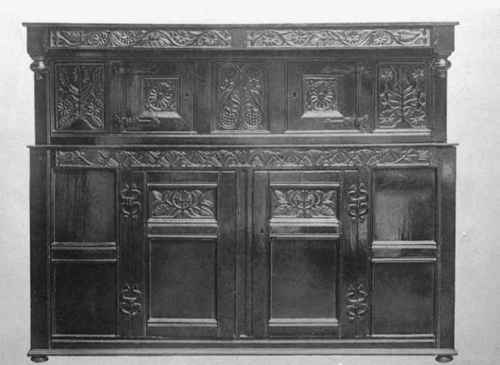
Plate XL. Yorkshire Cabinet, Oak About 1630
xl. Yorkshire Cabinet, oak. About 1630. Mrs. C. Newton-Robinson.
Dimensions: Height 59, Breadth 73½, Depth from front to back 20½ inches.
The shelf in front of the cupboards is very narrow, and on the framing below is a pattern of a waved line filled up with fan shapes. The lower part has four main panels, of which the two outside ones are plain. The two middle panels form the lower cupboard doors, and are subdivided into two panels of which the upper and smaller ones have again the upright flower with branches. There are good hinges of the familiar type. It is a pity that besides the initials M K s there does not appear a date, but it will not be amiss to assign that of 1620 or 1630.
Continue to:


My Books

