


Chapter VI. Cabinets Of The Sixteenth And Seventeenth Centuries
Description
This section is from the book "English Furniture", by Frederick S. Robinson. Also available from Amazon: English Furniture.
Chapter VI. Cabinets Of The Sixteenth And Seventeenth Centuries
WE have to return for a moment to an earlier period. In the chapter upon panelled rooms and beds there is reproduced a series, from the Victoria and Albert Museum, of panels originally at Waltham Abbey. These show, as is there pointed out at greater length, an obvious admixture of Gothic and Renaissance ornament. The chief characteristic of this panelling (Plates XIV. and XXXVII.) is the series of profile heads in medallions which seem to be portraits. They are carved with considerable apparent truth to life. An unique instance of such panelling employed as the chief ornament of what may be perhaps called a 'court cupboard,' the precursor of those illustrated in this chapter, is in the possession of Sir Charles Lawes-Wittewronge, Bart., Rothampstead, near St. Albans. Its elements are simple. It is flat-fronted, with an upper part consisting of three panels in a row, bearing profile heads in medallions similar in style to those of Waltham Abbey. The lower part has a higher cupboard composed of two folding doors, each containing four portrait profiles.
The upper three panels are divided by graceful pilasters of Tudor style, and of the same kind as those which appear on the end of the bedstead with linen-fold panelling (Plate XVII.). Strap hinges with fleur-de-lys shaped ends adorn the doors, and there are fine locks. This is perhaps the sole example of figure-work upon an English cabinet of the date of Henry VIII. remaining. Indeed it is difficult to find any sort of cabinet of this date. With the end of the sixteenth century we at last arrive at a more prolific period, though it is not till the seventeenth that we have ample material to our hand.
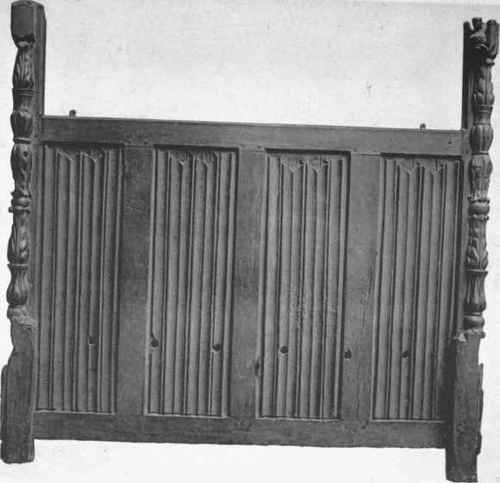
Plate XVII. End Of A Bedstead Of Oak, Decorated With "Linen" Pattern First Half Of 16th Century
XVII. End of a Bedstead of oak, decorated with 'linen' pattern. First half of sixteenth century. V. & A. M.
What has been said upon the familiar decorative motives of late sixteenth and early seventeenth century furniture in the chapters upon the Renaissance house, and upon panelled rooms and beds, applies equally to the cabinets and cupboards of the same time. It was to be regretted that owing to the difficulty of moving such cumbrous objects there were not more than three or four specimens of the cabinet or court cupboard in the exhibition of furniture at Bethnal Green in 1896. A fine opportunity was lost of seeing gathered together in one place examples hidden away here and there in our country houses. Had many cabinets been assembled with figure-work similar to that upon the Courtenay bed, Mr. Seymour Lucas's fine chest, or the panelling from Exeter which are reproduced in this volume, there would have been an opportunity of debating which were genuinely English, which were the work of foreigners in England,and which, finally, were merely imported fronts from Flanders, with backs and sides added by our native carpenters. The mention of these three categories is sufficient to suggest the complications of the task.
A good number of rather florid cabinets exist, which their owners would like to pronounce indubitably English, but which it is the habit to regard with suspicion.
Before referring in detail to the examples reproduced, it is advisable to mention the two types into which these cabinets may be divided.
Judging from the custom in Gothic 'credences' or 'buffets,' such as the Flemish one in the Victoria and Albert Museum, another in the Musee de Cluny, and an early sixteenth-century example in the Louvre, all of which have 'splayed' sides, the earliest shape is that in which the upper cupboard is narrower in front than it is at the back, the sides sloping or being 'splayed.' In these cabinets the cornice is as long as the back, and the part of the cornice projecting beyond the sides of the upper cupboard is supported by pillars at the corners.
Continue to:


My Books

