


Oriental Influences. Continued
Description
This section is from the book "Furniture", by Esther Singleton. Also available from Amazon: Furniture.
Oriental Influences. Continued
The Dutch East India Company imported enormous quantities of porcelain: the fleets of 1664-5 alone brought in more than sixty thousand pieces. Before this, however, the Dutch had begun to imitate the Oriental wares with great success, both in clay and varnish. Delft pottery soon became famous; and japanning in close imitation of lacquer was soon an important industry both in Holland and England. Home labor, however, cost more than foreign; and European manufacturers found it cheaper to have the panels, etc., decorated abroad and then make them up into furniture at home. This aroused great discontent in the trade towards the end of the century. The English japanners complained to the government, reciting their grievances. In 1702, one complaint states that in 1672 the East India Company sent agents abroad with a great quantity of English patterns for the Indians to manufacture the wares most marketable in England and other European countries. The cargoes of three ships sold at the East India House in 1700 give evidence that much lacquer-work was made up in England. The sale of the chinaware alone realized £150,000; and the other articles as much more. These included:
Fans............................. | £38,557 |
Lacquered sticks for fans ........................ | 13,470 |
Lacquered trunks, escritoires, bowls, cups, dishes . . . | 10,500 |
Lacquered inlaid tables ........................ | 189 |
Lacquered panels, in frames, painted and carved for rooms | 47 |
Lacquered boards ..................... | 178 |
Lacquered brushes ............................. | 3,099 |
Lacquered tables (not inlaid).................. | 277 |
Lacquered fans for fire .......................... | 174 |
Lacquered boards for screens ....................... | 54 |
Screens set in frames ..................... | 71 |
Paper josses ...................... | 1,799 |
Shells double gilt ..................................... | 281 |
Paper painted for fans, images, pictures, brass for lanterns and embroideries.
The tall japanned clocks that were so popular for nearly a century after the accession of William and Mary in 1689, must have been constructed in England with the above-mentioned imported boards or panels, when not of home manufacture, because the tall clock was not in vogue in the East. Only the table clock was used there, and it seems that even this was a Euporean novelty in the Sixteenth Century. De Laval (1601) writes that among the goods taken by the Portuguese from Goa to China are "all sorts of glass and crystal ware and clocks which are highly prized by the Chinese." The latter soon profited from the models, for Samuedo says in his History of China: "The workmanship of Europe which they most admired was our clocks, but now they make of them such as are set upon tables, very good ones." The tall case-of-drawers on Plate XXIV. is a fine example of this lacquered work. Each drawer presents a different picture of Chinese scenes - houses, trees, birds, dragons, etc. The piece is in two parts. The case-of-drawers consists of four drawers and the stand of one long drawer and three short drawers below. In modern parlance this is frequently called a "high boy" and the stand is sometimes used as a "low boy." These names, however, never appear in the inventories. The cabriole legs with hoof feet preceded those of the claw-and-ball.
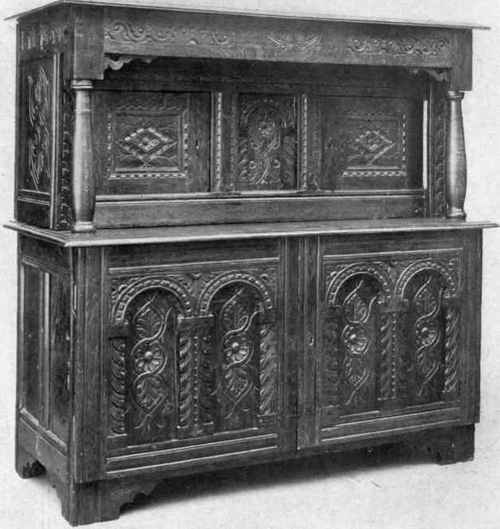
Plate XVII - Court or Press Cupboard. American. (i680-1690) - Metropolitan Museum
The craze for the Chinese style of ornament lasted in England till the accession of George III. Books of design containing so-called Chinese furniture had appeared before Chippendale, whose Director caters to the French, Gothic, and Chinese tastes of the middle of the century. Sir William Chambers wrote his book Designs of Chinese Buildings, Furniture, Dresses, Machines, and Utensils (1757), partly, as he explains in the preface, to put a stop to "the extraordinary fancies that daily appear under the name of Chinese, though most of them are mere inventions, the rest copies from the lame representations found on porcelain and paper hangings,"
This authority resided for some time in Canton, and therefore was able to write a trustworthy description of Chinese architecture and house decoration. He says:
"The movables of the saloon consist of chairs, stools, and tables; made sometimes of rosewood, ebony, or lacquered work, and sometimes of bamboo only, which is cheap, and, nevertheless, very neat. When the movables are of wood, the seats of the stools are often of marble or porcelain, which, though hard to sit on, are far from unpleasant in a climate where the summer heats are so excessive. In the corners of the rooms are stands four or five feet high, on which they set plates of citrons, and other fragrant fruits, or branches of coral in vases of porcelain, and glass globes containing goldfish, together with a certain weed somewhat resembling fennel; on such tables as are intended for ornament only they also place the little landscapes, composed of rocks, shrubs, and a kind of lily that grows among pebbles covered with water. Sometimes, also, they have artificial landscapes made of ivory, crystal, amber, pearls, and various stones. I have seen some of these that cost over 300 guineas, but they are at least mere baubles, and miserable imitations of Nature. Besides these landscapes they adorn their tables with several vases of porcelain, and little vases of copper, which are held in great esteem. These are generally of simple and pleasing forms. The Chinese say they were made two thousand years ago, by some of their celebrated artists, and such as are real antiques (for there are many counterfeits) they buy at an extravagant price, giving sometimes no less than £300 sterling for one of them.
"The bedroom is divided from the saloon by a partition of folding doors, which, when the weather is hot, are in the night thrown open to admit the air. It is very small, and contains no other furniture than the bed, and some varnished chests in which they keep their apparel. The beds are very magnificent; the bedsteads are made much like ours in Europe - of rosewood, carved, or lacquered work: the curtains are of taffeta or gauze, sometimes flowered with gold and commonly either blue or purple. About the top a slip of white satin, a foot in breadth, runs all round, on which are painted in panels different figures - flower pieces, landscapes, and conversation pieces interspersed with moral sentences and fables written in Indian ink."
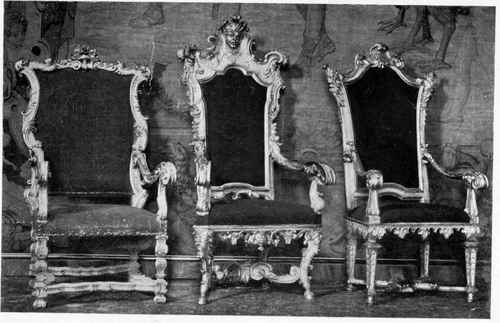
Plate XVIII - Seventeenth Century Chairs, Italian, carved and gilt - Parma Museum
France took longer than Holland or England to feel the influence of the East. In the early years of the century, as we have seen, decoration was subject to the Italians patronized by Marie de' Medicis, and then came the style Rubens. In the next generation, Mazarin was a leading patron of Oriental art, which was apparently a revelation to the Court. We learn from the diary of La Grande Mademoiselle, the eccentric cousin of Louis XIV., that in 1658, the Cardinal gave a lottery in which everybody got a prize. Beforehand, he gave her, in company with Anne of Austria, Queen Henrietta Maria and her daughter, a private view of the treasures, taking them into a gallery, where, among other treasures displayed, were "all the beautiful things that come from China."
At this time, Oriental goods reached Paris by way of Amsterdam or London. The Jesuit missionaries contributed largely to the knowledge of their countrymen in this field. In 1660, John Evelyn, living in voluntary exile in Paris, notes in his diary:
"One Tomson, a Jesuit, showed me such a collection of rarities, sent from the Jesuits of Japan and China to their Order at Paris as a present to be received in their depository, but brought to London by the East India ships for them, as in my life I had not seen. The chief things were rhi-nosceros horns, glorious vests wrought and embroidered on cloth-of-gold, but with such lively colors that for splendor and vividness we have nothing in Europe that approaches it; fans like those our ladies use, but much larger, and with long handles curiously carved and filled with Chinese characters; a sort of paper very broad, thin and fine, like abortive parchment,1 and exquisitely polished, of an amber yellow, exceedingly glorious and pretty to look on; several other sorts of paper, some written, others printed; prints of landscapes, their idols, saints, pagods, of most ugly, serpentine, monstrous, and hideous shapes, to which they paid devotion; pictures of men and countries rarely printed on a sort of gum'd calico, transparent as glasse; flowers, trees, beasts, birds, etc., excellently wrought in a sort of sieve silk very naturall."
1 Fine vellum.
Continue to:


My Books

