


The Gothic Style. Part 2
Description
This section is from the book "Furniture", by Esther Singleton. Also available from Amazon: Furniture.
The Gothic Style. Part 2
"In the Fifteenth Century, the bedchamber is thus represented: the curtained bedstead, with corniced tester, displayed its costly coverlets; on one side was the master's chair, then the devotional picture or small domestic altar attached to the wall. The dressoir and other small pieces of furniture were to be seen ranged round the apartment and often in front of the immense fireplace was a high-backed seat where the inmates came to seek warmth. This arrangement which is seen in miniatures and tapestries taken from various sources, proves the uniformity of habits in the different classes of society. Here we find personages whose dress and elegance denote their high position; here again are plain citizens surrounded by their serving-men, and by a number of objects which allow us to judge that the apartment is at once the bedchamber, reception-room, and refectory of the family.
"If we enter the study of the statesman or of the writer, we find the high-chair, or faldistoire, with its monumental back, the revolving-desk called a 'wheel,' used to keep a certain number of books within reach, lecterns and various other sorts of desks for writing."1
1 Jacquemart.
Gothic furniture dating before 1400 A. D. is exceedingly scarce: even the most famous museums think themselves fortunate if they possess one or two examples. Plate I. represents a celebrated chest of Lorraine workmanship, now in the Cluny Museum. It was made about 1300 A. D., and is regarded as one of the finest specimens of the art of the period. Over the front are carved twelve fully armed warriors in Gothic niches, the spaces between being occupied by grotesque faces and chimerical animals. The panels on the ends of the chest are also richly carved. The left one contains an oak tree with fantastic birds on its branches and on the ground. The right panel is carved with a body of cavalry on the march. The back of the chest is ornamented with four groups of workmen, warriors, porters, and falconers. On the lid are twelve medallions separated by chimerical animals: they are framed with foliage and animals of the chase picked out with painting. The principal medallions are filled with love scenes, men fighting and tilting, musicians and jongleurs, all carved with great spirit and humor.
Another famous Gothic chest, also in the Cluny Museum, is reproduced on Plate II. The carving on the front represents a tournament scene of the first half of the Fifteenth Century, and is interesting as a record of the costume and armor of the period.
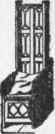
Prie-Dieu Chair, Fifteenth Century
Germany is richer in Gothic furniture that has survived than either England or France. Several museums and castles have fine collections of Mediaeval woodwork. The cupboard, or wardrobe, shown on Plate VII. is an excellent example of the late Gothic art. It is in the Nuremberg Museum. The figures of Peter and Paul in the top panels are in the style of Peter Visscher, the great Nuremberg sculptor (1460-1529).
The splendid carved bench or settle (Plate III.) in the same museum belongs to the same period. It is a fine type of the seat of honor that was found in every great baronial hall. When complete, it had a step, or foot-board, a dais, or canopy, and cushions.
Another treasure of the Nuremberg Museum is the half-headed Gothic bed (Plate V.) with its panels of flamboyant plate and thistle design.
The richly carved Gothic press, or Schrauk (Plate VI.), also in the Nuremberg Museum, came from Sterzing in the Tyrol: it was made about 1500 A. D. This type of wardrobe was common all over Germany in wealthy homes where the mistress used it for fine linen and plate; and in the sacristy, where it was used for storing ecclesiastical paraphernalia.
A very ordinary form of Gothic bed is one in the Munich Museum, reproduced on Plate IV. As a rule, it was fixed to the paneling of the room and carved in the same style.
"The real certosino originated in Venice and was an Oriental imitation; from the Thirteenth Century to the end of the Fourteenth the incrustations were in black and white wood, sometimes enriched with ivory; it was not until later that the number of colored woods was increased, and that ivory was used with its natural tint or stained green; sometimes small metallic plaques were added to the work. These primitive labors are almost always of small dimensions, consisting of boxes and jewel-caskets of rather hasty make. When the inlaid work is applied to furniture it is at first with a certain reserve; a chest (bahut) belonging to M. Henri Cernuschi is simply ornamented with fillets round its circumference, and on each side by a circle formed of small bone lozenges incrusted in the brown wood. This chest dates from the Fifteenth Century. Later on come the cassoni, the cabinets, the folding-tables, the seats shaped in the form of an X, and even elegantly carved high-backed chairs in which colored woods combined with ivory form geometrical designs of great richness; often in circular medallions, or in the middle of panels, a vase appears, whence issue flowered stems, which rise upwards, spreading out like a bouquet of fireworks. Nearly all the furniture in pique alla certosa comes from Italy; but some may be met with, among the most striking of which have been made in Portugal; these are generally to be recognized by the plentiful appliances of pierced copper that ornament them. The cabinets have complicated corners and keyholes which the gilding renders peculiarly brilliant.
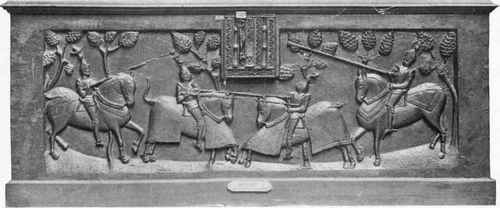
Plate II - Tilting Chest. Fifteenth Century - Cluny Museum
"The word tarsia, or intarsia, was used in Italy to designate all incrustations or marquetry either in wood or any other material on a background of wood, but, strictly speaking, it should only be employed when the pictures represent landscapes, still life, architecture or other scenes, while the word certosino is used to describe marquetry composed of very minute fragments put together in geometrical patterns.
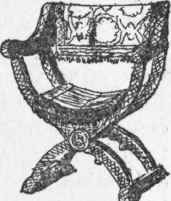
Spanish Chair, Wood And Ivory Inlaid, About 1500
Continue to:


My Books

