


Cloisonne Enamels Of The East
Description
This section is from the book "A History Of Furniture", by Albert Jacquemart. Also available from Amazon: A History Of Furniture.
This section is from the "" book, by .
Cloisonne Enamels Of The East
As already stated, it is to the extreme East that undoubtedly belongs the invention of enamelling on metals, and the process originally devised, is that called cloisonne.
An unheard-of circumstance which shows the exceeding skilfulness of the Eastern nations in the practice of this art is, that there exist enamels almost translucid, and which the artists have succeeded in fixing in their cloisons alone, without any subjectile, in fact, which might be described as without a reverse side, so that when looking at them through the light we may distinguish the richness of the tones and trace the design sharply defined by its opacity. This style seems peculiar, more especially to the Indians, while among the Chinese is found another speciality. In the rectangular plaques, intended to serve as screens, and which appear to date from an extremely remote period, are depicted birds, flowers, and especially landscapes, representing the seasons, in which enamels of various colours are often in close contact, the cells appearing on the grounds rather to heighten the effect than to fix and define the vitreous substance. This style is accordingly found in extremely ancient works, where the tones are few in number, and the designs very simple.
It is needless to say that many specimens cannot be quoted of these objects, which are in truth excessively rare in Europe. Not till we come to more recent epochs, and especially to the fifteenth century, do we meet with vases consecrated to religious rites, and these often bear dates and votive legends. This was the Ming era, when the Art reached its highest perfection.
Under King-tai (1450-1457) it was in its apogee, and nothing can convey an adequate idea of its richness at this time. The many coloured enamels show an extraordinary lustre in the pale tints, and are velvety in the others, a composition of great breadth, and well conceived, giving these splendid colours full play. Large branches skilfully combined support ornamental flowers of a grand design, and show upon turquoise blue or olive green grounds dots of red, bright yellow, deep blue, violet, and white, encircled with beautiful emerald green foliage. These branches are enclosed in rich borders like a cashmere embroidery. Characteristic of this period are its pansy-violet and golden-yellow colours, which do not again occur till about the Renaissance attempted by the Tai-thsing dynasty, when their comparative paleness betrays them at once and fixes the date of the works so coloured.
It is probable that the Chinese cloisonne enamel was reserved in principle for the decoration of sacred vases, and that it took the place of those heightened with gold and gems. This seems to be proved by the form of the oldest specimens, those screens and altar ornaments already spoken of which no doubt characterise the sacrifices of the four seasons; or else circular quadrangular "tings" adorned with sacred animals, and the accompanying beakers intended to hold flowers. The altar furniture is completed by flambeaux, in their form closely resembling those in vogue during the sixteenth century in Italy. As in the case of the tings, in their ornamentation are introduced the sacred emblems and animals of good omen. We have even seen something still better - a portable chapel, enamelled all over, and containing its gilt bronze divinity set up in a sort of tabernacle.
Large circular cisterns in which arc placed golden carp; others of a rectangular form intended to contain the fire, and answering to the braziers of the south of Europe; lenticular boxes with.medallions and many-coloured compartments seem, on the other hand, to constitute the chief adjuncts of a sumptuously furnished apartment. If we may again refer to screens or pictures offering nothing but representations of graceful plants and real birds, such as pheasants, swallows, and grosbeaks; neither must we omit the square-shaped lanterns with their elegant stands, painted on the glass of which are the words "long life" and "happiness," apparently implying that they are amongst the objects suitable to be offered as Jou-y gifts; nor yet the tables, some of which arc of carved iron-wood, with four feet and the top cloisonne, like that belonging to the Baronne Gustave de Rothschild, while others take the form of quadrangular "guertdons," with its pendants and the accessories of the foot enamelled, such as is owned by the Baronne Salomon de Rothschild, described by us in the "Collections Celebres " of M. Ed. Lievre.
The Japanese cloisonne enamels, very rare in the older collections, are now arriving in great numbers. Those of a remote age are scarcely known; but their style and manner of workmanship may be conjectured from what has already come to hand. The turquoise blue fundamental colour of the Chinese, serving as a ground for the other ornaments, is replaced in Japan by a sombre green. The cloisonnage is very delicate and close, most frequently disposed in geometrical figures, prominent among which are lozenges on a white ground. Although a beautiful red is found on the palette of the artist, this colour is very sparingly used. Altogether Japanese enamel has a sombre appearance, and is very inferior in decorative effect to the beautiful compositions of the Chinese.
It is a singular fact that the Japanese, so skilful in the composition of bronze vases and of various descriptions of earths, seem to neglect altogether the form of their cloisonne enamels, most of which are heavy, unsightly, and overladen with accessories increasing their heaviness. There can assuredly be nothing in common between the centres of industry whence come their bronzes, and those where the enamels are manufactured. One might even suppose that the artists employed in the execution of these works are utterly regardless of the perfection attained in the other branches.
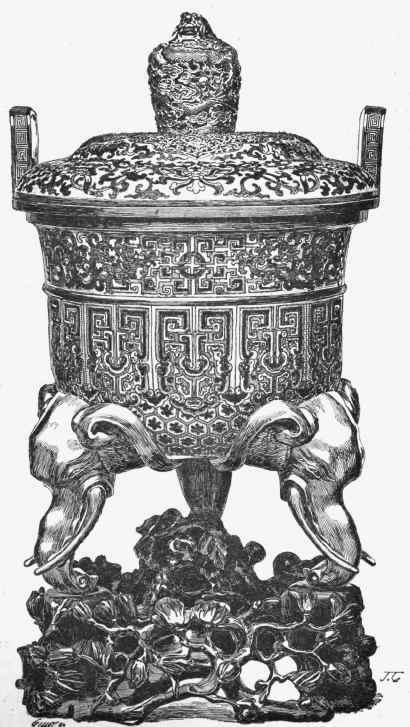
Chinese Perfume burner in cloisonne enamel. (Collection of Admiral Coupventdes Bois.).
Nevertheless there are preferences even here, and the Liverpool exhibition, where were shown the specimens belonging to Mr. James L. Bowes, has proved that the Japanese enamellers could, when needs be, reproduce the symbolic dragon with all his fearful contortions, or display the gorgeous plumage of the national Fo or Fong-hoang. We may add that these objects bore the personal or official arms of the emperor, showing their high destination, and implying works of the first order.
The same collection contained a somewhat large number of objects described as coming from Persia, but which to us seem rather of Indian origin. The peculiar character of their workmanship is a smooth ground of a rosy grey, cut by a cloisonnage of very fine network or imbricated tracery, or simply strewn with detached metal figures, forming, as it were, a groundwork of clouds. The bright colours are reserved for the borders, where they run round in foliage or stand out like embroidered ribbons. These various works have been inspired by those of the far East, and on them is occasionally found the armorial chrysanthemum adopted by the Emperor of Japan and even inscriptions in Chinese characters. Under a bowl we have read the word "tribute," inscribed in beautiful red enamel.
Let us conclude with a description of the marvellous pieces already spoken of; those cloisonne plates "en resille," that is to say, without an excipient, and which are semi-translucid. Their rim has all the characters of the specimens we have just described, but the centre is occupied by flowering branches, delicately designed, on which perches a bird allied to the pheasant, and which often appears in Indian miniatures. Nothing is more strikingly elegant than these specimens that formed an important feature in the Debruge-Dumenil collection before it passed into the cabinet of M. Salomon de Rothschild. They are all the more valuable that by the character of their decoration they give us reason to believe that among the enamelled faience attributed to Persia, a share should be awarded to the artists in India.
We will not speak here of champleve enamels, undoubtedly known to the Eastern nations from remote times, but very seldom practised by them. Were the question further inquired into, it might even be found that they revived this process only at periods of decline, and in order to keep pace with the European movement, the products of which.in this branch of the Art may have come under their notice.
Evidently among a patient and industrious people, to whom time is of little value, cloisonnage is preferable to the champleve workmanship, which is neither so delicate nor so durable.
It seems at first sight surprising to find the Eastern nations executing enamelled vases of enormous size and gigantic dishes, the placing and firing of which in an open furnace appear to be impossible. But for enamelling, as for the other arts, those industrious people seek simplicity in the processes. Thus, thanks to a marvellous skill in handling the implements available to them, they have been able to dispense altogether with the firing in an open furnace, replacing it by partial fusion with the enameller's lamp. With a rare patience and confidence they contrive in this way to enamel piecemeal, and without danger of running, objects of the largest size and most intricate form. They work with such unerring certainty, no resuming of the work, no accidents from burning or crazing are to be perceived. By a skilful manipulation of the blowpipe they melt to the desired point the least fusible enamels, and make all the parts cohere with perfect accuracy.
It is sufficient to be acquainted with Oriental enamels in order to realise what an important part they may play in the decoration of interiors. How many magnificent vases have been converted to the use of lamps! How many braziers have been astonished to find themselves changed into jardinieres! To adapt such things to the requirements of daily use must be the care of those who are not what are called amateurs, and who in the works of foreign people, see nothing but a means of increasing the splendour of indoor life and relieving the monotony of the ordinary articles of home manufacture. We would not, assuredly, venture to protest against such natural tendencies, which are themselves a proof of taste. But while thus utilising meritorious and valuable works that may be procured through the medium of commerce, let respect be shown to the rarer monuments that serve to illustrate history and the arts.
Continue to:


My Books

