


Painting New Walls Or Stucco
Description
This section is from the book "Cyclopedia Of Painting", by George D. Armstrong. Also available from Amazon: Cyclopedia of Painting.
Painting New Walls Or Stucco
It does not appear that any painting in oil can be done to any good or serviceable effect in stucco, unless not merely the surface is dry, but the walls have been erected a sufficient time to permit the mass of brickwork to have acquired a sufficient degree of dryness.
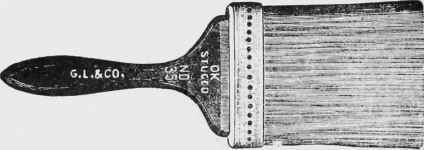
Fig. 10. Stucco Wall Paint Brush.
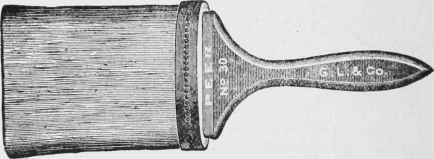
Fig. 13. Stucco Wall Paint Brush.
When stucco is on battened work, it may be painted over much sooner than when prepared as brick. Indeed, the greater part of the mystery of painting stucco so as to stand or wear well, certainly consists in attending to these observations, for whoever has observed the expansive power of water, not only in congelation, but also in evaporation, must be well aware that when it meets with any foreign body obstructing its escape, as oil paint, for instance, it immediately resists it, forming a number of vesicles or particles, containing an acrid lime water which forces off the layers of plaster, and frequently causes large defective patches extremely difficult to get the better of.
Perhaps in general cases, where persons are building on their own property, or for themselves, two or three years are not too long to suffer the stucco to remain unpainted; though frequently in speculative works as many weeks are scarcely allowed. Indeed, there are some nostrums set forth in favor of which it is stated, in spite of all the natural properties of bodies, that stucco may, after having been washed over with these liquids, be painted immediately with oil colors. It is true there may be instances, and in many experiments some will be found, that appear to counteract the general laws of nature, but on following them up to their causes it will be found otherwise.
Supposing the foregoing precautions to have been attended to, there can be no better mode adopted for priming or laying on the first coat on stucco than by linseed or nut oil boiled with driers, with a proper brush, taking care in all cases not to lay on too much so as to render the surface rough and irregular, and not more than the stucco will absorb. It should then be covered with three or four coats of ceruse or white lead, prepared as described for painting on wainscoting, letting each coat have sufficient time to dry hard.
If time will permit, two or three days between each coat will not be too long. If the stucco is intended to be finished of any given tint, as gray, light green or apricot, it will then be proper, about the third coat of painting, to prepare the ground for such tint by a slight advance towards it.
Continue to:


My Books

