


Child's Swing
Description
This section is from the book "Shop Projects Based On Community Problems", by Myron G. Burton. Also available from Amazon: Shop Projects Based on Community Problems.
Child's Swing
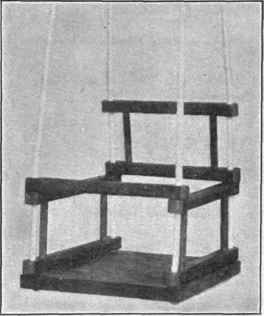
Materials
Yellow Pine (Chap. III., Par. 48).
2 pcs. 7/8"x6"xl2" S 2 S Bottom. 2 pcs. 7/8"x1 1/2"xl2" S2S Bottom battens. 7 pcs. 7/8"xl1/8"xl2" S 2 S Rails. 1 pc. 1/2" dowel 30" long. 8-1 1/2" No. 10 F. H. B. screws. 20 ft. 3/8" cotton rope (sash cord).
Introductory Statement
This lesson presents an easy but attractive and substantial way of making a swing which can be put up in the house or on the porch.
The seat may be upholstered with denim, canvas or imitation leather if the swing is to be used entirely indoors; the upholstering would not be desirable for outdoor use. If intended for outside use the seat should be reinforced with cleats, as indicated in the suggestions; the wood parts should also be well painted to protect them from the weather.
By using heavier material and making all the parts proportionately larger, and substituting small chain for the rope, a very excellent playground swing may be had.
References:
Rope. Upson Walton Co., Cleveland, Ohio.
Minnesota Bulletin No. 136, Rope and Its Uses on the Farm.
Minnesota Bulletin No. 33, Some Knots and Splices.
Flax, Hemp and Other Fiber Plants - Sixty Lessons in Agriculture. American Book Co.
Fiber Plants, the Book of Useful Plants, Rogers. Doubleday, Page & Co.
Cotton, Flax and Hemp; How the World Is Clothed, Carpenter. American Book Co.
Playgrounds and Parks; Health in Home and Town, Brown. D. C. Heath & Co.
Public Playgrounds, Day Allen Willie, St. Nicholas Magazine, May, 1909.
The School Playground, U. S. Bureau of Education, Bulletin 1912, No. 16.
Tree Planting on Rural School Grounds, U. S. Bulletin No. 134.
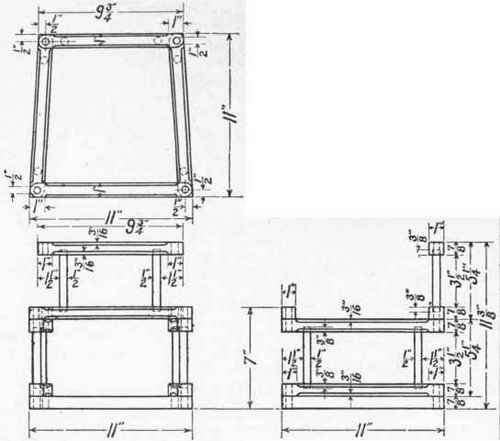
Child's Swing
Suggestions For Original Design
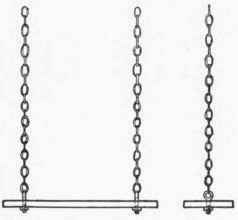
No.1
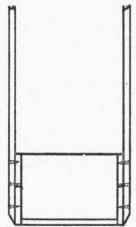
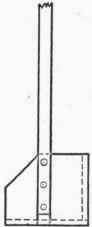
No. 2
Play Ground Swings
Child's Swing Specifications
The Bottom
The material for the bottom will probably be furnished in two pieces; if so, they should be joined with the dowel joint (Chapter V., Paragraph 72). Select the best surface of one board and mark it the working face (Chapter II., Paragraph 2). Note: - It will not be necessary to plane it now, for it will have to be replaned after the two pieces are glued together. Prepare a working edge (Chapter II., Paragraph 4). In like manner prepare the other bottom piece. Lay out (Chapter II., Paragraph 18) and bore (Chapter II., Paragraph 13) for the dowels. Make the glue joint and clamp securely. Leave the work clamped while you proceed with the other parts.
Continue to:


My Books

